
CDM Compliance Consultancy: The 2026 SME Guide to Construction Safety
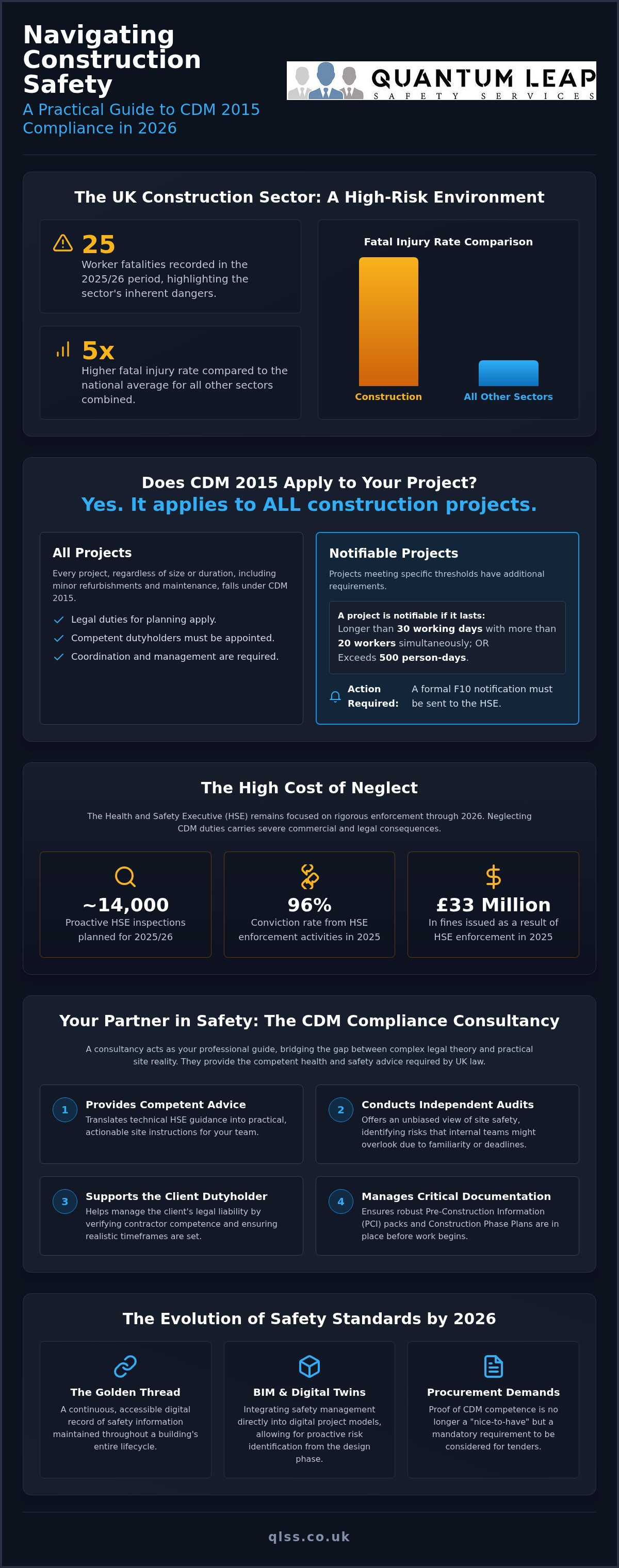
With 25 worker fatalities recorded in the British construction sector over the 2025/26 period, the industry remains the most hazardous in the country. This statistic represents a fatal injury rate nearly five times the national average for all other sectors. For SME directors, these figures underscore the heavy responsibility of meeting CDM 2015 obligations whilst managing the rigorous requirements of the Building Safety Act. It's why many firms now lean on professional CDM compliance consultancy to bridge the gap between complex legal theory and practical site reality.
We understand that you'd rather be on-site than buried in paperwork. You likely feel the pressure of balancing safety documentation with tight deadlines, often wondering where the role of a Principal Designer ends and a CDM advisor begins. Our guide provides a pragmatic roadmap for 2026, ensuring your projects remain safe and your business stays protected from HSE intervention. We'll explore the transition of the Building Safety Regulator, clarify new competency standards, and show you how to maintain a golden thread of information without halting your progress. By the end of this article, you'll have a clear strategy for achieving zero accidents through manageable, compliant documentation.
Table of Contents
Navigating CDM 2015 Regulations in the Modern UK Construction Landscape
The Construction (Design and Management) Regulations 2015, commonly known as CDM 2015, serve as the primary legal framework for health and safety in the UK construction sector. Whilst these rules have been in place for over a decade, the Health and Safety Executive (HSE) remains focused on rigorous enforcement through 2026. The regulator has planned approximately 14,000 proactive inspections for the 2025/26 period, targeting high risk issues such as falls from height and respiratory health. The core objective of the legislation is to ensure that health and safety is considered throughout a project’s entire lifecycle, from the first sketch to final demolition. CDM compliance is the systematic management of risk from concept to completion.
Why CDM Compliance is Mandatory for All Projects
Many SMEs mistakenly believe that safety regulations only apply to large scale infrastructure or multi million pound developments. This is a dangerous misconception. CDM duties apply to every construction project, including small scale refurbishments and maintenance work. Whilst only "notifiable" projects (those exceeding 30 working days with more than 20 workers, or 500 person days) require a formal F10 notification to the HSE, the legal requirements for planning and coordination apply across the board. Directors who fail to appoint competent dutyholders or neglect their responsibilities face significant legal ramifications. In 2025, HSE enforcement activity resulted in a 96% conviction rate and approximately £33 million in fines. Engaging a CDM compliance consultancy ensures that your business doesn't fall foul of these requirements, providing a structured approach to dutyholder appointments and safety management.
The Evolution of Construction Safety Standards by 2026
The industry has moved beyond static safety folders towards a "Total Compliance" model that integrates safety into the daily workflow. In 2026, CDM data management is heavily influenced by Building Information Modelling (BIM) and digital twins. These digital tools allow for the "golden thread" of safety information to be maintained and accessed easily by all stakeholders throughout the building's life. Modern procurement now demands proof of CDM competence before a tender is even considered. Buyers want to see that safety isn't just a box ticking exercise but a core part of your operational culture. This means that CDM compliance consultancy is now a strategic investment. It helps SMEs prove they are a reliable partner for high risk renewable energy projects or complex urban builds. By treating compliance as a framework for excellence, businesses can reduce site accidents and improve project delivery times simultaneously.
Defining the Role of a CDM Compliance Consultancy for Dutyholders
A consultant isn't a legal shield, but they are a professional guide. Under UK law, all businesses must have access to competent health and safety advice to manage their operations safely. A CDM compliance consultancy provides this expertise, translating the technical HSE guidance on CDM 2015 into practical site instructions. They bridge the gap between a design on a screen and the actual safety behaviour of workers on a scaffold. Independent audits are a core part of this service. These audits provide an unbiased view of site safety, identifying risks that internal teams might miss due to project deadlines or familiarity. By acting as the "competent person," the consultant ensures that safety remains a constant priority rather than an afterthought.
Supporting the Client: Managing Your Legal Liability
The Client often carries the most legal risk but possesses the least technical safety knowledge. You're responsible for ensuring that all dutyholders are competent and sufficiently resourced. A professional CDM compliance consultancy steps in as your eyes and ears. They help prepare the initial project brief to set high standards from day one. They ensure project timeframes are realistic, preventing the rushed environments where accidents often occur. Crucially, they verify that the Principal Contractor has produced a robust Construction Phase Plan before any boots hit the ground. This methodical approach protects your reputation and your bottom line. If you're looking for a steady partner to manage these duties, our Construction QSHE Services provide the nationwide support you need.
Assisting the Principal Designer and Contractor
During the pre-construction phase, the focus is on "designing out" risk. It's far more efficient to eliminate a hazard on a drawing than to manage it on a live site. Consultants support the Principal Designer in identifying these opportunities early, ensuring that safety is baked into the project's DNA. Once construction begins, the consultant assists the Principal Contractor with site-specific risk management and subcontractor inductions. This ensures that every person on-site understands their specific safety obligations. Finally, they manage the compilation of the Health and Safety File. This digital record is vital for the end-user, providing the information needed to clean, maintain, or alter the building safely in the years to come.
The Cost of Compliance vs the Risk of Neglect: An SME Perspective
Many SMEs view construction safety as a "paperwork exercise" that slows down production. This is a dangerous misconception that ignores the commercial reality of modern building projects. Poor management leads to hidden costs that far outweigh the price of professional support. Engaging a CDM compliance consultancy early in the project helps identify these risks before they become financial liabilities. By following CITB industry guidance, businesses can integrate safety into their planning phase, which actually reduces overall project costs through better resource allocation and fewer site delays. Viewing compliance as an investment in Business Total Compliance Solutions ensures your project remains viable and profitable.
HSE Intervention Fees and Legal Penalties
The financial impact of non-compliance is immediate and measurable. Under the Fee for Intervention (FFI) scheme, the HSE recovers the costs of their inspections if a "material breach" of health and safety law is found. These costs escalate quickly. If an inspector issues a Prohibition Notice, work stops instantly. This halts your cash flow whilst your overheads continue to mount. Beyond the direct fines, professional indemnity insurance providers now frequently require proof of robust CDM consultancy before offering coverage. Without this evidence of competence, your business remains exposed to claims that could lead to insolvency or severe reputational damage within the industry.
Gaining a Competitive Edge through Safety Accreditations
Compliance isn't just about avoiding penalties; it's a tool for business growth. Demonstrating a strong safety record is essential for achieving prestigious accreditations like CHAS or Alcumus SafeContractor. These badges of competence are often the first thing a lead contractor or local authority looks for during the procurement process. A solid CDM record proves you're a reliable partner capable of managing complex site conditions safely. To help you evaluate your current standing, we recommend using the ultimate health and safety audit checklist. By transforming a legal obligation into a clear competitive advantage, you open doors to larger commercial contracts that require high standards of safety management.
Integrating CDM Management into the Pre-Construction and Construction Phases
Successful safety management starts long before a spade touches the ground. The early appointment of a CDM compliance consultancy allows for risk elimination during the design phase, which is significantly more cost-effective than managing hazards on a live site. This process follows a methodical five-step path: initial appointment, PCI development, CPP review, ongoing site monitoring, and final handover. By engaging a professional CDM compliance consultancy at the concept stage, you ensure that the "golden thread" of information begins with technical precision rather than guesswork.
The Pre-Construction Information (PCI) Pack
A generic "boilerplate" PCI pack often fails to satisfy HSE requirements because it lacks site-specific detail. A robust pack must include precise site constraints, known existing hazards, and structural information relevant to the build. Detailed structural data is vital for ensuring that modification work doesn't compromise the integrity of the building. Our consultants gather this data by liaising with utility providers and reviewing previous site surveys to identify buried services or asbestos risks. This technical accuracy ensures that the Principal Contractor can develop a safe, realistic work programme that accounts for all known variables.
On-Site Monitoring and Construction Safety Audits
Once the project moves to the construction phase, the focus shifts to verifying that the Construction Phase Plan (CPP) is actually being followed. It's common for "drift" to occur, where site practices slowly deviate from the original safety plan due to production pressures. Regular workplace safety inspection services are essential to identify these gaps early. We use construction safety audit services to mentor site managers, helping them manage the complex flow of information between different trades and subcontractors. This ensures that every trade on a multi-site project understands their specific interface with other contractors, maintaining a consistent safety culture regardless of the project's scale.
The final step in this lifecycle is the review and handover of the Health and Safety File. This document provides the end-user with the information needed for future maintenance, cleaning, or demolition work. Ensuring this file is complete and accurate is a legal requirement that protects the building throughout its occupied life. For SMEs looking to secure their projects with expert oversight, our Construction QSHE Services offer a comprehensive solution for nationwide compliance and project certainty.
Securing Your Project with Quantum Leap Safety Services
Quantum Leap Safety Services (QLSS) operates as a pragmatic partner for SMEs navigating the complexities of modern site safety. Since our establishment in 2012, we've positioned ourselves as a "safe pair of hands" for businesses requiring expert Construction QSHE Services. Our experience spans high-risk sectors, particularly within renewable energy and large-scale infrastructure projects. With nationwide UK coverage, we support multi-site operations, ensuring that safety standards remain consistent regardless of your project's location.
Financial predictability is essential for SME growth. Our CDM compliance consultancy provides project-based fees that offer fixed-cost certainty. This allows directors to budget effectively without the fear of escalating consultancy costs. We also recognise that safety doesn't exist in a vacuum. We specialise in integrating CDM obligations with ISO 9001, 14001, and 45001 management systems. This holistic approach ensures that your safety protocols align with your quality and environmental standards, creating a unified framework for operational excellence through Business Total Compliance Solutions.
Our Managed Service Retainers for Construction
A managed service retainer provides your business with continuous access to competent advice throughout the lifecycle of a project. This isn't just about technical support; it's about building a partnership with a dedicated consultant who understands your specific business culture and operational constraints. By opting for QSHE Managed Services, you ensure that occupational health and fire safety management are seamlessly integrated into your CDM framework. This prevents the fragmentation of safety duties and ensures that all dutyholders are working towards a common goal of zero accidents and total legal compliance.
Next Steps: Booking a CDM Compliance Review
Securing your next project starts with a clear understanding of your current compliance status. We recommend beginning with a comprehensive gap analysis. This review identifies any weaknesses in your current safety documentation or dutyholder appointments. During your first consultation with a QLSS advisor, we'll walk you through the necessary steps to rectify these gaps and establish a robust safety culture on-site. We're here to act as your steady, methodical guide through the intricacies of corporate responsibility. To begin, enquire about our CDM compliance consultancy today and protect your business from the risks of non-compliance.
Future-Proofing Your Construction Safety Strategy
Managing the 2026 regulatory landscape requires a shift from reactive safety measures to a proactive, integrated strategy. CDM 2015 obligations aren't merely administrative hurdles; they're the foundation of project certainty and worker protection. By appointing a professional CDM compliance consultancy early in the design phase, you protect your business from the significant financial and reputational risks associated with HSE intervention. This methodical approach ensures that safety is baked into your project's DNA, rather than added as an afterthought.
Quantum Leap Safety Services offers the pragmatic advice and steady guidance that SMEs need to thrive in a high-risk industry. With full UK national coverage and deep expertise in integrated QSHE and ISO management systems, we act as a dedicated partner for your business. We help you turn legal obligations into a competitive advantage that wins contracts and protects lives. If you're ready to secure your next project with a safe pair of hands, contact Quantum Leap Safety Services for expert CDM consultancy. Let's build a safer, more compliant future for your construction business together.
Frequently Asked Questions
Who is responsible for CDM compliance on a construction project?
Responsibility for CDM compliance is shared across all dutyholders, including the Client, Principal Designer, and Principal Contractor. The Client holds the ultimate legal duty to ensure that appropriate arrangements are in place and that all appointed parties are competent and sufficiently resourced. Each role has specific obligations to manage health and safety risks throughout the project. Engaging a CDM compliance consultancy helps these dutyholders coordinate their efforts and maintain full legal alignment.
What is the difference between a CDM Advisor and a Principal Designer?
The Principal Designer is a legally defined dutyholder responsible for planning and managing health and safety during the pre-construction phase. In contrast, a CDM Advisor is a professional consultant who provides technical expertise and support to the dutyholders. Whilst the Principal Designer focuses on design risk, the advisor ensures that all administrative and procedural requirements of the regulations are met. Many firms use an advisor to bolster their internal competence and ensure unbiased safety reporting.
Do small domestic building projects need a CDM consultant?
Yes, CDM 2015 regulations apply to all construction work, including small domestic building projects. Whilst a formal consultant isn't strictly mandatory for minor maintenance, the dutyholders still have legal obligations to manage risks. For domestic clients, duties usually pass automatically to the contractor or principal designer. Many SMEs working on domestic sites find that project-based support ensures they meet these requirements without the overhead of a full-time safety manager.
What happens if I fail to comply with CDM 2015 regulations?
Failing to comply with CDM 2015 regulations can lead to severe consequences, including unlimited fines and criminal prosecution for directors. The HSE may issue a Prohibition Notice, halting work immediately and disrupting project cash flow. Additionally, the Fee for Intervention (FFI) scheme allows the HSE to recover inspection costs if a material breach is found. Beyond legal penalties, non-compliance often results in site accidents, project delays, and significant reputational damage that can prevent future contract wins.
How much does CDM compliance consultancy typically cost for an SME?
The cost of CDM compliance consultancy for an SME is typically determined by the project's scale, duration, and technical complexity. Most consultancies offer project-based fees for specific deliverables or retainer-based managed services for ongoing support. This flexible approach provides businesses with fixed-cost certainty, allowing for accurate budgeting without hidden charges. By tailoring the support to the specific risks of the build, SMEs can ensure total compliance whilst managing their resource constraints effectively.
What should be included in a Construction Phase Plan (CPP)?
A Construction Phase Plan (CPP) must outline the health and safety arrangements, site rules, and specific measures needed to manage significant risks. Key inclusions are a project description, the management structure, and clear procedures for monitoring site safety. It should also detail how subcontractors will be inducted and how emergencies will be handled. A robust CPP is a living document that must be developed before work begins and updated as the project evolves on-site.
When must a construction project be notified to the HSE?
A construction project must be notified to the HSE if it's expected to last longer than 30 working days and have more than 20 workers working simultaneously at any point. Alternatively, notification is required if the project exceeds 500 person days of work. This notification is submitted via an F10 form. It's important to remember that even if a project isn't notifiable, all other CDM 2015 duties regarding planning and coordination still apply.
Can a CDM consultant help with CHAS or SafeContractor applications?
Yes, a consultant can provide essential support for CHAS, Alcumus SafeContractor, and other safety accreditation applications. This involves managing the administrative burden and ensuring your safety documentation meets the rigorous standards required by these bodies. Demonstrating robust CDM records is a core part of the assessment process. By using professional support to achieve these certifications, SMEs can prove their competence to lead contractors and local authorities, ultimately helping to win more commercial work.


Comments