
Renewable Energy Health and Safety: The 2026 Project Success Guide
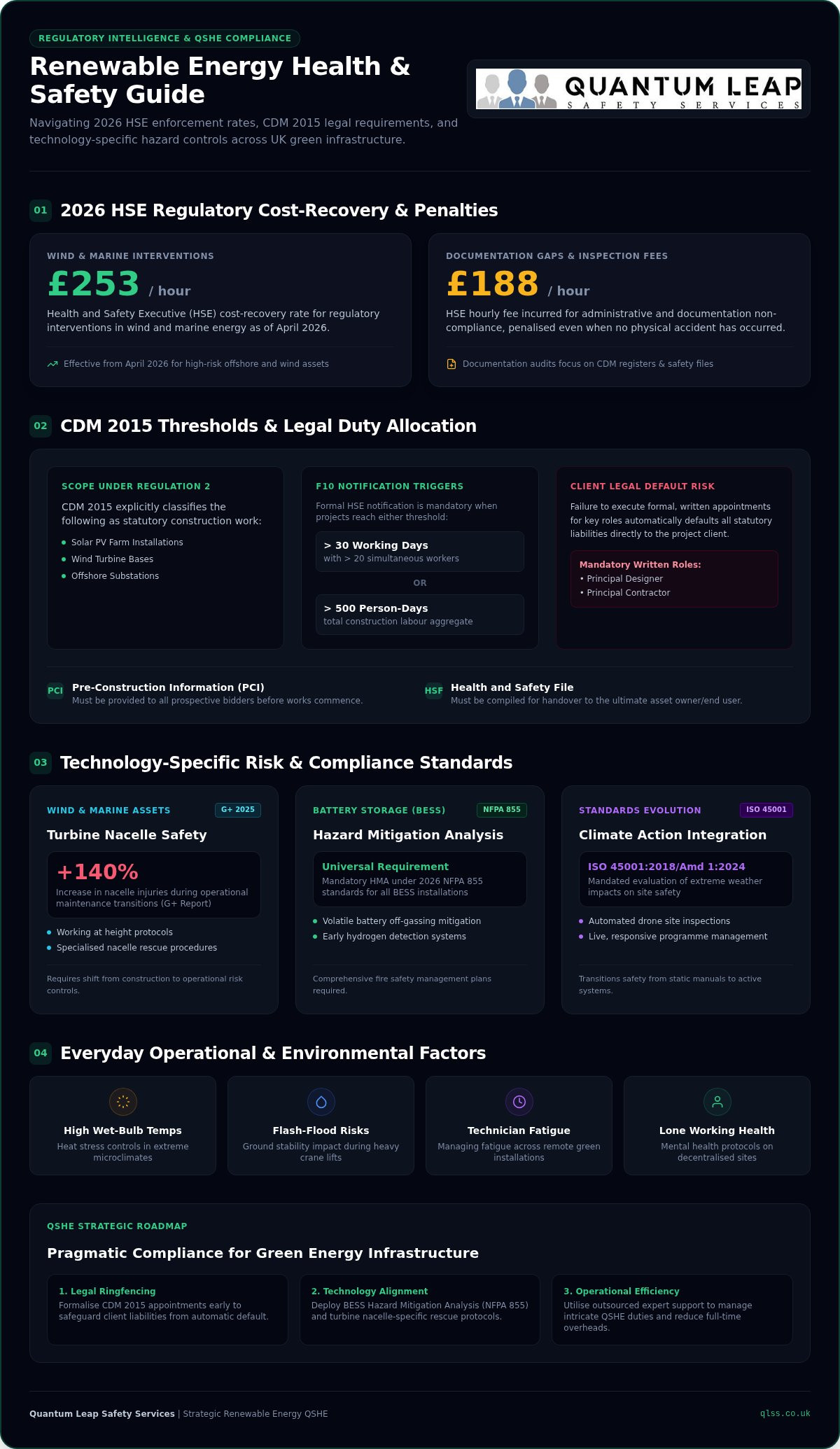
Did you know that as of April 2026, the HSE cost-recovery rate for regulatory interventions in wind and marine energy has risen to £253 per hour? When you're overseeing complex solar PV arrays or battery energy storage systems (BESS), these financial stakes are only the beginning. You're likely feeling the pressure of increasingly intricate renewable energy health and safety requirements, from the latest ISO 45001 climate action amendments to the rigorous demands of CDM 2015. It's a lot to handle when your primary focus is keeping a project on schedule and within budget.
We understand that managing these high-risk environments requires more than just a standard safety manual. It demands a pragmatic, steady approach that integrates compliance directly into your site workflow. This 2026 project success guide will show you how to master QSHE compliance whilst maintaining total operational efficiency. We'll explore the universal requirement for Hazard Mitigation Analysis under the 2026 NFPA 855 standards, the shift in operational risk profiles, and the specific steps required to foster a zero-harm culture that stands up to the most intensive regulatory audits.
Table of Contents
Understanding the Renewable Energy Health and Safety Landscape
Renewable energy health and safety is the systematic management of risks unique to the generation, storage, and distribution of green power. While many project managers attempt to adapt traditional construction protocols, these often fall short when faced with the technical nuances of modern renewable energy technologies. A standard site induction doesn't account for the volatile nature of battery off-gassing or the specific rescue procedures required for a technician stranded in a turbine nacelle. As the Health and Safety Executive (HSE) increased the wind and marine energy cost recovery rate to £253 per hour in April 2026, the financial cost of failing to understand this landscape has never been higher.
Effective renewable energy health and safety requires a shift from reactive problem-solving to a pragmatic, steady management of technical environments. This involves balancing high-voltage electrical risks with the logistical challenges of decentralised infrastructure, ensuring that every operative is equipped for the specific reality of green tech sites.
The Evolution of Safety in Green Energy
The transition from centralised power stations to decentralised renewable networks has fundamentally changed site safety requirements. In 2026, technological advancements like early hydrogen detection and automated drone inspections are becoming standard, yet they introduce new complexities for UK SMEs. We've seen a move towards proactive QSHE management, driven largely by the ISO 45001:2018/Amd 1:2024 climate action amendments. These changes mandate that organisations evaluate how extreme weather impacts their site safety, moving safety planning from a static document to a live, responsive programme.
Core Risks: Beyond High Voltage
Identifying hazards on a renewable site goes far beyond electrical safety. Working at height remains a critical concern; the G+ 2025 report highlighted a 140% increase in injuries within turbine nacelles as projects transitioned into operational maintenance. Remote locations also introduce "silent" risks such as technician fatigue and mental health challenges during lone working assignments. Environmental factors now play a larger role in safety protocols, as site managers must account for high wet-bulb temperatures and flash-flood risks during crane lifts. Managing these variables requires a dedicated, hands-on partner who understands that a zero-harm culture is built on addressing these practical, everyday site realities.
Regulatory Compliance and CDM Duties in 2026
Navigating the legal framework for renewable energy health and safety requires a precise understanding of the Construction (Design and Management) Regulations 2015. Many SME developers mistakenly believe CDM only applies to traditional building sites; however, Regulation 2 explicitly includes solar farm installations, wind turbine bases, and offshore substations as construction work. Failing to make formal, written appointments for the Principal Designer and Principal Contractor means legal liabilities default automatically to the client. This is a significant risk, especially as HSE inspection regimes now penalise documentation gaps via hourly fees of £188, even when no physical accident has occurred.
A robust compliance strategy must also incorporate comprehensive fire safety management plans, particularly for projects involving battery energy storage systems (BESS). Under the 2026 NFPA 855 standards, a Hazard Mitigation Analysis (HMA) is now a universal requirement for all BESS installations. Ensuring your documentation clearly outlines your duties under CDM 2015 and fire safety protocols is essential for passing regulatory scrutiny during the planning and construction phases.
CDM 2015 and Beyond: Application to Renewables
CDM duties apply to any project crossing the F10 notification threshold: work lasting longer than 30 working days with more than 20 workers simultaneously, or exceeding 500 person-days. Even if your project falls below these specific limits, the duty to manage safety remains. You must provide clear Pre-Construction Information (PCI) to all bidders and ensure a comprehensive Health and Safety File is compiled for the end user. These documents aren't just administrative hurdles; they're the foundation of a safe site culture that protects your workforce and your investment.
ISO Standards as a Framework for Compliance
Adopting ISO 45001 provides a global benchmark for renewable energy health and safety, specifically through the recent mandatory climate action amendments. These require site managers to document how extreme weather affects their risk assessments, such as flash-flood risks or heat stress on remote technicians. Integrating this with ISO 14001 ensures environmental protections and site safety work in tandem. To strengthen your project delivery, consider how ISO 9001 implementation services UK can improve overall quality and consistency. For those seeking a reliable partner to navigate these intricacies, our renewable projects support offers a pragmatic way to maintain total site compliance without the overhead of a full-time department.
Risk Management Across Different Renewable Technologies
Effective renewable energy health and safety management requires a granular understanding of the specific technology in use. A wind farm's civil engineering risks are vastly different from the chemical volatility of a battery storage facility. Whilst broad OSHA guidance on green job hazards provides a useful foundation, site managers need technology-specific protocols to prevent high-potential incidents. Managing these diverse risk profiles requires a methodical approach that balances technical complexity with site-level practicality.
High-voltage grid connections remain a universal hazard across all sectors, yet the delivery of these works varies. Whether you are managing the energisation of a solar array or a multi-turbine wind farm, your safe systems of work must account for the specific equipment and local grid requirements. This is where a tailored health and safety audit for renewable projects becomes indispensable, providing a clear roadmap for compliance across varying technical environments.
Wind Energy: Managing High-Risk Assets
Wind energy projects involve some of the most complex lifting operations in the power sector. Beyond the initial installation phase, operational maintenance requires robust emergency rescue planning for technicians working at height. With injuries in turbine nacelles rising by 140% according to 2025 G+ data, relying on basic fall arrest isn't enough. Modern sites now utilise drone technology for blade inspections to reduce human exposure to high-risk environments. However, these operations still require specific protocols to manage ground-based hazards and ensure that exclusion zones are strictly maintained during flight.
Solar and Battery Storage (BESS) Safety
Commercial solar and Battery Energy Storage Systems (BESS) present a different set of challenges, primarily centred on electrical and chemical stability. Large-scale solar arrays carry significant DC arc flash risks that require specialised PPE and rigorous isolation procedures. In the BESS sector, the 2026 regulatory shift has prioritised the management of thermal runaway. Under the latest NFPA 855 standards, developers must implement early-detection systems for off-gassing and ensure explosion venting conforms to strict safety codes. Safe handling and disposal of hazardous materials, such as lithium-ion components, must be integrated into the site's environmental management plan to prevent both safety breaches and environmental contamination.
Building a Robust QSHE Management System
A functional renewable energy health and safety system isn't a static document; it's a living framework that integrates safety with environmental stewardship. For many UK SMEs, the challenge lies in bridging the gap between ISO 45001 safety standards and ISO 14001 environmental requirements. Renewable projects often take place in ecologically sensitive areas, meaning a spill or land disturbance is just as much a compliance failure as a physical injury. Building this system requires a methodical four-step process.
Step 1: Identifying legal requirements. You must map out all project-specific hazards, from CDM duties to DSEAR explosive atmosphere zones in battery storage.
Step 2: Developing a competency framework. Ensure every technician, whether a direct employee or sub-contractor, holds verified certifications like GWO or ECS cards.
Step 3: Implementing real-time monitoring. Use digital reporting tools to track near-misses and high-potential incidents before they escalate.
Step 4: Continuous improvement. Maintain site standards through regular site safety inspections UK to identify drifting standards.
The Role of Competent Advice
Many SMEs lack the internal resource to maintain a full-time QSHE department, which is why they benefit from outsourced QSHE managed services. This approach provides access to a "safe pair of hands" without the full-time overhead. When choosing an advisor, it's vital to ensure they have specific renewable experience rather than just a general construction background. A specialist understands the nuances of high-voltage grid connections and thermal runaway risks in BESS. If you're unsure where your current system stands, you can request a QSHE gap analysis to identify immediate priorities.
Training and Competency Management
Managing sub-contractor competency is often the weakest link in renewable projects. You must establish a clear induction process that goes beyond a simple tick-box exercise. Mandatory training should include technology-specific safety, whilst recommended training focuses on lone worker protocols and emergency response. High-stress environments also require a focus on technician wellbeing. Implementing occupational health services for SMEs helps manage fatigue and mental health risks, ensuring your workforce remains fit for duty throughout the project lifecycle.
Securing Project Success with Quantum Leap Safety Services
Quantum Leap Safety Services acts as a dedicated partner for businesses managing the intricate demands of renewable energy health and safety. We understand that for most SMEs, the goal is to maintain operational momentum whilst fulfilling heavy legal obligations. Our pragmatic approach focuses on delivering clear, common-sense solutions that bridge the gap between technical regulatory complexity and the day-to-day reality of site management. By positioning ourselves as a "safe pair of hands", we allow project managers to focus on delivery while we handle the intricacies of QSHE compliance and risk mitigation.
We've successfully guided numerous clients through rigorous third-party audits, ensuring their management systems meet the high standards required for industry accreditation. These case highlights demonstrate our ability to translate abstract ISO requirements into functional site behaviours that protect workers. A total compliance solution isn't just about passing an inspection; it's about building long-term project viability and protecting your reputation in a competitive green tech market. Our team provides the steady guidance needed to ensure that renewable energy health and safety becomes a core driver of your project's success rather than a hurdle to its completion.
Managed Services for Renewable SMEs
One of the primary advantages of our QSHE Managed Services is the ability to access expert advice without the financial burden of a full-time safety manager. As regulations evolve throughout 2026, we ensure your documentation remains current and your site remains compliant. This proactive support includes professional audit and inspection schedules that identify potential issues before they lead to regulatory intervention or costly downtime. We provide the stability needed to navigate shifting standards in solar, wind, and battery storage technologies, ensuring your business stays ahead of the compliance curve.
Getting Started: Your Safety Roadmap
Our process begins with a thorough initial gap analysis and site risk assessment. This allows us to identify immediate priorities and develop a bespoke safety management system tailored to your specific project needs. We don't believe in generic templates; every renewable site has a unique risk profile that requires a targeted response. From the initial CDM appointments to the final Health and Safety File, we provide methodical support at every stage of the project lifecycle.
If you're ready to secure your project's future, contact us today for a tailored renewable project support plan. We'll work alongside your team to implement a robust framework that ensures total site safety and operational efficiency.
Future-Proofing Your Renewable Infrastructure
Mastering renewable energy health and safety is a strategic necessity that ensures your project remains viable in an increasingly scrutinised regulatory environment. We've explored how navigating CDM duties and implementing robust ISO frameworks protects both your workforce and your commercial reputation. By addressing technology-specific hazards like BESS thermal runaway and wind turbine maintenance with pragmatic site-level controls, you build a resilient site culture that stands up to the most intensive audits.
Quantum Leap Safety Services brings over 14 years of expert QSHE consultancy to your project, offering specialised support for high-risk renewable infrastructure. We provide comprehensive ISO and CDM compliance solutions that allow you to focus on operational delivery without the overhead of a full-time department. Enquire about our Renewable Projects Support today to secure your site's long-term success. With a steady partner by your side, you can turn complex compliance into a reliable foundation for growth.
Frequently Asked Questions
What are the main health and safety risks in renewable energy projects?
The primary risks in renewable energy health and safety include working at height, heavy lifting operations, and high-voltage grid connections. Wind energy sites often face nacelle-based injuries, whilst solar and battery storage projects deal with DC arc flash and chemical thermal runaway hazards. Remote locations also introduce logistical challenges for emergency response and technician fatigue. Managing these diverse risks requires a technology-specific approach that balances physical safety with technical compliance.
Does CDM 2015 apply to small-scale renewable installations?
CDM 2015 applies to any renewable installation classified as construction work, regardless of scale. If your project involves more than one contractor, you must appoint a Principal Designer and a Principal Contractor in writing. Failing to do so means the legal duties and liabilities default to the client. Even small-scale solar or wind maintenance can trigger these duties if the work is complex or involves multiple parties on site.
How can I ensure my sub-contractors are compliant with safety standards?
You can ensure sub-contractor compliance by implementing a robust competency framework and verification process. This involves checking specific certifications like GWO or ECS cards before site entry and conducting thorough site inductions. Regular site safety inspections identify if standards are slipping during the project. Ongoing monitoring through a managed service ensures that all parties adhere to the project's QSHE management system and latest regulatory updates.
What ISO certifications are most important for renewable energy companies?
ISO 45001 is the most critical certification for managing occupational renewable energy health and safety, especially with the 2024 climate action amendments. ISO 14001 is equally important for managing the environmental impact of green infrastructure. ISO 9001 ensures project quality and consistency. Together, these standards provide a comprehensive framework that demonstrates technical authority and a commitment to high operational standards during third-party audits and accreditation applications.
How often should a health and safety audit be conducted on a wind farm?
Health and safety audits should be conducted at regular intervals based on the project's risk profile and lifecycle stage. During the construction phase of a wind farm, monthly audits are often necessary to manage high-risk lifting and installation works. Once operational, annual audits or inspections following major component swaps are standard. These systematic reviews ensure that safety management systems remain effective and that site behaviours align with established emergency rescue protocols.
What is the role of a Principal Designer in a solar project?
The Principal Designer in a solar project is responsible for managing health and safety during the pre-construction phase. Their role involves identifying, eliminating, or controlling foreseeable risks through the design process. They coordinate the flow of health and safety information between designers and contractors. Crucially, they prepare the Health and Safety File, ensuring that future maintenance teams have the necessary information to work safely on the array and grid connections.
Can I outsource my entire QSHE management for a renewable project?
You can outsource your entire QSHE function through managed service retainers. This approach is highly effective for SMEs who need access to competent advice without the cost of a full-time manager. An external consultant acts as a "safe pair of hands", managing documentation, conducting site inspections, and ensuring continuous compliance with evolving regulations. This allows your team to focus on project delivery while maintaining total site safety and operational efficiency.
What are the fire safety requirements for battery energy storage systems (BESS)?
Fire safety for battery energy storage systems (BESS) now requires a formal Hazard Mitigation Analysis (HMA) under the 2026 NFPA 855 standards. Requirements include the installation of early-detection systems for hydrogen and carbon monoxide to prevent thermal runaway. Sites must also feature explosion and deflagration venting that conforms to current safety codes. Coordination with local Fire and Rescue Services and the submission of a Battery Safety Management Plan are essential for planning approval.


Comments