
Workplace Health and Safety Risk Assessment: A Practical UK Guide
A risk assessment can be neatly completed and still fail the people it is meant to protect. A useful workplace health and safety risk assessment reflects real tasks and conditions, and its controls remain effective as work changes. If you’re unsure which activities to cover, how to prioritise actions or when to review a template, this guide sets out a practical approach.
UK employers must assess workplace risks and take a suitable and sufficient approach. A generic form can’t capture every site, piece of equipment, hazardous substance or way of working, including home working. The assessment should help you make sensible decisions, not simply add paperwork.
Use a straightforward process: identify hazards and who may be harmed, assess the risks, choose proportionate controls, record significant findings and review them when circumstances change. The steps below explain how to ground your assessment in actual working conditions, and when in-house knowledge may be enough or specialist support could help.
Table of Contents
What a workplace health and safety risk assessment must actually achieve
A workplace health and safety risk assessment is a structured way to identify hazards, judge the risks they create and decide what controls are needed. Its purpose is to prevent harm through practical action, not to produce a completed form that sits unused. A useful assessment reflects how work is actually done, including routine tasks and less frequent activities that could still cause harm.
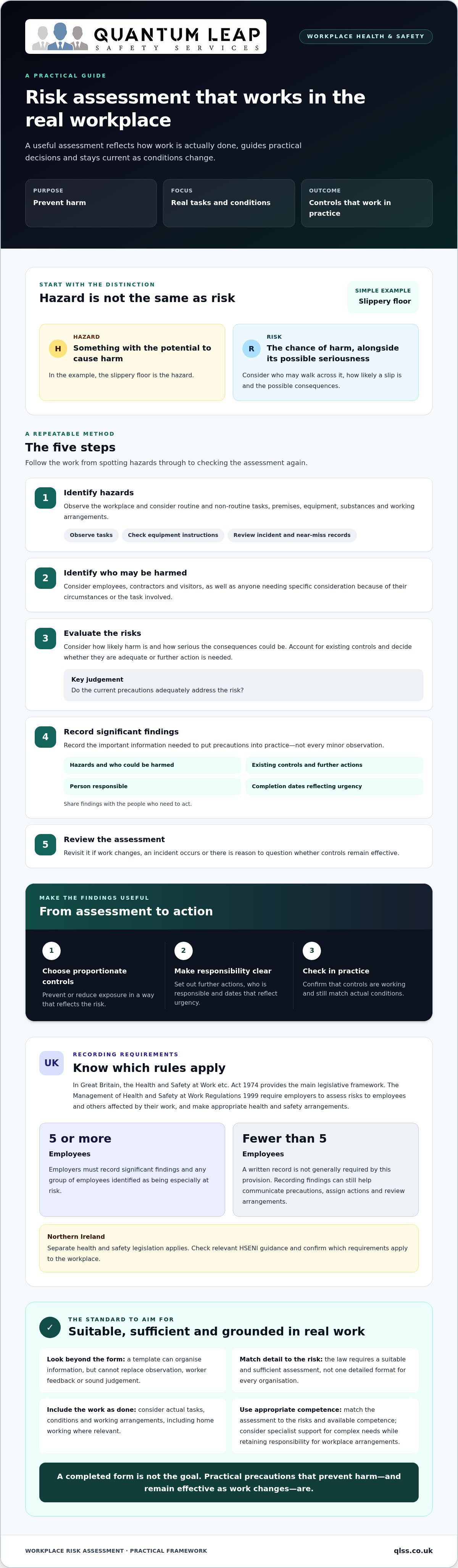
A hazard is something with the potential to cause harm. Risk is the chance that harm will happen, considered alongside how serious the consequences could be. For example, a slippery floor is a hazard. The risk depends on who may walk across it, how likely a slip is and the possible consequences. The general Risk assessment overview explains the wider concept, but workplace decisions must be based on applicable health and safety requirements and conditions at work.
Assessment is not a one-off paperwork exercise. Findings should lead to suitable precautions, clear responsibilities and checks that controls are working. A template can help organise information, but it can’t replace observing the work, consulting workers or applying sound judgement.
Which legal framework applies to your UK workplace?
In Great Britain, the Health and Safety at Work etc. Act 1974 provides the main legislative framework. The Management of Health and Safety at Work Regulations 1999 require employers to assess risks to employees and others affected by their work, and to make appropriate health and safety arrangements. The law requires a suitable and sufficient assessment, not one detailed format for every organisation. The level of detail should reflect the work and its risks.
Northern Ireland has separate health and safety legislation. Employers there should check relevant guidance from the Health and Safety Executive for Northern Ireland (HSENI) and confirm which requirements apply to their workplace.
When is a written risk assessment required?
The duty to assess risks applies whether or not a written document is required. Under the Management Regulations in Great Britain, employers with five or more employees must record the significant findings of their assessment and any group of employees identified as being especially at risk. Record the important hazards, who may be harmed and the controls or further actions required, rather than every minor observation.
Employers with fewer than five employees are not generally required by this provision to make a written record. However, recording findings can still help communicate precautions, assign actions and review arrangements consistently. In either case, the assessment should be usable by the people responsible for putting controls into practice.
How to carry out a workplace health and safety risk assessment in five steps
A practical workplace health and safety risk assessment follows a clear sequence. The HSE's steps to manage risk provide official guidance. Use the process below to apply those steps to the work being done.
Identify hazards, identify who may be harmed, evaluate the risks and controls, record significant findings, then review the assessment. These five steps provide a repeatable method, not a fixed form or risk-scoring system.
Identify hazards. Observe the workplace and consider routine and non-routine tasks, premises, equipment, substances and working arrangements. Check relevant equipment instructions and incident or near-miss records for hazards that might not be obvious during a brief walk-through.
Identify who may be harmed. Consider employees, contractors and visitors, as well as anyone who may need specific consideration because of their circumstances or the task involved.
Evaluate the risks. Consider how likely harm is and how serious the consequences could be. Take existing controls into account, then decide whether they’re adequate or whether further action is needed.
Record significant findings. Note the hazards, who could be harmed, existing controls, further actions and the person responsible. Set completion dates that reflect the urgency, and share findings with those who need to act.
Review. Revisit the assessment if work changes, an incident occurs or there’s reason to question whether controls remain effective.
How do you identify hazards and people at risk?
Look beyond routine tasks. Consider maintenance, deliveries, cleaning and other occasional work, as well as equipment, substances and the condition of the premises. Speak with workers: they may know about near misses, awkward movements or safeguards that are difficult to follow in practice. Use their feedback alongside direct observation, equipment instructions and incident information.
How should you evaluate risk and record significant findings?
There’s no universal score that suits every workplace. Judge the likelihood and potential severity of harm in context, then document what needs to happen, who will do it and by when. Make the record clear enough for the responsible person to act and for workers to understand relevant precautions.
Illustrative example: An inspection finds that a delivery route crosses a busy work area. The assessment considers how often people use the route, who could be exposed and the possible consequences of a collision. The employer records current arrangements and assigns someone to consider whether a separate route or another control is practical. This example doesn’t prescribe a risk rating; the appropriate judgement depends on the actual workplace.
If your team needs support with a defined assessment or ongoing documentation, health and safety support for SMEs may be relevant. The employer remains responsible for putting suitable arrangements into practice.
How to choose controls that reduce risk beyond a tick-box assessment
A completed template doesn’t prove that meaningful risks are controlled. Findings from a workplace health and safety risk assessment should lead to precautions that reduce exposure in practice. First consider whether you can eliminate a hazard. If not, consider whether a safer alternative or physical changes to the workplace can reduce exposure. Controls should be proportionate to the risk and prevent exposure where reasonably practicable.
The HSE's five steps to risk assessment support a practical approach to managing risk. The table below describes common types of control. They aren’t interchangeable: the most suitable option depends on the hazard and the work.
Training and PPE have a role, but shouldn’t automatically replace more effective controls that are reasonably practicable. Workers may forget a procedure, while protective equipment depends on correct selection, fit and use. Consider what could happen if a control fails or isn’t followed.
How do you prioritise actions when several hazards need attention?
Start with the potential severity of harm, how likely it is, how many people could be exposed and how reliable current controls are. Put immediate precautions in place where needed, then plan longer-term improvements. Assign each action to a named person and set a completion date that reflects its urgency. If you use a scoring matrix, explain how it works and don’t let a score replace informed judgement.
How can you check that controls work in practice?
Compare written arrangements with actual work. Observe a task and ask workers whether controls are clear, workable and consistently used. Check relevant maintenance, training or inspection records where they help confirm a control is in place. For example, a machine guard may be listed in a procedure, but observation and maintenance records can help establish whether it remains fitted and effective. If the evidence doesn’t match the assessment, investigate and revise the controls.
How to keep a workplace risk assessment current and useful
A risk assessment can become outdated even if the document is still on file. Review it when it may no longer be valid or after a significant change, and check that controls still work in practice. Simply changing the review date doesn’t make a workplace health and safety risk assessment current.
Use changes in the work and evidence from the workplace to prompt a review. These may include:
New tasks, processes, work locations or staffing arrangements.
Different machinery, equipment, materials or substances.
Changes to contractor activities or how work is organised.
An incident, near miss or new understanding of a hazard.
Worker feedback or observations suggesting a control is ineffective or difficult to follow.
After a change, revisit the affected hazards, people at risk and controls. For example, new machinery may alter access, maintenance tasks or exposure to moving parts. Consider what has changed and whether existing precautions remain suitable, rather than updating the document date alone.
What changes should trigger a review?
Review the assessment when there’s reason to think it may no longer reflect actual conditions. A near miss can reveal an overlooked hazard; a new material may introduce a different exposure; changes in staffing may affect who needs instruction. Establish whether controls remain effective and whether further action is needed.
How can SMEs connect assessments to wider safety arrangements?
Make assessment findings part of normal work management. Link actions to relevant training, equipment maintenance, supervision and occupational health arrangements. Where risks indicate a need to consider health surveillance, occupational health services for SMEs may help inform appropriate support. Ensure workers receive the findings relevant to their tasks, and ask each action owner to report when work is complete. Keep a record of completion and check that the control has made a practical difference.
A simple review checklist can help keep follow-up consistent:
Does the assessment still describe the tasks, equipment and people involved?
Have there been changes, incidents or near misses that affect the risks?
Are the stated controls in place and being followed?
Have assigned actions been completed, and have they reduced exposure?
Have relevant workers been informed or given any needed instruction?
There’s no single review interval that suits every workplace. Set an approach that reflects the nature of the work, then act sooner if conditions change or evidence raises concerns. SMEs that need help maintaining documentation and responding to changing risks can consider outsourced QSHE managed services. Find out more about QSHE managed services.
When to complete a workplace risk assessment yourself or seek specialist support
Whether you assess risks in-house or get outside help depends on the work, the hazards and the competence available. Employers retain responsibility for their health and safety arrangements, even when competent external advisers help carry out an assessment or recommend controls. Advice can inform decisions, but the employer still needs to ensure agreed actions are put into practice.
For a workplace health and safety risk assessment, consider four practical questions:
Competence: Does the assessor understand the task, relevant hazards and suitable controls?
Complexity: Are the risks familiar and straightforward, or do they require specialist knowledge?
Capacity: Is there enough time to assess the work properly and follow through on actions?
Independence: Would an impartial review help identify gaps or test existing assumptions?
When is an in-house assessment likely to be proportionate?
An internal assessment may suit familiar, lower-complexity work when the assessor understands how tasks are carried out and can recognise relevant hazards. They should be able to speak with workers, access accurate information and get appropriate controls implemented. Check the assessment against actual working conditions. A downloaded template can help structure the process, but it can’t establish what happens at your workplace or whether the listed precautions are practical.
What can external health and safety support add?
External support may be useful where hazards are complex, specialist knowledge is needed, internal capacity is limited or an independent perspective would add value. Depending on the need, support could involve reviewing an assessment, helping develop one, prioritising actions or providing ongoing advice. For construction-related risks and arrangements, see this guide to health and safety for construction sites.
Quantum Leap Safety Services provides health and safety consultancy for SMEs, including managed support and defined project assistance. The right level of input depends on your workplace and the gaps you need to address. Explore practical health and safety support to consider whether project-based or ongoing advice could suit your requirements.
Make your next assessment useful in practice
A workplace health and safety risk assessment should reflect the work as it’s actually done, identify who could be harmed and lead to controls people can follow. Treat the findings as working arrangements, not paperwork: assign actions, share relevant information and review the assessment when conditions or risks change.
In-house assessment can be proportionate for familiar work when the right knowledge and time are available. Where hazards are complex or an independent perspective would help, competent external advice can support better-informed decisions. The employer remains responsible for ensuring suitable arrangements are in place.
Quantum Leap Safety Services supports businesses across the UK with managed services, audits, training and compliance support. Whether you’re addressing a defined assessment need or looking for ongoing advice, choose support that fits your workplace and its risks.
Discuss practical health and safety support and take the next step towards risk controls that work for your business.
Frequently Asked Questions
What is a workplace health and safety risk assessment?
A workplace health and safety risk assessment is a structured process for identifying hazards, considering who could be harmed, judging the likelihood and possible severity of harm, and deciding what controls are needed. For example, an assessment might consider whether a delivery route exposes workers or visitors to moving vehicles. Its purpose is to guide practical precautions and action, not simply to complete a form.
Is a workplace risk assessment a legal requirement in the UK?
Yes. In Great Britain, employers must assess risks to employees and others affected by their work under the Management of Health and Safety at Work Regulations 1999. Northern Ireland has separate health and safety legislation, so employers there should check guidance from the Health and Safety Executive for Northern Ireland (HSENI). The assessment should be suitable and sufficient for the work and risks involved, rather than follow one prescribed format.
Do small businesses need a written health and safety risk assessment?
In Great Britain, employers with five or more employees must record the significant findings of their risk assessments. Employers with fewer than five employees are not generally required to record those findings under this provision, but they still need to assess risks and take appropriate action. A written record can help any small business communicate precautions, assign actions and check that controls are followed. Other specific requirements may also apply to particular risks.
How often should a workplace risk assessment be reviewed?
There’s no single review interval that suits every workplace. Review the assessment if it may no longer be valid, such as after a change to tasks, equipment, substances, premises or working arrangements. An incident, near miss or evidence that a control isn’t working should also prompt a review. Check that the assessment still reflects actual work and that precautions are effective, rather than simply changing its review date.
Who can carry out a workplace health and safety risk assessment?
A suitable person within the business can carry out the assessment if they understand the work, relevant hazards and appropriate controls, and can involve workers and act on findings. The employer remains responsible for health and safety arrangements. Where risks are complex or specialist knowledge is needed, competent external advice can help with assessment or review. Getting assistance doesn’t transfer the employer’s responsibility to ensure suitable precautions are implemented.
What should a workplace risk assessment include?
Record the significant hazards, who may be harmed, how harm could occur and the existing controls. Note any further action needed, who is responsible and an appropriate completion date. The assessment should reflect actual tasks and working conditions, including relevant non-routine activities. It should also be clear enough for workers and managers to understand the precautions they need to follow and how outstanding actions will be completed.
Can I use a generic risk assessment template for my business?
A template can provide a useful structure, but it shouldn’t be treated as a completed assessment. Check each entry against your premises, tasks, equipment, substances and workers. Remove irrelevant hazards and add risks the template misses. For instance, a form may mention machinery guarding without describing the equipment or how it’s used at your workplace. Speak with workers and observe the work before deciding whether listed controls are suitable.


Comments