
ISO 14001 Gap Analysis Checklist: The 2026 SME Guide to Certification Readiness
A thorough ISO 14001 gap analysis isn't a passive paperwork exercise; it is a vital operational stress test for your business. If you are preparing for certification, you likely share a familiar concern: the dread of facing a costly Stage 1 audit failure due to overlooked non-conformances. Interpreting complex environmental management clauses, establishing compliance obligations, and evaluating genuine life-cycle impacts can quickly stretch internal capacity beyond its normal limits.
You don't have to leave your assessment outcome to guesswork. Discover how a structured ISO 14001 gap analysis identifies environmental compliance shortfalls, streamlines certification, and builds a clear roadmap to formal audit readiness. Ahead, we provide a methodical, clause-level checklist to benchmark your documentation and operational controls, explain critical audit timelines and risks, and present a prioritised remediation plan to achieve UKAS-accredited certification on your first attempt.
Table of Contents
Understanding the ISO 14001 Gap Analysis: Purpose, Scope, and Business Value
The ISO 14001:2015 Gap Analysis Checklist: Clause-by-Clause Review
Internal Self-Assessment vs External Specialist Gap Analysis: Evaluating the Strategic Choice
Executing the Gap Analysis: From Site Inspection to Corrective Action Roadmap
Translating Gap Analysis Findings into UKAS-Accredited ISO 14001 Certification
Understanding the ISO 14001 Gap Analysis: Purpose, Scope, and Business Value
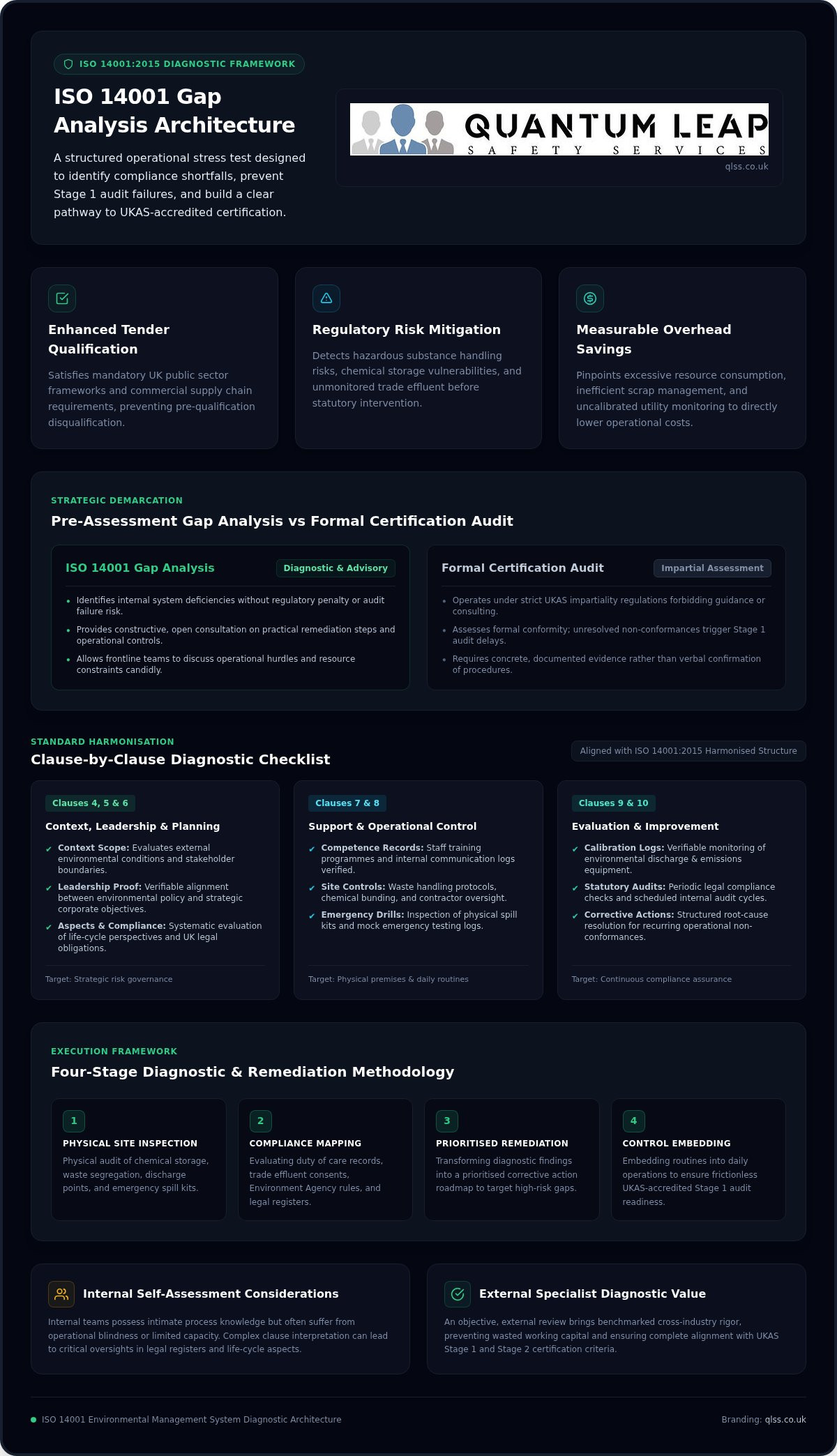
An ISO 14001 gap analysis serves as an objective baseline assessment comparing your organisation's current operational practices against formal international benchmarks. Rather than acting as a theoretical document check, it provides a practical review of your daily activities, waste management protocols, and energy controls. Establishing this operational baseline early protects working capital by pinpointing exact compliance shortfalls before you commit resources to external assessors.
Within the UK regulatory framework, statutory compliance obligations form the foundation of any environmental management system. Evaluating operational controls ahead of time uncovers vulnerabilities in duty of care compliance, chemical storage, or discharge consents. Grounded in the broader ISO 14000 family of standards, a methodical gap evaluation translates complex environmental criteria into manageable, site-specific adjustments that safeguard day-to-day operations.
Defining the Difference Between a Gap Analysis and a Formal Certification Audit
A gap analysis is an advisory, diagnostic exercise designed to identify system deficiencies without regulatory penalty. Accredited certification bodies operate under strict impartiality regulations; they cannot advise you on how to resolve non-conformances during an official assessment. In contrast, a pre-certification gap review creates an open, constructive space. Frontline staff can discuss practical hurdles candidly, allowing you to rectify procedural weaknesses before formal scrutiny begins.
Key Commercial and Operational Benefits for Growing UK Businesses
Completing a rigorous pre-assessment delivers clear advantages across commercial bidding and internal site governance:
Enhanced tender qualification: UK public sector frameworks and commercial supply chains routinely mandate verified environmental credentials. Early readiness prevents disqualification during procurement rounds.
Regulatory risk mitigation: Identifying hazardous substance handling issues or unmonitored trade effluent early helps prevent enforcement notices from bodies like the Environment Agency.
Measurable overhead savings: Pinpointing excessive resource consumption, inefficient scrap management, or poor utility monitoring yields immediate reductions in operating costs.
The ISO 14001:2015 Gap Analysis Checklist: Clause-by-Clause Review
A rigorous ISO 14001 gap analysis evaluates whether everyday operational realities match the formal criteria established by the ISO 14001 international standard. Built upon the Harmonised Structure, the standard shares its high-level architecture with quality and safety systems, simplifying integration across existing business processes. Auditors require tangible documented evidence rather than verbal confirmation. A methodical checklist exposes systemic gaps across leadership, operational controls, and support tiers before an external assessment takes place.
Clauses 4, 5, and 6: Organisational Context, Leadership, and Planning
Diagnostic checks begin by evaluating internal and external context. Auditors examine stakeholder expectations, environmental conditions, and the defined boundaries of your environmental management system scope. Leadership accountability requires verifiable proof that environmental policies align with strategic corporate objectives. During planning reviews, teams scrutinise your evaluation of significant environmental aspects, life-cycle perspectives, and UK legal compliance obligations to confirm that operational risks are systematically managed.
Clauses 7 and 8: Support Resources and Day-to-Day Operational Control
Clauses 7 and 8 verify daily operational execution across physical premises. Reviewers inspect staff competence records, training programmes, and internal communication logs. On-site operational controls must cover procurement, contractor activities, and waste handling protocols. Emergency preparedness requires physical verification; teams check spill kits, inspect chemical bunding, and review testing frequencies for mock environmental emergency drills.
Clauses 9 and 10: Performance Evaluation, Internal Auditing, and Improvement
The closing clauses ensure your organisation monitors performance and resolves non-conformances systematically. Auditing teams review monitoring equipment calibration logs, statutory compliance checks, and scheduled internal audit records. Management review meetings must demonstrate active leadership participation, whilst corrective action logs must demonstrate thorough root-cause investigations. Establishing these review mechanisms connects naturally with other disciplines, such as benchmarking alongside ISO 9001 implementation services UK. Organisations seeking tailored guidance can benefit from specialist ISO management systems support to structure these controls efficiently.
Internal Self-Assessment vs External Specialist Gap Analysis: Evaluating the Strategic Choice
Determining whether to conduct an internal review or engage external specialists requires a clear evaluation of operational capacity, commercial risk, and technical capability. While internal teams understand daily workflows, they frequently struggle with audit objectivity. An external ISO 14001 gap analysis introduces third-party scrutiny that mirrors the expectations of certification assessors, ensuring that systemic weaknesses are identified before formal audits take place.
The Limitations and Hidden Traps of In-House Gap Analyses
Self-assessment frequently suffers from operational familiarity. Internal personnel often overlook chronic non-compliances, assuming informal site habits constitute acceptable procedure. Diverting operations managers to interpret complex criteria like life-cycle perspectives or supply chain impacts pulls focus from core commercial priorities. Without daily auditing experience, internal staff routinely misinterpret regulatory thresholds, leaving critical documentation gaps unaddressed ahead of external visits.
The Measurable ROI of Engaging External Environmental Compliance Specialists
Commissioning experienced environmental practitioners delivers tangible commercial returns by accelerating preparation and safeguarding capital. Specialist consultants provide several distinct operational advantages:
Audit objectivity: An external practitioner delivers an impartial evaluation, identifying real operational oversights without internal political friction or departmental defensiveness.
Pre-built compliance structures: Experienced consultants provide proven registers, evaluation matrices, and policy structures, drastically reducing administrative drafting time.
Cross-regulatory insight: External specialists understand current UK enforcement priorities, ensuring your environmental register reflects active statutory duties.
Integrated systems delivery: Professional consultants can align environmental controls with broader management goals through outsourced QSHE managed services, preventing duplicate record-keeping across health, safety, and quality functions.
Investing in a structured diagnostic assessment eliminates the financial and reputational setback of a failed Stage 1 audit. By pinpointing required remediations immediately, an external ISO 14001 gap analysis provides a predictable delivery route to successful assessment.
Executing the Gap Analysis: From Site Inspection to Corrective Action Roadmap
Executing an effective ISO 14001 gap analysis requires a disciplined, four-stage diagnostic methodology rather than a rushed desktop review. It bridges the divide between written policy and daily operations, establishing precisely where operational realities diverge from international standards. This methodical process provides business leaders with complete transparency over environmental performance before an official assessor arrives.
Stage 1 & Stage 2: Documentation Review and Operational Site Inspection
Stage 1 focuses on a desktop review of core environmental documentation. Evaluators inspect statutory registers, environmental aspect evaluations, operational procedures, and emergency response plans to verify baseline compliance.
Stage 2 shifts the evaluation directly onto the operational floor. A thorough site walk-around investigates physical risk areas, verifying the structural condition of chemical bunds, oil interceptors, drainage networks, and waste storage bays. Inspectors interview operational staff across shifts to evaluate working habits. Frontline teams must demonstrate practical knowledge of spill response kits and waste segregation rules, confirming that procedures exist in practice rather than just on paper.
Stage 3 & Stage 4: Compiling Findings and Developing the Remediation Plan
Stage 3 compiles observations into a structured diagnostic register. Findings are risk-graded into distinct operational categories:
Critical non-conformances: Direct breaches of UK environmental law or complete omissions of mandatory standard requirements.
Minor gaps: Inconsistencies between documented procedures and practical execution that don't pose immediate pollution risks.
Advisory observations: Process improvement opportunities designed to boost resource efficiency and reduce overheads.
Stage 4 converts this diagnostic data into a prioritised, time-bound Corrective Action Plan. This roadmap outlines designated task owners, required resource allocations, and realistic completion targets. For specialised high-hazard infrastructure, these remediation actions integrate smoothly alongside a health and safety audit for renewable projects. To benchmark your operational premises and establish a practical route to certification, schedule an audit and inspection review with our team.
Translating Gap Analysis Findings into UKAS-Accredited ISO 14001 Certification
Completing an ISO 14001 gap analysis gives your business a clear diagnosis, but real compliance relies on consistent operational execution. Closing the identified shortfalls transforms static policies into a living environmental management system. For leadership teams, the objective is straightforward: embed new controls into daily routines so compliance becomes second nature rather than an administrative burden.
Closing Identified Gaps: Implementing Controls, Training, and System Evidence
Remediation begins by addressing documentation deficits flagged during your diagnostic review. This process involves refining environmental aspects registers, defining operational criteria, and formalising spill response procedures. Writing policies isn't enough on its own; personnel must understand their daily responsibilities. Short, tailored training workshops help bridge knowledge gaps across departments, ensuring frontline operators follow correct waste segregation and chemical storage rules.
Accredited certification assessors require objective proof of performance. You cannot present empty registers on audit day. Businesses must operate their newly aligned system for several months before booking an assessment, generating genuine records such as completed inspection logs, waste transfer notes, and continuous utility monitoring data.
Selecting a UKAS-Accredited Certification Body and Securing Stage 1 Readiness
Selecting the right assessment body protects your investment. In the UK, commercial supply chains and public procurement bodies demand certification accredited by the United Kingdom Accreditation Service (UKAS). Non-accredited certificates may appear cheaper initially, but they often face rejection during tender pre-qualification checks. UKAS-accredited certification guarantees that your environmental credentials carry genuine market credibility.
Before inviting a certification body for your Stage 1 audit, your team must complete two mandatory milestones:
A full cycle of internal audits: You must audit every clause and operational process within your defined system scope to verify conformances internally.
A formal management review meeting: Senior leadership must review environmental performance metrics, compliance obligations, and resource allocations, recording decisions in formal minutes.
Partnering with dedicated compliance professionals removes ambiguity throughout this preparatory phase. An external expert conducts a final pre-assessment stress test, verifying that every finding from your ISO 14001 gap analysis has been resolved effectively. This disciplined approach eliminates audit anxiety, prevents costly re-assessments, and secures first-time certification success.
Taking the Next Step Towards Seamless Certification Readiness
Navigating the route to UKAS-accredited compliance doesn't have to strain your operations. A structured baseline assessment delivers clarity by replacing uncertainty with a practical remediation roadmap. By benchmarking your operational controls against standard clauses and resolving shortfalls early, your business eliminates the risk of Stage 1 audit failure.
Success relies on partnering with specialists who understand the commercial pressures facing growing organisations. Quantum Leap Safety Services brings comprehensive QSHE expertise and a proven track record of delivering pragmatic ISO management systems for UK commercial enterprises. With fixed-price project consultancy fees that remove budget uncertainty, our consultants provide the objective scrutiny needed to get your systems audit-ready.
Take control of your environmental compliance journey today. Book your comprehensive ISO 14001 gap analysis with Quantum Leap Safety Services and build lasting operational confidence across your organisation.
Frequently Asked Questions
What is the primary objective of an ISO 14001 gap analysis?
The primary objective is establishing an objective operational baseline by comparing your current environmental practices against the standard. An ISO 14001 gap analysis highlights undocumented procedures, missing legal registrations, and practical site oversights. Identifying these shortfalls early allows your business to address non-conformances before an official certification body carries out a formal audit, safeguarding capital and commercial reputation.
How long does a professional ISO 14001 gap analysis typically take for an SME?
For a typical single-site SME, the on-site diagnostic review usually concludes within one to two days. Preliminary desktop document reviews take place beforehand, followed by physical inspections and workforce discussions. A full corrective action plan and diagnostic report are generally compiled and delivered within a week, giving leadership an immediate, prioritised schedule for closing compliance shortfalls.
What is the difference between a gap analysis and an internal ISO 14001 audit?
A gap analysis evaluates an uncertified or transitioning management system to discover what components are missing entirely. An internal audit tests an active, established system to confirm staff adhere to approved procedures. Gap assessments take an advisory approach to help build compliance structures, whereas internal audits verify existing conformity against defined operating criteria.
Can our business fail an ISO 14001 gap analysis?
No, a business cannot fail a gap analysis. It is an advisory diagnostic tool designed to uncover system weaknesses without regulatory penalty. Identifying extensive operational shortfalls is beneficial; it exposes critical compliance blind spots internally so your team can rectify them safely before paying for formal, high-stakes Stage 1 assessments.
Which operational documents must we prepare before the gap analysis commences?
Your team should assemble waste transfer notes, utility records, discharge consents, and existing environmental risk assessments. Providing your spill response procedures, chemical registers, and staff training logs also speeds up the diagnostic. If certain documentation doesn't exist yet, leave the gap open so your advisor can map out the required templates accurately.
Why is UKAS accreditation crucial when progressing from gap analysis to certification?
UKAS accreditation confirms that your chosen certification body operates under verified national standards of competence and impartiality. Non-accredited certificates lack oversight and are regularly rejected during UK public sector tenders and commercial pre-qualification questionnaires. Securing UKAS-accredited certification guarantees that your environmental credentials carry genuine commercial value and international standing.
Can an ISO 14001 gap analysis integrate with our existing ISO 9001 quality system?
Yes, integration is straightforward because both standards share the common Harmonised Structure framework. Conducting a joint review allows environmental aspects to align directly with established document controls, internal audit schedules, and management reviews. This unified approach eliminates administrative duplication and embeds environmental governance neatly into your existing operating model.


Comments