
How to Build an Environmental Aspect and Impact Register: 2026 Guide
Most environmental registers fail certification audits not because they lack detail, but because they document theoretical paperwork rather than operational reality. If you've ever stared at a complex spreadsheet struggling to separate causes from effects under ISO 14001 Clause 6.1.2, you aren't alone. Confusing an operational aspect with its true environmental impact remains one of the most frequent sources of audit non-conformities across UK businesses. Creating an audit-ready environmental aspect and impact register shouldn't feel like an exercise in administrative guesswork or arbitrary risk scoring.
You can establish a practical, defensible register that satisfies certification bodies whilst giving your team genuine operational control. In this 2026 guide, you'll master how to identify, evaluate, and manage environmental aspects and impacts to achieve lasting ISO 14001 compliance. We'll walk step by step through establishing objective significance criteria, mapping activities across the operational lifecycle, and streamlining your environmental management system for seamless ongoing reviews.
Table of Contents
What Is an Environmental Aspect and Impact Register?
At its core, an environmental aspect and impact register is a structured inventory that documents how your organisation touches the natural world. It operates as the technical backbone of an Environmental Management System (EMS), specifically under ISO 14001 Clause 6.1.2. The standard mandates that organisations determine the environmental aspects of their activities, products, and services that they can either control or influence. Rather than keeping abstract policies on a shelf, this register translates environmental ambitions into practical, day-to-day risk management across UK facilities.
Statutory bodies and UK accreditation assessors expect businesses to maintain this documentation systematically. Without a comprehensive register, identifying significant risks, setting quantifiable objectives, and allocating operational controls becomes impossible. It establishes your baseline compliance profile, ensuring that regulatory requirements connect directly to operational realities.
Aspect Versus Impact: Understanding the Difference
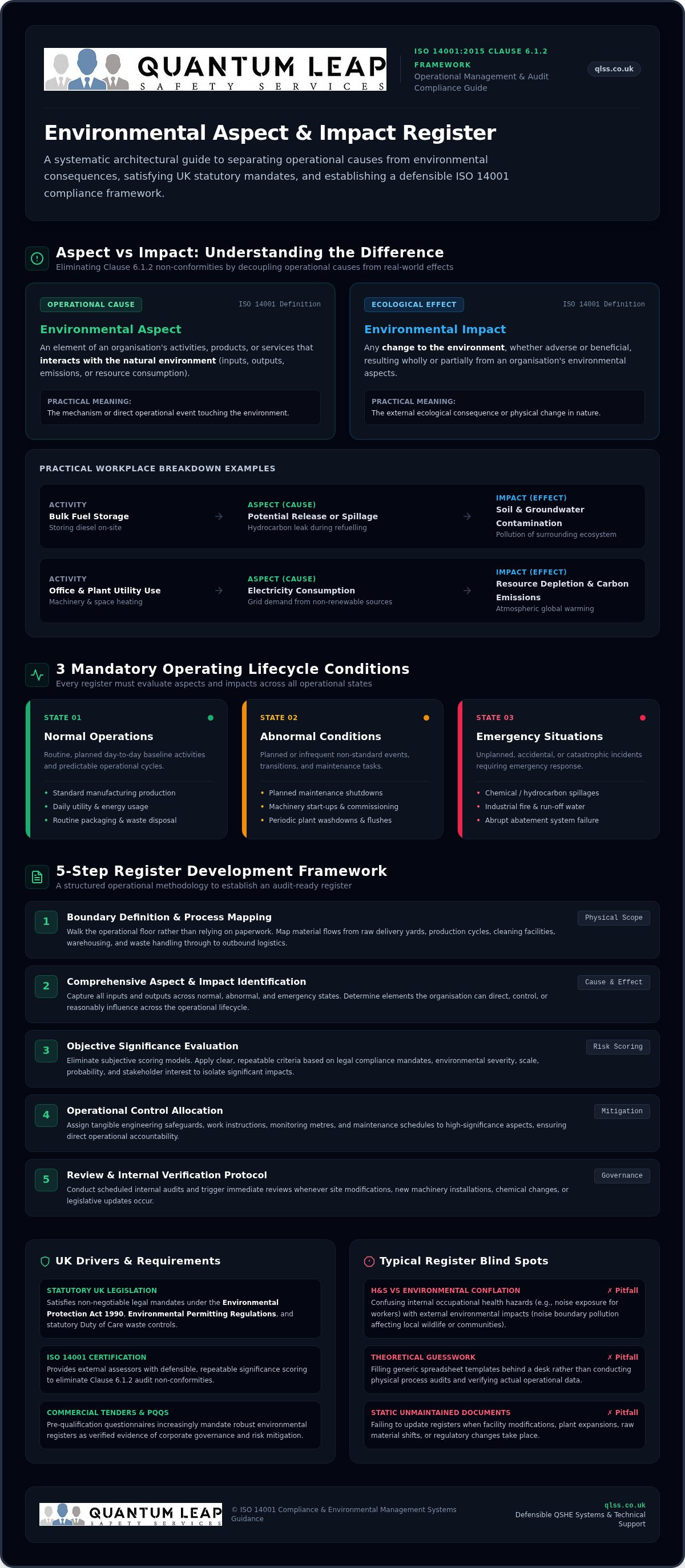
Many registers fail audits because teams confuse cause with effect. An environmental aspect is an element of your organisation's activities, products, or services that interacts with the natural environment. Think of the aspect as the operational cause. In contrast, an environmental impact is any change to the environment, whether adverse or beneficial, resulting wholly or partially from that aspect. The impact represents the real-world effect.
Consider two practical workplace examples:
Bulk fuel storage: Storing diesel on-site is the operational activity. The environmental aspect is the potential release or spillage of hydrocarbons during refuelling. The resulting environmental impact is soil contamination and groundwater pollution.
Office and plant electricity use: Operating machinery or heating an office is the activity. The aspect is electricity consumption from non-renewable generation. The corresponding impacts are natural resource depletion and greenhouse gas emissions driving atmospheric warming.
Understanding this distinction aligns with broader principles found in an Environmental Impact Assessment, where predicting the precise ecological consequence of an activity dictates the necessary engineering controls.
Why UK Organisations Require a Maintained Register
Operating a business without an up-to-date environmental aspect and impact register exposes leadership to acute legal and commercial liabilities. First, it satisfies non-negotiable statutory obligations under UK legislation, including the Environmental Protection Act 1990, the Environmental Permitting Regulations, and Duty of Care waste requirements. Regulators require evidence that you actively monitor discharge points, hazardous materials, and waste streams.
Second, the document remains essential for achieving and maintaining ISO 14001 certification. External auditors scrutinise the register to ensure your significance scoring is defensible, repeatable, and regularly updated. Beyond certification, prospective public and private sector clients increasingly demand rigorous environmental registers during pre-qualification questionnaires (PQQs) and commercial tenders. A transparent, robust register proves your organisation operates with strict corporate governance, safeguarding commercial relationships and preventing regulatory penalties.
How to Build an Aspect and Impact Register in 5 Steps
Creating an audit-ready environmental aspect and impact register requires operational investigation, not theoretical guesswork behind a desk. Generic templates fail because they disconnect from site realities. To build a robust register that satisfies ISO 14001 auditors and delivers genuine operational control, follow this structured five-step methodology.
Step 1 & 2: Process Mapping and Aspect Identification
Start by establishing clear physical and operational boundaries across your facilities, products, and contracted services. Rather than reviewing invoices in isolation, walk the operational floor. Track raw materials from delivery yards through production, parts cleaning, warehousing, and waste disposal. Review utility metering data, chemical handling protocols, and outbound transport logistics.
Capture inputs and outputs across three distinct operating conditions:
Normal operations: Routine production, standard utility usage, and day-to-day packaging disposal.
Abnormal conditions: Planned maintenance shutdowns, machinery start-ups, washdowns, and plant commissioning.
Emergency situations: Tank ruptures, chemical spills, fires, and drainage system back-ups.
Systematically categorising these conditions aligns directly with the EPA's guide to identifying environmental aspects, ensuring no overlooked support processes undermine your baseline register.
Step 3 & 4: Linking Impacts and Determining Significance
Once aspects are identified, correlate each activity directly to its receiving media: air emissions, water discharges, land contamination, or natural resource depletion. A chemical delivery (activity) involves transfer risk (aspect), which threatens local watercourse toxicity (impact).
Next, apply a defensible scoring framework. Evaluate aspects using consistent quantitative factors: severity of environmental harm, probability or frequency of occurrence, detection controls, and statutory compliance status. Any aspect subject to explicit UK environmental permitting or legal obligations must automatically register as significant. Establish an unambiguous numerical cut-off threshold; aspects scoring above this score become your significant environmental aspects requiring prioritised operational control.
Step 5: Documenting Control Measures and Ownership
A significance score carries little value without concrete operational controls. For every significant aspect, document the exact preventive measures, physical containment systems, planned preventative maintenance (PPM) routines, and emergency spill response procedures in place. Assign explicit job roles to manage each control rather than leaving responsibility to general management.
Finally, link these significant items directly into your environmental targets and internal audit schedules. If establishing this scoring framework or mapping operational workflows strains internal resources, partnering with specialists in ISO management systems helps your team build a defensible, audit-ready register without operational delays.
Significance Evaluation Methodologies: Comparing Assessment Models
ISO 14001 Clause 6.1.2 requires organisations to establish objective criteria for determining which environmental aspects have or can have a significant environmental impact. Auditors frequently reject registers that rely on vague impressions or unsupported judgments. Your evaluation methodology must be consistent, transparent, and repeatable across every department. Selecting the right framework depends on operational scale, technical complexity, and regulatory exposure.
Most commercial organisations evaluate their registers using one of three primary structures: risk matrix scoring, direct assessment, or multi-criteria evaluation.
Risk Matrix Scoring (Probability vs Severity)
The standard numerical risk matrix calculates significance by multiplying probability against severity. Consequence severity assesses the ecological scale and reversibility of the damage, scored from 1 (negligible) to 5 (catastrophic). Probability rates the frequency of occurrence, scored from 1 (unlikely) to 5 (continuous routine occurrence).
To ensure practical accuracy, organisations often add multiplying weighting factors:
Legal compliance status: Applies an automatic multiplier if the aspect is subject to UK statutory limits, such as discharge consents or trade effluent controls.
Stakeholder concern: Accounts for scrutiny from local communities, clients, or insurers, raising the overall score.
Scores exceeding a defined cut-off (for instance, 15 or higher out of 25) designate the aspect as significant. External certification bodies readily validate this model because it provides clear mathematical justification.
Direct Assessment vs Multi-Criteria Evaluation
Direct assessment bypasses complex mathematical scoring by establishing categorical rules. If an activity is governed by specific environmental legislation (such as hazardous waste consignment or refrigerant handling under F-gas regulations), it is automatically designated as significant. While rapid to implement and simple for non-technical teams to maintain, this binary approach lacks granularity. It fails to rank priorities when numerous operational activities carry legal duties.
In contrast, multi-criteria evaluation models appraise aspects against five distinct operational dimensions:
Scale and severity: The geographic footprint and concentration of the release or resource draw.
Duration and reversibility: How long the environmental impact persists and whether natural recovery is possible.
Regulatory exposure: The presence of binding statutory limits or permitting duties.
Commercial sensitivity: Supply chain contractual requirements and brand reputational impact.
Control feasibility: Technical viability and practical capacity to reduce the impact.
For mid-sized enterprises and complex industrial sites, multi-criteria models offer the highest level of audit defensibility. They reflect operational realities far better than rigid off-the-shelf spreadsheets, ensuring that your environmental aspect and impact register directs resources toward actual operational priorities rather than administrative formalities.
Common Pitfalls When Developing an Environmental Register
Compiling an environmental aspect and impact register often exposes operational blind spots. Assessors routinely identify critical gaps where teams treat documentation as a compliance formality rather than an accurate operational record. One widespread error involves conflating internal occupational health and safety hazards with external environmental impacts. A chemical vapour exposure affecting factory staff is a workplace safety issue under COSHH regulations, whereas atmospheric venting of that same substance constitutes an environmental aspect. Keeping these regulatory boundaries distinct prevents audit confusion and ensures accurate reporting.
Another systemic failing is leaving the register static once initial certification concludes. When production modifications, equipment upgrades, or legislative updates occur without corresponding register amendments, the management system quickly falls out of compliance.
Neglecting Abnormal Conditions and Emergency Scenarios
Auditors frequently raise non-conformities when organisations assess only routine, steady-state manufacturing. The most severe environmental liabilities almost invariably arise during operational disruption, maintenance procedures, or catastrophic system failures.
Your assessment must actively account for low-frequency, high-consequence events:
Firewater containment failures: Untreated water from emergency firefighting entering surface drains carrying toxic chemical runoff.
Utility disruptions: Sudden power outages disabling effluent treatment plant pumps, leading to unmonitored discharges.
Seasonal operational swings: Heightened fuel consumption and boiler cycling throughout winter, or increased dust generation during dry summer maintenance shutdowns.
Omitting these scenarios leaves your business entirely unprepared when non-routine incidents inevitably occur.
The Lifecycle Perspective: Overcoming Scope Limitations
ISO 14001 requires organisations to evaluate aspects they can control and those they can influence across a broad lifecycle perspective. Confining your scope strictly within the physical site gates remains a frequent reason for major non-conformities.
Organisations must review environmental pressures across their wider value chain:
Upstream procurement: Raw material extraction, packaging specifications, and haulage contractor fuel standards.
In-use efficiency: Energy demands, emissions, and maintenance requirements associated with finished products in customer hands.
Downstream disposal: Decommissioning feasibility, recyclability of packaging materials, and end-of-life recovery routes.
Integrating these lifecycle aspects requires seamless alignment between environmental protocols and standard operating procedures. Discover how ISO 9001 implementation services UK align quality systems alongside environmental standards to ensure procedural consistency across procurement, operations, and waste handling.
If identifying these extended lifecycle risks strains internal resources, book an assessment through our Audit & Inspection Services to eliminate critical vulnerabilities before external certification visits.
Maintaining Your Register and Integrating Professional QSHE Support
Compiling an environmental aspect and impact register marks an important operational milestone, but ongoing maintenance determines its real value. Registers quickly lose relevance if they aren't actively integrated into routine operational reviews. Scheduled internal environmental audits verify whether physical controls and administrative procedures mitigate significant impacts as intended, ensuring management plans don't drift away from daily site practices.
Trigger Points for Register Reviews and Updates
A compliant register cannot sit untouched between annual certification surveillance visits. Operational shifts create new environmental interactions that require immediate documentation. Management teams should establish defined triggers that mandate a prompt reassessment of aspect significance:
Process and plant modifications: Installing new manufacturing equipment, altering chemical storage locations, or extending site facilities.
Regulatory and statutory updates: Changes to UK environmental legislation, revisions to trade effluent consents, or updated emissions limits.
Operational incidents: Spillages, containment leaks, environmental near-misses, or regulator audit findings highlighting control deficiencies.
Outside of these immediate operational triggers, formal register reviews must form a standard agenda item during planned management review meetings, verifying that operational objectives align with your latest risk profile.
The Business Advantage of Outsourced Environmental Expertise
Tracking evolving statutory duties whilst managing commercial operations often stretches internal resources to capacity. Many leadership teams lack the in-house bandwidth or specialist technical knowledge needed to challenge significance ratings objectively. Partnering with external practitioners introduces independent scrutiny, robust significance scoring methodologies, and structured legal register maintenance without inflating internal overheads.
Engaging outsourced QSHE managed services enables organisations to maintain steady compliance, preventing audit non-conformities and tender disqualifications. Founded in 2012, Quantum Leap Safety Services delivers comprehensive multi-disciplinary support across UK compliance frameworks, uniting safety, environmental, and quality systems into one seamless operational model. A maintained environmental aspect and impact register protects your commercial standing, providing the operational clarity and regulatory confidence required for sustainable growth.
Achieving Long-Term Environmental Compliance and Audit Readiness
Building an effective environmental aspect and impact register turns a complex regulatory duty into a strategic operational advantage. By separating operational causes from environmental effects, scoring significance through objective criteria, and accounting for abnormal operating scenarios, you eliminate the common blind spots that disrupt certification audits. A maintained register doesn't just satisfy external assessors; it safeguards your business against statutory enforcement and commercial disqualification.
Maintaining full compliance alongside daily operations requires persistent oversight and technical precision. Since 2012, Quantum Leap Safety Services has supported organisations across the UK with comprehensive ISO management systems, independent compliance audits, and tailored QSHE managed services designed for growing SMEs. We provide the practical framework needed to keep your documentation defensible, current, and aligned with UK environmental standards.
Take the uncertainty out of your next audit cycle. Discuss your environmental compliance requirements with Quantum Leap Safety Services to secure reliable, professional support for your management systems.
Frequently Asked Questions
What is the primary purpose of an environmental aspect and impact register?
The primary purpose of an environmental aspect and impact register is to systematically identify, evaluate, and control how an organisation's activities interact with the environment. It translates corporate environmental policies into practical operational controls, prioritising high-consequence risks such as legal breaches, chemical spills, and excessive resource consumption. Maintaining this structured register satisfies ISO 14001 Clause 6.1.2, proving to assessors and regulators that your business actively manages its ecological liabilities.
How often should our organisation update its environmental aspect and impact register?
You should review your environmental aspect and impact register at least annually, but operational shifts require dynamic, immediate updates. Introducing new plant machinery, altering chemical storage, changing suppliers, or experiencing an on-site spillage demands a prompt reassessment of relevant aspects. Integrating routine register reviews into planned management review meetings and internal audit cycles ensures your operational controls stay aligned with current UK environmental legislation.
What is the difference between direct and indirect environmental aspects?
Direct environmental aspects arise from activities, products, or services that your business controls directly on site, such as boiler emissions, internal effluent discharges, and maintenance solvent use. Indirect aspects stem from activities you can influence but do not manage directly, including upstream supply chain haulage, raw material extraction, and downstream customer disposal. ISO 14001 requires organisations to evaluate both categories across a reasonable lifecycle perspective.
Is an environmental aspect register mandatory for ISO 14001 certification?
Yes, maintaining documented information on environmental aspects and associated impacts is a mandatory requirement under ISO 14001. While the standard does not enforce a rigid spreadsheet layout or specific document name, external certification bodies require verifiable evidence that you have identified, scored, and prioritised your aspects using objective criteria. Without a structured, documented register, your business cannot satisfy assessment standards or achieve accredited certification.
How do you determine if an environmental aspect is considered significant?
An aspect is determined to be significant by applying a documented scoring methodology, such as a probability-consequence matrix or multi-criteria evaluation. Teams appraise factors including damage severity, occurrence frequency, detection controls, and commercial sensitivity. Crucially, aspects governed by binding statutory requirements, such as trade effluent consents or hazardous waste disposal duties, automatically rank as significant and require formal operational controls and measurable objectives.
Who is responsible for maintaining the environmental aspect register in a business?
Ultimate accountability sits with senior leadership under ISO 14001 governance duties, but operational maintenance is typically managed by internal QSHE professionals or designated facility managers. Effective maintenance requires cross-functional collaboration, drawing operational data from procurement, engineering, and site operations teams. Many organisations also engage external compliance specialists to provide impartial oversight, ensuring significance scoring remains defensible and aligned with regulatory updates.
Can an organisation combine its environmental register with health and safety risk assessments?
Organisations can integrate environmental registers with health and safety assessments within a unified compliance management system, provided regulatory boundaries remain distinct. Workplace risk assessments address internal hazards to employee safety under legislation such as COSHH, whilst environmental registers evaluate external ecological consequences beyond facility boundaries. Combining these frameworks into an integrated system reduces administrative duplication while keeping operational controls clearly assigned.


Comments