
Outsourced Health and Safety Services Cost: 2026 UK Buying Guide
The assumption that hiring an in-house safety manager provides superior legal protection is quickly unravelling across British industry. For most growing organisations, carrying a dedicated full-time salary inflates fixed overheads without delivering the multidisciplinary oversight modern operations demand. Understanding the true outsourced health and safety services cost allows leadership teams to secure legally mandated Competent Person cover whilst keeping operating margins firmly protected.
Yet commercial safety proposals often feel needlessly complex. Between rigid multi-year tie-ins, unpredictable call-out rates, and retainers loaded with hidden administrative fees, procurement uncertainty is entirely understandable. You need reliable, proportionate compliance that shields your business from regulatory intervention without draining internal time or capital.
This 2026 buying guide clarifies how UK health and safety consultancy fees are structured, evaluates key cost drivers across different risk profiles, and helps you select the right compliance partner. Ahead, we break down standard commercial fee models, assess retained support against direct employment, and explain how to maintain robust compliance without unnecessary expenditure.
Table of Contents
Understanding Outsourced Health and Safety Pricing Structures in the UK
Key Commercial Factors That Influence Health and Safety Outsourcing Costs
In-House Safety Advisor vs Outsourced Consultancy: Assessing Commercial Value
How to Choose and Procure an Outsourced Health and Safety Partner
Securing Tailored QSHE Compliance with Quantum Leap Safety Services
Understanding Outsourced Health and Safety Pricing Structures in the UK
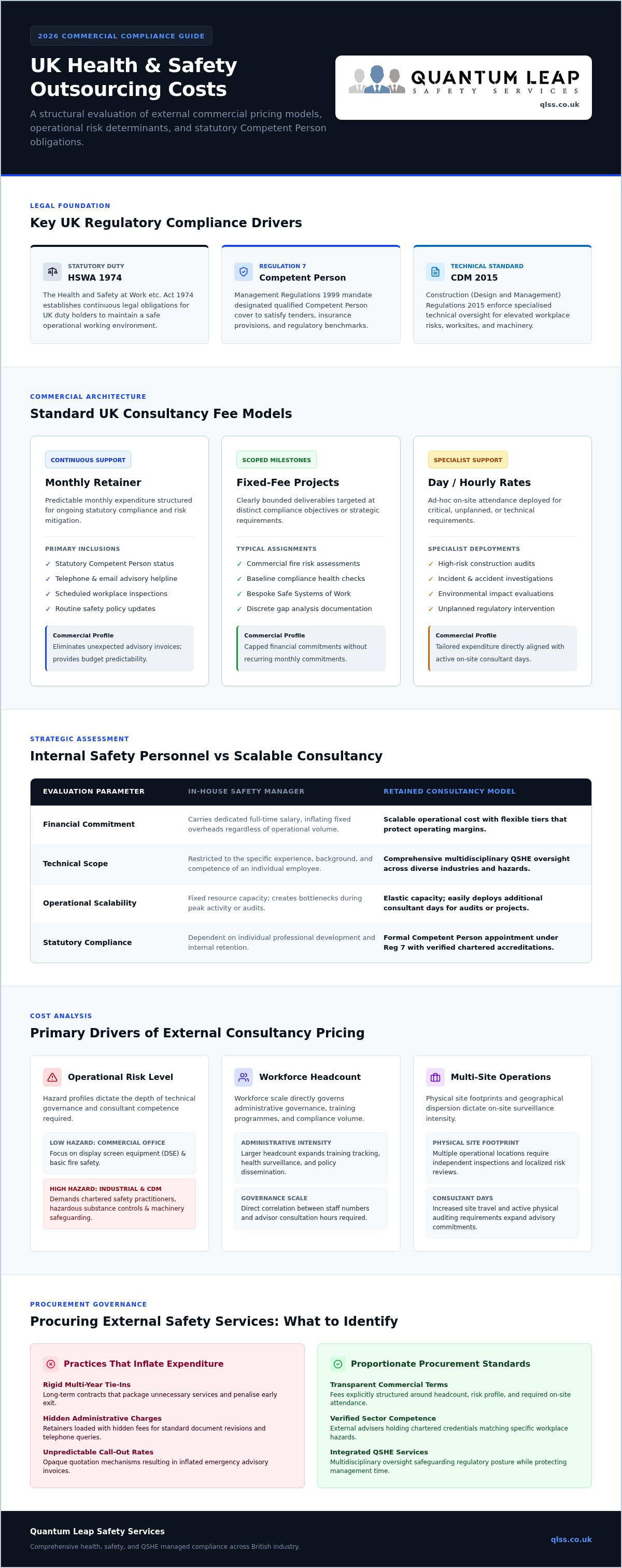
Commercial safety pricing in the United Kingdom rarely follows a single standard model. Many national corporate providers hide their pricing mechanisms behind opaque quotation forms, often locking growing companies into rigid, multi-year subscription contracts that package unnecessary services. In contrast, transparent consultancies structure their commercial terms around three core elements: workforce headcount, operational risk profile, and required on-site attendance.
Under the Health and Safety at Work etc. Act 1974, duty holders carry an ongoing legal obligation to maintain a safe working environment. UK consultancies generally deliver this compliance through three distinct engagement models:
Monthly Retainer Packages: Continuous competent person cover, scheduled audits, and direct access to qualified advisory support.
Fixed-Fee Project Engagements: Scoped deliverables designed to resolve a specific compliance requirement or strategic milestone.
Standard Day or Hourly Rates: Ad-hoc specialist technical assistance, site surveillance, or unplanned regulatory support.
Understanding how these commercial mechanisms function allows directors to budget their outsourced health and safety services cost accurately without absorbing hidden contract administration charges.
Monthly Retainer Agreements: Scope and Value
Retainers represent the most practical commercial choice for organisations seeking predictable compliance expenditure. A structured monthly agreement formalises the statutory appointment of an external Competent Person under Regulation 7 of the Management of Health and Safety at Work Regulations 1999. Beyond naming rights for tenders and insurance documentation, competent retainers usually include routine policy updates, telephone and email helpline support, and scheduled workplace inspections. This arrangement prevents sudden, inflated advisory invoices when urgent compliance queries or operational challenges arise.
Project-Based Fees and Day Rates
When an organisation requires targeted technical intervention rather than routine guidance, fixed-fee deliverables offer clear financial boundaries. Defined projects work best for bounded assignments such as commercial fire risk assessments, baseline compliance audits, or bespoke safe systems of work. Day rates apply when an organisation needs dedicated on-site consultancy, such as high-risk construction audits, environmental impact evaluations, or incident investigations. Selecting the right pricing model ensures your outsourced health and safety services cost aligns directly with actual operational activity rather than passive contractual retainers.
Key Commercial Factors That Influence Health and Safety Outsourcing Costs
A standard rate card rarely reflects the operational realities across different UK businesses. Instead, your overall outsourced health and safety services cost is governed by tangible risk variables, physical operational scale, and technical complexity. Reputable consultancies evaluate the specific advisor time, specialist credentials, and governance frameworks required to maintain lawful compliance across your operations.
Workplace Hazard Profile and Industry Risk Levels
Low-risk commercial office spaces require straightforward display screen equipment assessments and basic fire safety precautions. Conversely, industrial processing, manufacturing, construction, and renewable projects demand intensive technical governance. These sectors require safe systems of work for hazardous substances, machinery safeguarding, and strict compliance with the Construction (Design and Management) Regulations 2015. As highlighted in official HSE guidance on using a health and safety consultant, duty holders must verify that external advisers hold sector-specific competence. Higher operational hazards necessitate chartered practitioners and deeper site surveillance, which increases the consultant days required.
Staff Numbers and Multi-Site Operational Demands
Workforce size directly dictates administrative intensity. Larger teams increase statutory training oversight, health surveillance tracking, and internal incident monitoring obligations. Operating across multiple properties compounds this requirement. When a business operates regional depots, distributed workshops, or multiple commercial facilities, safety advisers must factor in travel logistics, individual premises licensing, and site-specific risk assessments. Managing distributed workforces requires robust, standardised management systems to ensure compliance remains uniform across every operating location.
Scope of Integrated Management Services
Procuring health and safety advice in isolation addresses immediate statutory duties, but growing enterprises frequently require broader management oversight. Integrating health and safety alongside environmental management and quality frameworks (such as ISO 9001, ISO 14001, and ISO 45001) shifts the engagement from basic advisory checklists to structured operational governance. Consolidating these disciplines under professional QSHE managed services creates commercial efficiencies, streamlining multiple external audit programmes into a unified structure that eliminates duplicated administrative overheads.
In-House Safety Advisor vs Outsourced Consultancy: Assessing Commercial Value
Comparing internal recruitment with an external consultancy requires examining the true total cost of employment. Too many organisations look solely at advertised base salaries, ignoring the continuous baseline overheads that make an internal safety appointment financially rigid. Outsourcing converts a heavy, permanent payroll liability into a manageable, scalable operating expense that adjusts alongside business activity.
The True Cost of In-House Safety Employment
Recruiting an internal practitioner introduces substantial statutory and operational add-ons beyond basic pay. According to standard UK employment benchmarks, hiring an in-house Health and Safety Manager at a typical median salary of £46,321 to £48,000 carries an actual employer burden of 1.25 to 1.4 times the headline figure. Following changes effective from 6 April 2025, Employer Class 1 National Insurance sits at 15.0% on earnings above £5,000, adding £6,450 annually on a £48,000 salary alongside mandatory workplace pension contributions of at least 3%.
Beyond payroll taxes, maintaining an internal adviser introduces secondary overheads:
Upfront recruitment agency fees, which typically command 15% to 25% of first-year salary.
Annual professional development budgets, IOSH membership renewals, and mandatory refresher training.
Specialist software licences for risk management and digital accident logging.
Specialised monitoring hardware, such as air sampling monitors, sound level meters, and calibrated testing kit.
When balanced against these cumulative costs, an organisation's total outsourced health and safety services cost presents a far lighter financial footprint.
Operational Depth: Single Advisor vs Multidisciplinary Consultancy
Direct employment centralises all statutory compliance within one individual's personal knowledge base. While an internal practitioner may excel in everyday risk assessments, they rarely hold simultaneous chartered expertise in structural fire safety, high-voltage installations, occupational health, and formal ISO certifications. When that individual takes annual leave, calls in sick, or resigns, internal compliance stalls entirely.
Engaging a multidisciplinary consultancy solves this operational vulnerability. It fulfills Regulation 7 of the Management of Health and Safety at Work Regulations 1999 by providing continuous access to an entire team of qualified practitioners. Specialist advice across complex fire risk, workplace hygiene, or supply chain pre-qualification is delivered instantly under a unified agreement, ensuring steady business continuity during peak workloads or sudden regulatory visits.
How to Choose and Procure an Outsourced Health and Safety Partner
Selecting an external health and safety provider involves far more than comparing quotation bottom lines. An inadequate provider leaves your organisation exposed to statutory breach, civil liability, and enforcement action. Commercial leaders must examine technical credentials, operational depth, and contract structures to ensure their outsourced health and safety services cost delivers measurable compliance rather than generic paperwork.
Evaluating Technical Competence and Professional Accreditations
Statutory competence demands verified expertise. When reviewing potential partners, ensure lead consultants hold Chartered membership of the Institution of Occupational Safety and Health (CMIOSH) or equivalent registration on the Occupational Safety and Health Consultants Register (OSHCR). Sector familiarity is equally vital. Consultancies handling high-risk environments, such as renewables, civil engineering, or heavy fabrication, must demonstrate proven track records under CDM regulations and environmental management frameworks. Request sample audit reports, inspection templates, and bespoke risk assessments during procurement to confirm their output provides operational depth rather than basic off-the-shelf templates.
Scrutinising Service Level Agreements and Contract Terms
Contractual transparency separates dependable partners from aggressive sales operations. Many mainstream vendors lock businesses into three-to-five-year agreements featuring automatic renewal clauses and restrictive cancellation penalties. Avoid these arrangements in favour of transparent agreements that scale alongside your operational footprint.
Before signing any commercial agreement, interrogate the service level agreement across four critical areas:
Site Attendance Frequency: Establish exact physical inspection allocations rather than relying solely on remote telephone access.
Regulatory Support: Clarify whether the consultancy assists with formal HSE correspondence or Fee for Intervention (FFI) queries without charging separate day rates.
Scope of Documentation: Verify that bespoke method statements, risk assessments, and fire reviews are included rather than billed as ad-hoc deliverables.
Contract Flexibility: Ensure break clauses exist if your headcount shifts or operational requirements change.
A compliant partnership should protect your margins whilst reinforcing your internal safety standards. To build a transparent, scalable safety framework that aligns with your specific risk profile, explore our bespoke Safety Packages & Accreditations.
Securing Tailored QSHE Compliance with Quantum Leap Safety Services
Meeting statutory duties should never force a company into paying for unnecessary consultancy hours or rigid multi-year agreements. Quantum Leap Safety Services delivers transparent, proportional managed services to duty holders across the United Kingdom. By designing agreements around genuine operational needs, organisations keep their outsourced health and safety services cost fully aligned with their risk profile and commercial budget.
Tailored Retainers and Managed Compliance Solutions
Every operational environment presents unique compliance demands. Rather than forcing clients into off-the-shelf bundles, bespoke retainers adapt directly to your physical sites, workforce scale, and industrial hazards. Backed by over a decade of national consultancy experience across SME, renewable energy, and high-risk construction sectors, our multidisciplinary team provides comprehensive support spanning health, safety, environmental, and fire regulations.
Through our integrated QSHE Managed Services, clients secure designated Competent Person representation alongside structured policies, risk assessments, and practical on-site audits. Integrating fire safety management and ISO management systems under a single, unified partnership eliminates fragmented advice from separate vendors. You gain cohesive governance, direct access to experienced advisors, and predictable operational expenditure without restrictive lock-in clauses.
Taking the Next Step Towards Proportional Compliance
Establishing effective health and safety governance begins with an objective assessment of your operational baseline. A structured audit and inspection review examines your existing documentation, physical site standards, and administrative procedures, pinpointing technical gaps before they prompt regulatory intervention or operational disruption.
Proactive compliance management actively protects your balance sheet. Implementing structured safe systems of work and systematic training records mitigates the threat of costly enforcement notices, improves insurer confidence, and reinforces a reliable workplace culture. This systematic approach allows commercial leaders to control their outsourced health and safety services cost whilst maintaining robust statutory protection. Contact Quantum Leap Safety Services to review your compliance obligations with qualified practitioners and establish dependable safety support built for your organisation.
Securing Proportional Compliance for Your Business
Managing operational risk requires looking past rigid multi-year contracts and the heavy overheads of direct employment. Achieving robust workplace protection shouldn't demand excessive administration or inflated advisory packages. A well-structured partnership keeps compliance practical, targeted, and fully transparent. By evaluating how operational hazards, workforce scale, and multidisciplinary governance shape your outsourced health and safety services cost, you can procure specialist support that strengthens your baseline standards without stretching working capital.
Quantum Leap Safety Services delivers comprehensive competent person support across multidisciplinary UK regulatory frameworks. Backed by a proven track record supporting SMEs through to complex construction and renewable energy projects, our advisors focus on practical solutions rather than generic paperwork. You gain direct access to qualified practitioners who understand real-world commercial realities. Discuss your bespoke compliance requirements with Quantum Leap Safety Services to establish a clear, scalable safety partnership that safeguards your workforce and supports long-term commercial stability.
Frequently Asked Questions
How is the cost of outsourced health and safety services calculated in the UK?
Outsourced safety fees are determined primarily by your operational hazard level, total staff count, and the frequency of physical site visits. Consultancies assess whether your premises involve straightforward administrative spaces or high-hazard industrial environments requiring technical risk profiling. Headcount establishes statutory reporting and training administration volume, while geographic distribution across multiple operational bases dictates travel time and on-site audit frequency. These combined parameters form the baseline commercial proposal.
Is an outsourced health and safety retainer cheaper than hiring an internal advisor?
Yes, retained consultancy support is almost always significantly more cost-effective than an internal hire for small to medium enterprises. Employing a dedicated practitioner commits a business to permanent payroll obligations, Employer National Insurance, pension contributions, and continuous professional development expenses. In contrast, your total outsourced health and safety services cost scales directly with your operational requirements, converting heavy, fixed annual employment overheads into an agile, highly controllable operating expense.
What services are typically included in a monthly health and safety retainer fee?
A standard monthly retainer provides the legal appointment of an external Competent Person alongside proactive compliance management. Core inclusions generally encompass the drafting and annual review of your health and safety policy, direct telephone and email advisory access, scheduled workplace safety inspections, and initial risk assessment templates. Many comprehensive retainers also extend support to supply chain pre-qualification vetting, such as SSIP schemes, ensuring your operational credentials remain audit-ready.
Can outsourcing satisfy our legal duty to appoint a competent person?
Yes, appointing a reputable consultancy fully satisfies Regulation 7 of the Management of Health and Safety at Work Regulations 1999. UK legislation explicitly permits employers to appoint external assistance if internal personnel lack the necessary knowledge, training, and practical experience. Retaining a qualified consultancy provides formal entitlement to name their accredited specialists as your Competent Person on insurance policies, tender questionnaires, and statutory HSE correspondence.
Are there hidden costs or extra charges associated with outsourced safety services?
Hidden fees typically stem from restrictive contracts with ambiguous service boundaries. Some commercial consultancies exclude on-site accident investigations, major policy rewrites, or formal responses to Health and Safety Executive interventions from baseline retainers, billing them at premium ad-hoc rates. Always verify whether travel expenses, specialist risk assessments, and document amendments fall within the core retainer or incur separate charges before entering an agreement.
Do higher-risk industries pay higher health and safety consultancy fees?
Yes, operations with elevated risk profiles require greater consultant time and more specialised technical qualifications. Managing high-hazard activities like construction, renewable energy installations, manufacturing, or hazardous substance processing involves rigorous safe systems of work and intricate statutory frameworks. Because these environments demand experienced Chartered consultants and frequent on-site compliance surveillance, the overall outsourced health and safety services cost reflects this higher level of technical involvement.
Can our business cancel or amend an outsourced safety retainer as we grow?
Agreements vary considerably depending on the provider you choose. Traditional corporate consultancies often bind clients into rigid, auto-renewing contracts spanning three to five years with punitive termination penalties. Progressive, independent providers offer flexible agreements that adapt smoothly to organisational changes. Transparent retainers allow you to scale service tiers upwards as your workforce expands or adjust deliverables downward without facing administrative lock-ins.


Comments