
ISO Management System Maintenance: Guide for UK SMEs (2026)
What if the most expensive part of your ISO certification isn't the initial setup, but the cost of a failed surveillance audit? With UKAS-accredited auditor day rates rising by approximately 20% in 2026, the financial and operational stakes of losing your accreditation have never been higher. Most SME directors feel the weight of administrative overload, often struggling to keep pace with the Data (Use and Access) Act 2026 whilst managing daily operations. It's common to worry that your management system is a ticking clock rather than a business asset.
Effective ISO management system maintenance doesn't have to disrupt your core workflow. We understand the pressure of balancing technical compliance with commercial growth. This guide provides a clear, manageable framework to master the essential recurring tasks required to protect your certification and drive continuous operational improvement. We'll outline a structured schedule of internal audits, management reviews, and legislative updates, ensuring your business stays ahead of the new ISO 9001:2026 and ISO 14001:2026 requirements. By the end of this article, you'll have a pragmatic roadmap to maintain total compliance with minimal friction.
Table of Contents
Beyond the Badge: Why ISO Management System Maintenance is Critical
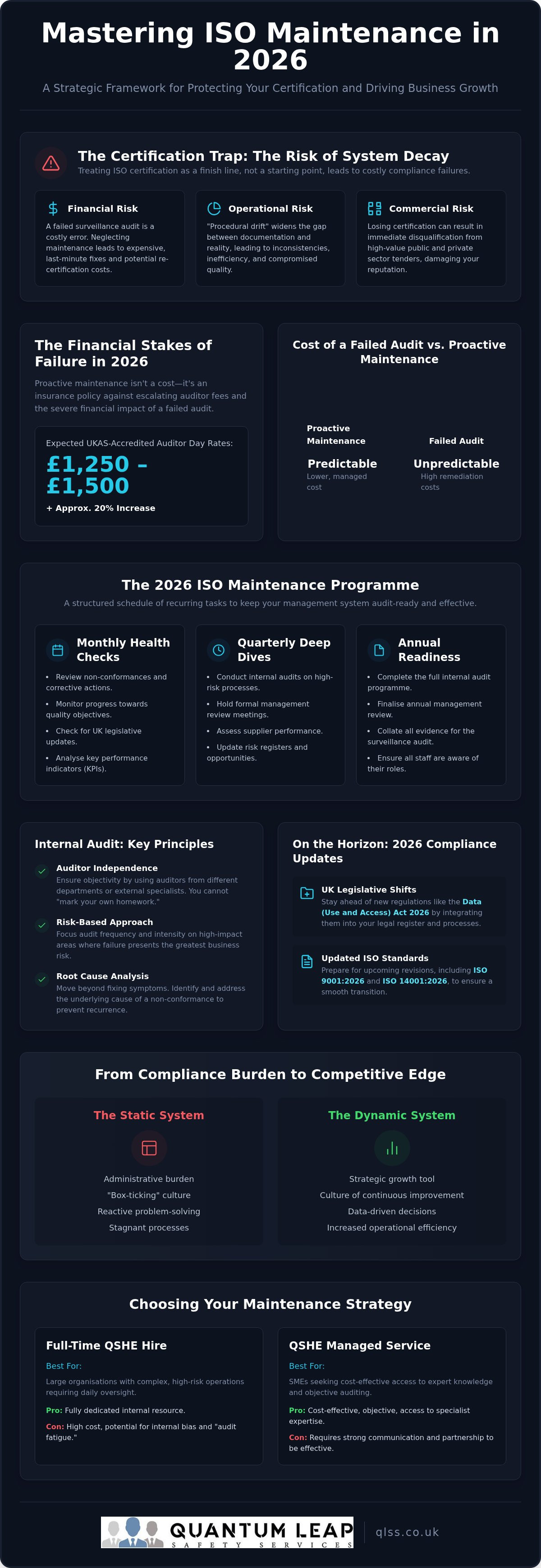
Many UK SMEs fall into the "Certification Trap." This occurs when an organisation treats the initial audit as a finish line rather than a starting point. Once the certificate is on the wall, attention often shifts elsewhere, leading to a slow decay of the very processes that earned the accreditation. Effective ISO management system maintenance ensures that your investment continues to yield returns long after the auditor has left. If you view ISO as a static trophy, you risk the system becoming a hollow administrative burden rather than a functional business tool.
A robust management system is a live framework designed to evolve with your business. When maintenance is neglected, the gap between what your documentation says and what your staff actually do begins to widen. This leads to "procedural drift," where shortcuts become the norm and safety or quality standards slip. For businesses operating in the UK, maintaining certification is often a non-negotiable requirement for high-value tenders. Losing your status doesn't just mean a failed audit; it can result in the immediate disqualification from lucrative public and private sector contracts. Protecting your ROI means recognising that the cost of consistent upkeep is significantly lower than the cost of emergency re-certification.
The Risk of System Decay
System decay isn't always obvious. It usually manifests as outdated legislation in your legal register or internal audits that haven't been conducted for months. These lapses create significant business risks. If a surveillance audit reveals major non-conformances, the cost of remediation often far exceeds the price of consistent upkeep. With UKAS-accredited auditor day rates reaching between £1,250 and £1,500 in 2026, failed audits are an expensive mistake that can damage your professional reputation amongst clients and partners. A decaying system isn't just a compliance risk; it's a threat to your operational stability.
Continuous Improvement as a Competitive Edge
Moving beyond a "box-ticking" exercise allows you to use your ISO framework for strategic growth. Consistent ISO management system maintenance provides a wealth of data that can inform better decision-making. By reviewing non-conformances and performance metrics regularly, you can identify patterns of waste and operational bottlenecks. This proactive approach transforms the system from an administrative weight into a tool for efficiency. Instead of rushing to fix problems before an annual visit, you create a culture of continuous improvement that aligns your compliance obligations directly with your overall business objectives. This steady, methodical approach makes your business a "safe pair of hands" for all stakeholders.
The Internal Audit Programme: Validating Your Processes
Internal auditing is the primary mechanism for validating that your processes are functioning as intended. It's a cornerstone of ISO management system maintenance, providing the evidence needed to satisfy external assessors during surveillance visits. Referencing resources like ISO 9001:2015 - A guidance document helps ensure your audit methodology aligns with international expectations. Without this validation, your management system is merely a collection of documents rather than a reflection of operational reality.
One of the most common hurdles for UK SMEs is auditor independence. You cannot "mark your own homework." If the person responsible for production is also auditing the production line, the results lack the necessary objectivity. This often requires training staff from different departments to audit each other or bringing in external specialists to maintain a clear perspective. When recording results, you must distinguish between observations and non-conformances. An observation highlights a potential area for improvement, whilst a non-conformance identifies a specific failure to meet a standard's requirement. Closing the loop is essential; every finding must lead to a documented corrective action that addresses the root cause to prevent recurrence.
Designing Your Annual Audit Schedule
A risk-based approach is the most efficient way to manage your schedule. Rather than auditing every process with the same frequency, focus on high-impact areas where failure presents the greatest risk to your business or your clients. Spreading these sessions across the calendar year prevents "audit fatigue" and ensures that compliance remains a steady, year-round priority rather than a panicked scramble before the external auditor arrives. An internal audit serves as a vital health check to ensure your business processes remain effective and compliant.
Conducting Effective Audits in an SME Environment
In a small team, audits can feel like an interrogation if not handled correctly. Focus on the process, not the person, and use open questions to gather genuine evidence of how tasks are performed. Many businesses find that using internal ISO audit services provides the necessary distance and expertise to uncover real improvements. Moving beyond simple "yes/no" checklists toward evidence-based reporting ensures your findings are robust and actionable. If you need a safe pair of hands to manage this process, professional support can ensure your system remains audit-ready without draining your internal resources.
The 2026 ISO Maintenance Checklist: Scheduled vs Periodic Tasks
Successful ISO management system maintenance relies on a disciplined calendar of activities. Rather than treating compliance as a once-a-year event, SMEs should adopt a tiered approach that separates daily operational requirements from high-level strategic reviews. This steady rhythm prevents the system from becoming a burden and ensures that your data remains accurate and actionable. A well-organised checklist serves as your primary defence against the procedural drift discussed earlier, keeping your business audit-ready at all times.
Outside of scheduled tasks, certain ad-hoc triggers require immediate system updates. These include significant changes to your business structure, the introduction of new equipment, or shifts in UK law. For example, the commencement of the Data (Use and Access) Act 2025 on 19 June 2026 introduced mandatory procedures for handling data protection complaints. Such legislative changes must be reflected in your system immediately rather than waiting for the next quarterly review. Maintaining this level of responsiveness ensures your management system remains a reliable reflection of your current operating environment.
The Monthly and Quarterly Rhythm
Monthly tasks should focus on the "pulse" of the business. This includes reviewing incident logs, near-miss reports, and key performance indicators (KPIs). At a quarterly level, the focus shifts to document control and training. You must ensure that all staff are working from the latest versions of procedures and that any new hires have completed their required inductions. For those managing quality standards, revisiting the fundamentals of what is ISO 9001 can help ensure your quarterly checks align with core quality requirements. These deep-dives are essential for identifying trends before they become non-conformances.
The Annual Management Review
The Management Review is a mandatory requirement of the ISO standards and must involve senior leadership. It is not merely a summary of the year; it's a strategic session to set new objectives and targets. You must compile specific inputs, including audit results, customer feedback, and the performance of external providers. The output of this meeting must be a clear, documented action plan that outlines resource requirements and identifies opportunities for improvement. This ensures that ISO management system maintenance remains a priority at the highest level of the company, linking compliance directly to your commercial strategy for the following year.
Managing Non-Conformances and Legislative Updates
The "Update" phase of the maintenance cycle is where many SMEs struggle. Identifying a problem is only half the battle; the real value lies in how your business responds to failures and shifts in the external environment. Managing non-conformances is a critical pillar of ISO management system maintenance, as it demonstrates to auditors that your organisation is capable of self-correction and growth. In the 2026 regulatory landscape, this also requires a heightened sensitivity to UK-specific legislative changes that may impact your operational protocols.
When a process fails, the immediate priority is often a quick fix. However, ISO standards require you to look deeper. If you only address the surface level, the same issue will inevitably return, often at a higher cost. Integrating these fixes with broader strategic updates, such as those found in ISO 14001 implementation UK, ensures that your environmental and quality obligations are met simultaneously. Communicating these changes to your workforce is equally vital. Without clear internal briefings, even the most robust procedural updates will fail to take root in daily operations.
Mastering Root Cause Analysis
Root Cause Analysis (RCA) is the process of discovering why a problem occurred in order to prevent it from happening again. A common tool for this is the "5 Whys" technique, where you peel back layers of causality by asking "why" until the fundamental source is revealed. It is essential to distinguish between a correction, which is fixing the immediate symptom, and a corrective action, which addresses the underlying cause. For example, mopping up a spill is a correction; repairing the leaking valve that caused it is a corrective action. Documenting this thought process provides the objective evidence external auditors look for during surveillance visits.
Staying Legally Compliant in the UK
Maintaining a Legal Register is a mandatory requirement that often becomes outdated in busy SME environments. In 2026, UK businesses must account for specific post-Brexit regulatory shifts, such as the Data (Use and Access) Act 2025, which introduced new mandatory procedures for handling data protection complaints as of 19 June 2026. Additionally, the Cyber Security and Resilience Bill is expanding obligations for managed service providers and data centres. A Legal Register must be a live document, reviewed at least bi-annually to remain accurate. Knowing the law exists is not enough; you must document exactly how your business complies with each relevant statute. If you find the pace of legislative change overwhelming, our Business Total Compliance Solutions can provide the expert oversight needed to keep your registers current and your business protected.
The Managed Service Advantage: Outsourcing Your ISO Maintenance
Many SMEs reach a stage where internal ISO management system maintenance becomes a secondary priority, pushed aside by the demands of daily business operations. Hiring a full-time Quality or Compliance Manager is often a significant financial commitment that doesn't align with the resource constraints of a growing enterprise. This is where the cost-benefit analysis of outsourcing becomes clear. By utilising a QSHE Managed Service Retainer, you gain access to a team of experts for a fraction of the cost of a permanent hire. This approach ensures your system remains audit-ready without the overhead of a dedicated internal department.
A major advantage of external support is the elimination of silos. While many guides treat ISO 9001, 14001, and 45001 as separate entities, a sophisticated Business Total Compliance Solution integrates these standards into a single, cohesive framework. This integrated approach reduces duplication, simplifies documentation, and ensures that your quality, environmental, and safety objectives work in harmony. External consultants bring "best practice" insights from across various industries, allowing your business to benefit from proven methodologies and the latest regulatory interpretations without the trial and error of an in-house team.
Is Your Business Ready to Outsource?
The "tipping point" for outsourcing often arrives when the administrative burden of documentation begins to impact operational efficiency. If you find your senior team spending more time on audit preparation than on business strategy, it's time to reconsider your approach. Outsourcing also mitigates the risk of "key person dependency." If your only ISO-trained employee leaves, your compliance status could be at risk. A managed service provides a "safe pair of hands" that remains constant, offering the legal requirement of a competent person for safety advice whilst ensuring your system never decays.
Partnering with Quantum Leap Safety Services
Quantum Leap Safety Services offers a methodical and disciplined approach to QSHE management. We understand that SMEs need straightforward, dependable support that fits their specific scale. Our team handles the heavy lifting of internal audits, legal register updates, and management reviews, allowing you to focus on your commercial goals. We act as your dedicated compliance partner, navigating the complexities of UK legislation so you don't have to. If you're ready to secure your certification and improve your business efficiency, enquire about our ISO Managed Service Retainers today to see how we can support your long-term stability.
Future-Proofing Your Compliance Strategy for 2026 and Beyond
Sustaining a high-standard management system requires more than just an annual check-up. We have explored how a disciplined approach to internal audits and legislative monitoring protects your initial investment from the risks of procedural drift. By treating ISO management system maintenance as a strategic business tool rather than an administrative burden, you ensure your organisation remains competitive in the UK tender market whilst driving genuine operational efficiency. This proactive cycle of "Audit, Review, and Update" is what separates thriving enterprises from those merely "badge-hunting."
Transitioning to a managed service offers a cost-effective alternative to a full-time internal hire. Quantum Leap Safety Services provides professional QSHE consultants with UK-wide experience, offering specialist support for high-risk sectors including construction and renewables. Our fixed-price project fees and transparent retainer structures provide the financial predictability SMEs need to grow with confidence. Secure your ISO certification with our Managed Service Retainers and turn your compliance obligations into a platform for long-term stability. You can move forward with the reassurance that your business remains in a safe pair of hands.
Frequently Asked Questions
How often do I need to conduct internal audits for ISO maintenance?
You should conduct internal audits based on the risk and importance of each process, but every part of your system must be audited at least once per year. High-impact areas often require quarterly reviews to ensure operational stability. This frequency is a core part of effective ISO management system maintenance. Distributing these audits across the calendar year prevents administrative bottlenecks and ensures that your compliance remains a steady reality rather than a pre-audit scramble.
What happens if we fail an ISO surveillance audit?
Failing a surveillance audit usually results in a non-conformance being issued by the auditor. A minor non-conformance requires a plan for correction within a set timeframe, whilst a major non-conformance could lead to the suspension of your certificate if not addressed immediately. You won't lose your accreditation instantly; the certification body provides a window to demonstrate that you've implemented effective corrective actions. Consistent maintenance is the best way to avoid these high-pressure remediation periods.
Can one person manage ISO 9001, 14001, and 45001 simultaneously?
One person can manage multiple standards, especially if you use an integrated QSHE management system to reduce documentation duplication. However, for many SMEs, this often leads to key person dependency and administrative burnout. It's often more efficient to use a managed service retainer to support an internal lead. This provides access to specialist expertise across quality, environment, and safety standards without the cost of hiring multiple full-time managers for each individual discipline.
Is a Management Review the same as a board meeting?
A Management Review is a specific requirement of the ISO standards and differs from a standard board meeting in its required inputs and outputs. Whilst it can be held as part of a board meeting, it must specifically address audit results, customer feedback, and process performance. You must document the minutes to prove to external auditors that senior leadership is actively reviewing the system's effectiveness and setting new objectives for continuous operational improvement.
How do we keep our Legal Register up to date in the UK?
You should monitor official sources such as the Health and Safety Executive (HSE), Environment Agency, and GOV.UK for legislative updates. A Legal Register must be a live document, reviewed at least bi-annually to account for new regulations like the Data (Use and Access) Act 2026. Many SMEs find that outsourcing this task to professional consultants ensures they never miss a critical update, which is a vital component of long-term ISO management system maintenance.
What is the difference between a minor and a major non-conformance?
A minor non-conformance is an isolated lapse or a small failure in a process that doesn't threaten the integrity of the entire management system. In contrast, a major non-conformance represents a total breakdown of a process or a significant failure to meet a requirement of the standard. Major findings require immediate attention to prevent the suspension of your certification, whereas minor findings allow for a structured corrective action plan to be implemented over a set period.
Do we need to update our ISO documentation every time a process changes?
You must update your documentation whenever a change affects the quality, safety, or environmental impact of your operations. Minor tweaks might only require a revision note, but significant shifts in how you work must be reflected in your formal procedures to ensure staff are following the current best practice. Keeping documentation aligned with reality prevents procedural drift, a common issue that auditors look for during their annual inspections and surveillance visits.
How much does ISO management system maintenance cost for an SME?
The cost of maintenance depends on your business size and the complexity of your operations. You should consider the time investment for internal staff versus the fixed-price transparency of an outsourced retainer. Other factors include the fees charged by UKAS-accredited certification bodies for surveillance audits. Investing in consistent upkeep is typically more cost-effective than the emergency remediation required to fix a failed system. Professional support ensures your budget is used efficiently to maintain total compliance.


Comments