
2026 Health and Safety Audit for Renewable Projects
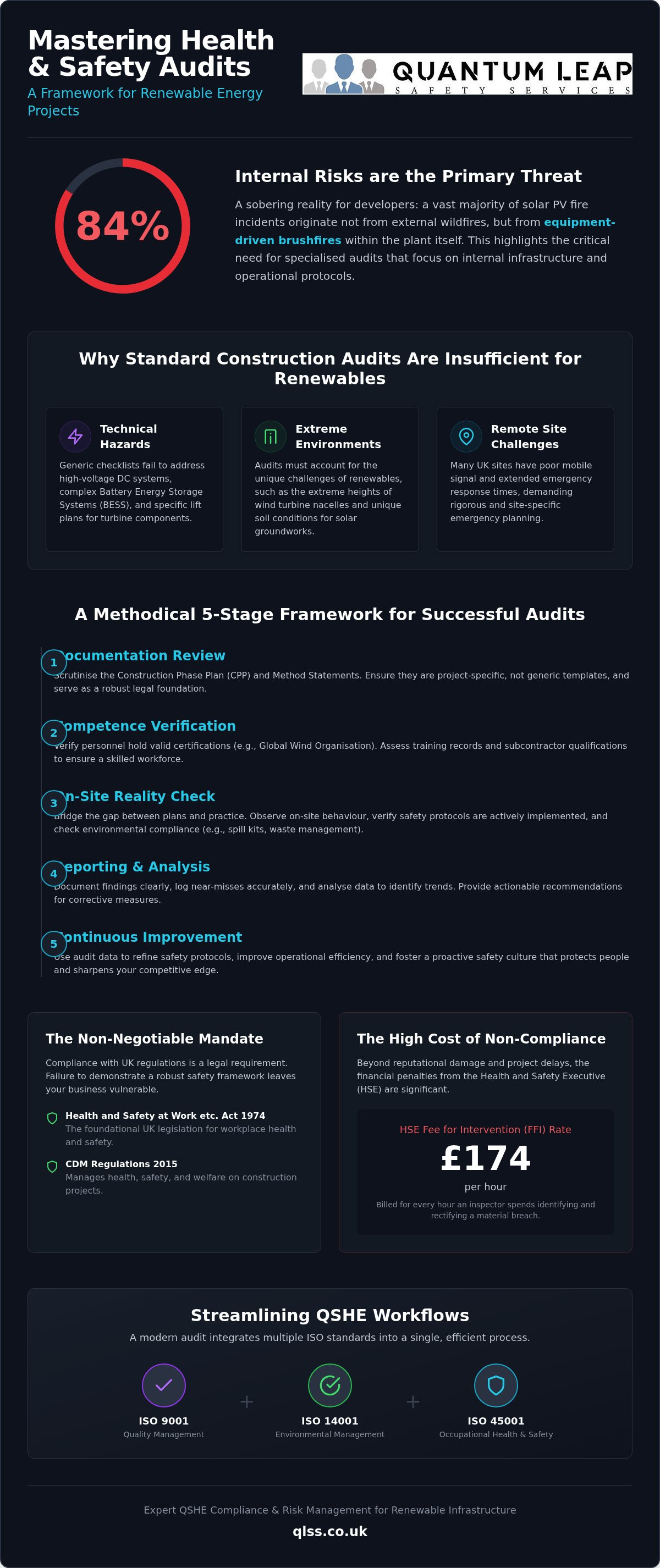
Did you know that 84% of solar PV fire events are caused by equipment-driven brushfires rather than external wildfires? This statistic highlights a sobering reality for developers; the most significant risks to your infrastructure often originate from within the plant itself. You're likely already aware that a robust health and safety audit for renewable projects is more than a simple administrative exercise. It's a critical tool to prevent HSE intervention and avoid the costly project delays that stem from non-compliance on remote, high-risk sites.
It's common to feel overwhelmed by the intricacies of CDM 2015 or the pressure of the January 2026 deadline for updated chemical Safety Data Sheets. This guide offers a pragmatic, expert-led framework to help you master QSHE compliance and risk management with confidence. We'll provide a clear roadmap for reducing incident rates and show you how to integrate ISO standards into your workflows without disrupting operational efficiency. By the end, you'll have the tools to transform safety from a source of stress into a streamlined, dependable process that protects both your people and your reputation.
Table of Contents
The Vital Role of a Health and Safety Audit for Renewable Projects
A health and safety audit for renewable projects is a systematic evaluation designed to scrutinise site-specific risks and management systems. It's a proactive deep dive into the practical application of your safety protocols. Unlike standard construction inspections, these audits must account for the unique volatility of energy infrastructure. A generic checklist won't suffice when your team is dealing with high-voltage DC arrays, complex battery energy storage systems (BESS), or the extreme heights of wind turbine nacelles. These environments demand a specialised approach that understands the physics of the site as well as the paperwork.
Compliance is a non-negotiable legal mandate under the Health and Safety at Work etc. Act 1974 and the Construction (Design and Management) Regulations 2015 (CDM 2015). Failure to demonstrate a robust safety framework leaves your business vulnerable to the Health and Safety Executive (HSE). Beyond potential prosecution, the financial impact of a "Fee for Intervention" (FFI) can be substantial. The HSE recovers its costs at a rate of £174 per hour for every hour an inspector spends identifying and helping you rectify a material breach. This isn't just about the invoice; it's about the reputational damage that can disqualify you from future tenders.
Beyond Compliance: The Business Case for Auditing
Regular audits do more than satisfy regulators; they protect your bottom line. By identifying hazards before they result in incidents, you significantly reduce project downtime and can often negotiate lower insurance premiums. For SMEs, establishing a "safety-first" culture is a prerequisite for winning contracts with tier-1 developers and securing investor confidence. Investors look for reliability, and a clean audit history proves you're a safe pair of hands. Using audit data allows for continuous improvement, turning safety observations into operational efficiencies that sharpen your competitive edge in a crowded market.
The Remote Site Challenge in the UK
Auditing isolated wind or solar farms presents unique logistical hurdles that general construction firms often overlook. Many UK sites suffer from poor mobile signal and extended ambulance wait times, making detailed emergency response planning a life-or-death priority. Whilst the UK regulatory landscape is governed by the HSE, global safety benchmarks often draw from the foundational principles of the Occupational Safety and Health Administration (OSHA). A successful health and safety audit for renewable projects ensures that every subcontractor's behaviour aligns with the primary contractor’s standards, regardless of how remote the location is. This oversight is vital for maintaining a consistent safety culture across fragmented project teams, ensuring that "out of sight" never means "out of mind" for safety compliance.
Core Components of a Comprehensive Renewable Safety Audit
A comprehensive health and safety audit for renewable projects must bridge the gap between office-based planning and site-level execution. It starts with a rigorous documentation review. We examine the Construction Phase Plan (CPP) and task-specific Method Statements to ensure they aren't just generic templates. These documents must reflect the specific hazards of the project, such as the unique soil conditions for solar groundworks or the specific lift plans for turbine components. Accurate documentation serves as the legal foundation for all on-site activity.
Competence verification is equally vital. Personnel working on these complex sites must hold valid Global Wind Organisation (GWO) or equivalent certifications. Starting 16 March 2026, the introduction of the Employer Prevention Passport provides a new centralised way for employers to report and verify this safety training. We also assess environmental compliance, checking that spill kits are accessible and waste management protocols protect local habitats. This holistic view is characteristic of modern clean energy safety programs that prioritise both workforce welfare and ecological protection.
Reviewing Management Systems and Policies
Effective audits align project-specific actions with broader ISO 45001 and ISO 14001 frameworks. We evaluate how well safety information flows through the organisation. Are toolbox talks engaging, or have they become a tick-box exercise? We also scrutinise the accuracy of incident reporting and near-miss logging. High-quality data in these areas is the best predictor of future incident prevention, allowing for proactive adjustments before a minor oversight becomes a major safety breach. To ensure your project meets these rigorous standards, consider our professional Audit & Inspection Services to identify potential gaps before they become liabilities.
On-Site Verification and Physical Controls
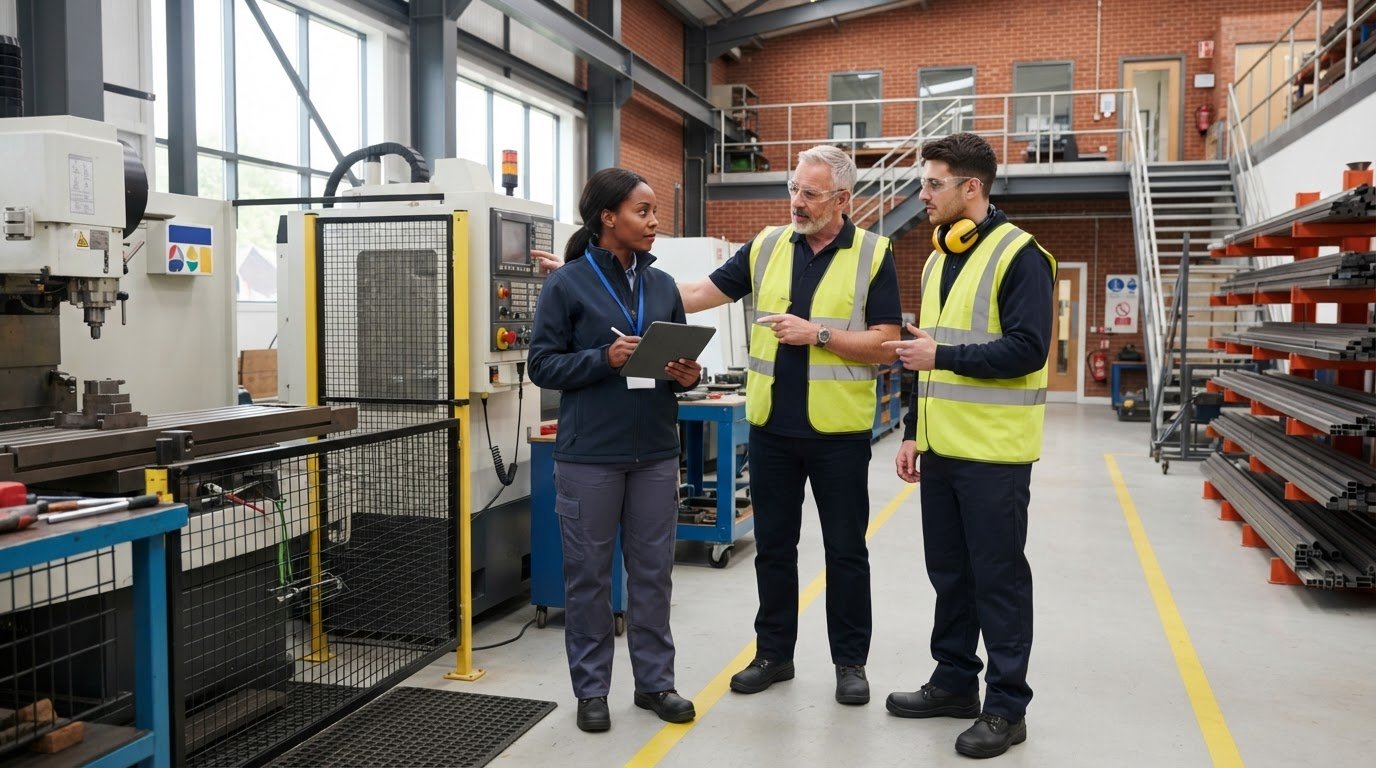
Theoretical risk assessments mean nothing if physical controls fail on the ground. We inspect plant and machinery, focusing heavily on high-voltage switchgear and lifting equipment. Exclusion zones must be clearly defined and strictly enforced, especially on sites with public rights of way or adjacent agricultural land. We also check that Personal Protective Equipment (PPE) is not only available but suitable for the UK's unpredictable and often extreme weather conditions. This includes verifying that fall arrest systems and arc-flash clothing are in good condition and correctly utilised by all site personnel, including subcontractors.
Navigating Technology-Specific Risks: Wind, Solar, and Battery
A generic audit framework often ignores the operational nuances of different energy assets. A robust health and safety audit for renewable projects should instead be built around the "High-Five" hazards: Electricity, Working at Height, Lifting Operations, Remote Working, and Transport. These hazards shift in intensity as a project moves from initial groundworks through commissioning and into long-term operations and maintenance (O&M). Transitioning from a construction site to a live operational power station is a high-risk period that requires specific audit oversight to ensure safety protocols remain effective as the site's status changes.
Wind Energy: Working at Height and Lifting
Wind assets present extreme challenges for working at height. Auditing must verify the integrity of internal safety systems, including ladders, fall arrest tracks, and service lifts within the tower. Complex tandem lifting operations during nacelle and blade installation are high-stakes events that require meticulous verification of lift plans and equipment certification. Lightning protection protocols are also critical. Data from 2025 showed a 32% increase in wind turbines being hit by four or more lightning strokes, which means auditors must ensure weather-dependent work permits and strike-detection systems are fully operational.
Solar PV: Electrical Hazards and Manual Handling
In solar PV, the primary risk is the "always-on" nature of DC strings. Unlike traditional electrical systems, solar arrays can't be simply switched off during daylight hours, creating a persistent risk of arc flash. Audits must focus on DC safety and rigorous cable management to prevent trip hazards and long-term fire risks. It's also vital to manage ergonomic risks. The repetitive manual handling involved in installing thousands of panels can lead to musculoskeletal injuries if the installation process isn't properly audited. Since 84% of solar fire events are caused by equipment-driven brushfires, electrical integrity remains a top priority for any site inspection.
Battery Energy Storage Systems (BESS): Fire and Chemical Risks
Battery storage requires a specialised audit focus on thermal runaway and the efficacy of fire suppression systems. Whilst failure rates for BESS dropped by 97% between 2018 and 2023, the chemical risks associated with battery electrolytes and hazardous material handling remain significant. Auditors must verify that site teams have received specialised training for BESS-specific emergencies. This ensures that the response to a potential fire or chemical leak is methodical and effective, protecting both the personnel and the surrounding environment from the unique hazards of lithium-ion technology.
The 5-Stage Process for a Successful Renewable Audit
A methodical health and safety audit for renewable projects follows a disciplined five-stage structure. This ensures the process provides a reliable snapshot of site safety rather than a superficial checklist. We don't believe in auditing for the sake of paperwork; we audit to ensure your people go home safely every day.
Stage 1: Scope Definition. We identify exactly which project areas, subcontractors, and specific UK regulations are under review. This prevents the audit from becoming too broad or losing focus on high-risk activities.
Stage 2: Information Gathering. This involves a pre-audit questionnaire and a deep-dive into the Construction Phase Plan (CPP) and Risk Assessments and Method Statements (RAMS).
Stage 3: The Site Visit. This is the physical verification stage. We gather objective evidence from both the infrastructure and the workforce to see how safety is managed in real-time.
Stage 4: Reporting and Analysis. Findings are categorised into Critical, Major, and Minor non-conformances. This helps management prioritise their response based on actual risk levels.
Stage 5: Action Planning. We create a pragmatic, timed roadmap to close out any identified gaps, ensuring the site returns to full compliance without unnecessary delay.
Gathering Objective Evidence on Remote Sites
Gathering evidence on remote wind or solar farms requires modern solutions. We use digital auditing tools to capture real-time photographic evidence with GPS tags. This provides an indisputable record of site conditions at the moment of inspection. We also conduct interviews with site personnel. This allows us to gauge the true safety climate and see if the official policy matches daily behaviour on the ground. In the context of a 2026 HSE inspection, objective evidence is defined as verifiable data, such as records, statements of fact, or physical observations, that prove a safety requirement is being consistently met.
From Findings to Action: Closing the Loop
Turning findings into action is where the real value lies. We prioritise corrective actions based on the "Hierarchy of Control," aiming to eliminate the most dangerous risks first. Every action is assigned a clear responsibility and a firm deadline. We don't just leave a list of problems; we help you plan the follow-up inspection to verify that changes have been effectively implemented. This methodical approach ensures that safety improvements are permanent and measurable. If you need a partner to lead this process, our Audit & Inspection Services provide the structure and expertise required for complex energy sites.
Strategic QSHE Support for Renewable Energy Infrastructure
Quantum Leap Safety Services (QLSS) acts as a "safe pair of hands" for developers and contractors. We understand that a health and safety audit for renewable projects isn't just a box-ticking exercise. It's about protecting your workforce whilst maintaining project momentum. By integrating ISO 9001, 14001, and 45001 into a single, streamlined audit process, we eliminate the redundancy of multiple inspections. This unified approach provides a holistic view of your project's compliance status. It ensures that environmental protection and quality control are managed with the same rigour as safety. This integration allows for a more efficient use of resources, as a single site visit can verify compliance across multiple management systems simultaneously.
Our Managed Service Retainer provides continuous competent advice throughout the entire project lifecycle. This model is particularly beneficial for SMEs that require high-level expertise without the cost of a full-time officer. We also offer bespoke safety packages designed to help smaller contractors achieve accreditations like CHAS or Alcumus SafeContractor. These accreditations are vital for entering the renewable supply chain, proving your business meets the high standards expected by tier-1 developers and investors. Having these safety packages in place demonstrates a commitment to stability and operational excellence.
Professional Consultancy for Project Success
Navigating modern energy regulations is a complex task. Our expert advisors leverage years of experience to help you manage these requirements effectively. This reduces the administrative burden on business owners, allowing you to focus on delivery. By outsourcing safety management, you ensure your business is "tender-ready" with a documented history of compliance. A strong audit record is often the differentiator during the procurement process. It shows potential clients that you're a stable, knowledgeable, and disciplined partner capable of managing high-risk environments.
The QLSS Approach: Pragmatic and Professional
Our approach is fundamentally pragmatic. We focus on common-sense solutions that support, rather than stifle, operational progress. Every health and safety audit for renewable projects is tailored to the specific size and scope of the asset, whether it's a wind farm, solar array, or battery storage facility. We act as a steady, methodical guide through the intricacies of corporate responsibility. This ensures your project remains safe, compliant, and on schedule, even when working on the most remote and challenging sites across the UK.
Securing the Future of Your Renewable Infrastructure
Managing a modern energy site requires a shift from reactive fixes to proactive, systematic oversight. By addressing technology-specific hazards like DC arc flash or turbine lifting operations, you protect both your team and your commercial investment. A methodical health and safety audit for renewable projects provides the objective evidence needed to satisfy the HSE whilst simultaneously streamlining your internal project workflows.
Integrating ISO 45001 and 14001 standards doesn't have to be an administrative burden. As implementation experts, we provide specialised renewable energy project support and pragmatic QSHE managed services tailored specifically for the resource constraints of SMEs. This ensures your business remains "tender-ready" and fully compliant with the latest 2026 regulatory updates. Our approach focuses on common-sense solutions that reinforce your reputation as a reliable partner in the green energy sector.
Secure your renewable project with a professional QLSS health and safety audit
With a robust framework and a dedicated partner by your side, you can focus on delivering clean energy with absolute confidence in the stability and resilience of your safety systems.
Frequently Asked Questions
Is a health and safety audit a legal requirement for renewable projects?
Yes, it's a legal necessity under the Management of Health and Safety at Work Regulations 1999 and CDM 2015. Employers must monitor and review their safety arrangements. A health and safety audit for renewable projects serves as a systematic way to fulfil this obligation. It proves that the management system is effective and that risks are being controlled in accordance with the Health and Safety at Work etc. Act 1974.
How often should a wind farm or solar site undergo a safety audit?
The frequency depends on the project's complexity and risk profile. Generally, an annual audit is the minimum benchmark for operational sites. However, during high-risk construction phases or when significant infrastructure changes occur, quarterly audits are more appropriate. This ensures that safety protocols keep pace with the shifting hazards of the site, such as nacelle installation or the commissioning of new battery storage arrays. Regular reviews prevent safety systems from becoming stagnant.
What is the difference between a safety inspection and a safety audit?
An inspection is a physical check of a workplace to identify immediate hazards like faulty equipment or blocked exits. It's a snapshot of a specific moment. A safety audit is a broader, more systematic evaluation of the entire management system. It examines policies, training records, and long-term trends to determine if the overall safety strategy is effective. Audits focus on the "why" behind safety performance, rather than just identifying what's broken.
Who is responsible for commissioning the health and safety audit under CDM 2015?
The Client has the primary responsibility for ensuring that health and safety arrangements are in place throughout the project. Whilst the Principal Contractor manages day-to-day site safety, the Client must verify that these arrangements are working. Commissioning an independent audit is a standard way for a Client to demonstrate they are fulfilling their legal duties. It provides an objective assessment of both the contractor's performance and the project's overall compliance with CDM 2015 regulations.
Can a health and safety audit help my SME win more renewable energy tenders?
Yes, maintaining a regular health and safety audit for renewable projects provides a significant competitive advantage. Tier-1 developers and investors look for partners who can demonstrate a disciplined approach to risk management. Including audit results in your tender documents proves that your business is stable, reliable, and capable of handling high-risk energy projects. It gives procurement teams the confidence that you won't cause delays or reputational damage through safety failures or HSE interventions.
What happens if a safety audit identifies a major non-conformance?
A major non-conformance requires immediate attention and a formal corrective action plan. It indicates a significant failure in the safety management system that could lead to an incident. The site manager must assign responsibility for fixing the issue and set a strict deadline for completion. A follow-up inspection is usually required to verify that the fix is effective. Addressing these gaps promptly prevents them from escalating into HSE "Fee for Intervention" scenarios or causing project-wide shutdowns.
Does a safety audit cover environmental compliance for renewable projects?
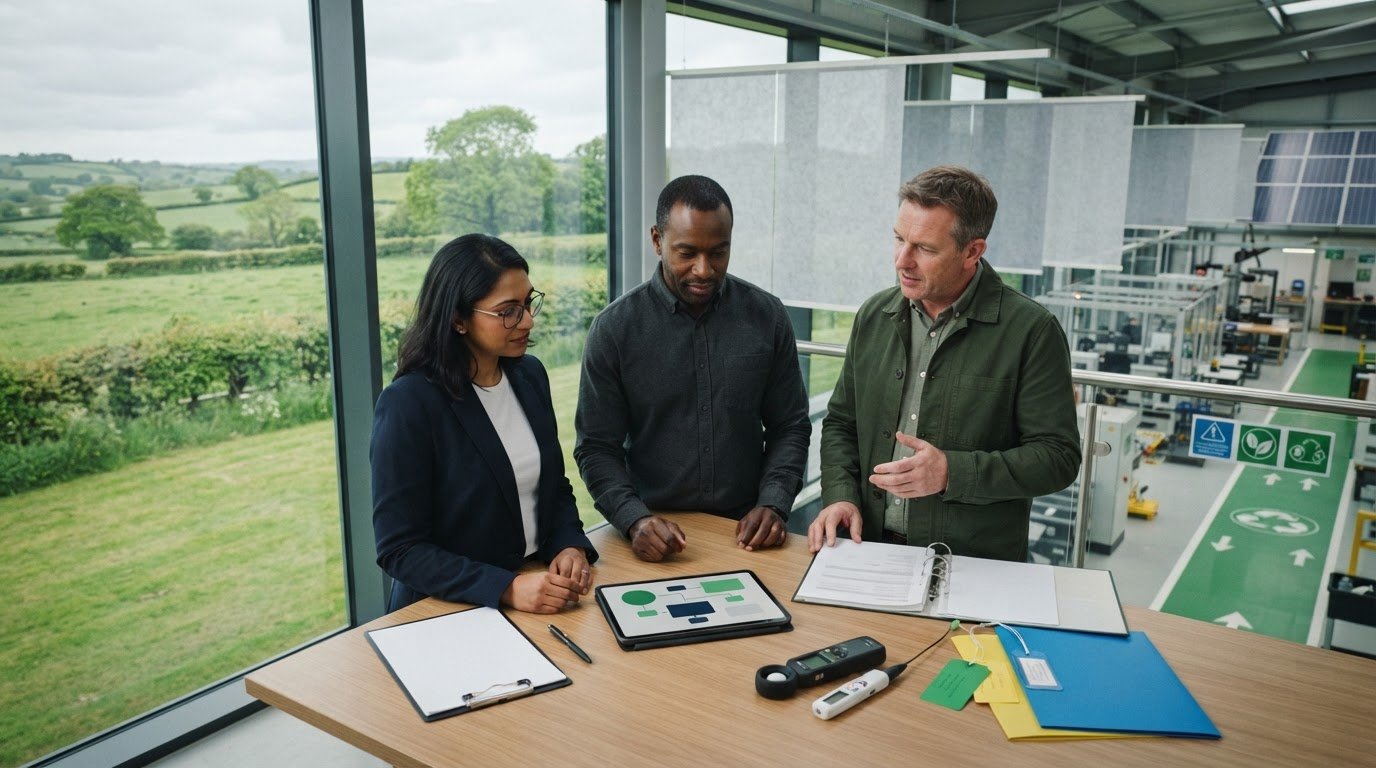
Yes, modern audits often integrate environmental compliance to align with ISO 14001 standards. This is particularly important for renewable projects that often sit on ecologically sensitive land. The audit examines spill containment, waste management protocols, and habitat protection measures. By combining safety and environmental checks, you ensure that the project fulfils its broader corporate responsibility goals whilst protecting the local ecosystem from potential contamination or damage during construction and long-term operations.
How long does a typical renewable project safety audit take to complete?
A standard audit usually takes between two to five days, depending on the site's size and the scope of the review. This includes the initial documentation deep-dive, the on-site physical inspection, and the final reporting phase. Larger wind farms with multiple turbines or complex hybrid sites with battery storage may take longer to ensure every technical hazard is thoroughly assessed. The process is designed to be efficient without compromising the depth of the investigation.

Comments