
Business Total Compliance Solutions: The 2026 UK SME Buying Guide
What if your compliance framework actually protected your profit margins instead of just draining your time and resources? Most UK business owners feel the weight of fragmented documentation and the constant fear of regulatory gaps. Managing separate providers for fire safety, health and safety, and ISO standards often leads to spiralling costs and an endless cycle of audits. It's time to move away from ad-hoc consultancy and embrace business total compliance solutions that unify every obligation into a single, pragmatic framework.
You already know that staying ahead of the 2026 regulatory shifts, such as the expanded "day one" employment rights and the doubling of redundancy consultation awards, is non-negotiable for stability. This guide shows you how to integrate your quality, safety, and environmental management to secure full legal protection whilst potentially reducing insurance premiums through proven risk management. We'll preview the essential updates to the Employment Rights Act and digital filing requirements, explaining how a unified managed service provides a steady, professional hand to guide your SME through these complex corporate responsibilities.
Table of Contents
Understanding Business Total Compliance Solutions for UK SMEs
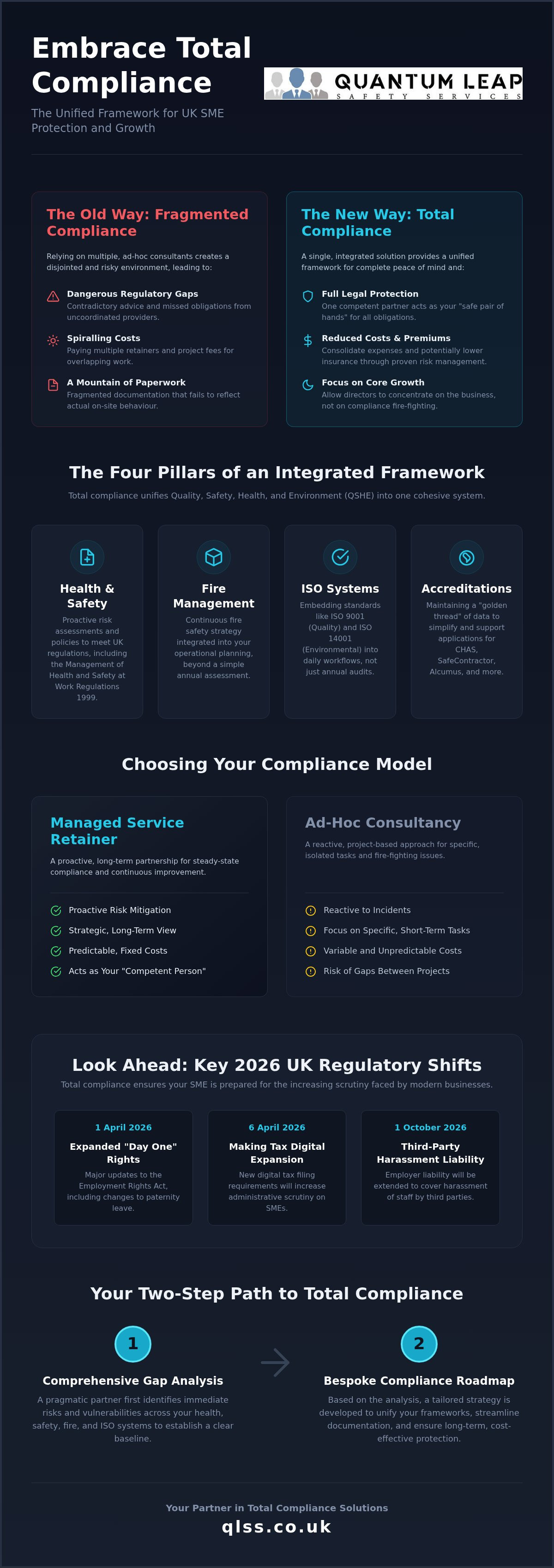
Effective business total compliance solutions represent a shift away from the traditional, siloed approach to corporate responsibility. Instead of treating health and safety, fire management, and ISO standards as separate entities, this integrated model brings them under one operational roof. Regulatory compliance isn't just about ticking boxes; it's about creating a cohesive system where quality management (ISO 9001) and environmental standards (ISO 14001) work in tandem with safety protocols. This unified strategy ensures that documentation is consistent and that a single audit can cover multiple requirements, saving both time and administrative costs.
Relying on multiple ad-hoc consultants often creates dangerous gaps. One provider might handle your fire risk assessments whilst another manages your QSHE (Quality, Safety, Health, and Environment) systems, yet neither sees the full picture. This fragmentation leads to contradictory advice and missed deadlines. Under UK law, specifically the Management of Health and Safety at Work Regulations 1999, every employer must appoint one or more "Competent Persons" to assist in undertaking the measures needed to comply with safety legislation. A total compliance partner fulfils this role with technical authority, acting as a "safe pair of hands" for directors who need to focus on core business growth.
The Shift from Reactive to Proactive Compliance
Many SMEs operate in a state of "fire-fighting," only addressing safety or quality issues after a near-miss or a failed inspection. This reactive stance is expensive and stressful. Transitioning to a managed service retainer allows for a steady-state system where risks are identified and mitigated before they become liabilities. Total compliance is a proactive risk-mitigation framework that integrates safety, fire, and quality management into the daily rhythm of business operations. This provides directors with a clear, strategic overview of their risk profile at any given time, ensuring that safety is never an afterthought.
Regulatory Drivers in 2026
The UK's legislative landscape is changing rapidly in 2026. On 1 April 2026, significant updates to the Employment Rights Act took effect, including expanded "day one" rights for paternity leave. Later this year, on 1 October 2026, employer liability for harassment will extend to third parties. These changes, alongside the expansion of Making Tax Digital on 6 April 2026, mean that SMEs are facing the same level of scrutiny as much larger corporations. Total compliance solutions ensure that your business stays ahead of these dates, protecting your reputation and your bottom line from the increasing fines associated with non-compliance. By adopting a unified approach, smaller enterprises can demonstrate a level of professionalism and stability that was previously the preserve of the blue-chip sector.
The Core Pillars of an Integrated Compliance Framework
A resilient business relies on four primary pillars: health and safety, fire management, ISO systems, and professional accreditations. When these functions operate in isolation, the result is often a "paperwork mountain" that fails to reflect actual site behaviour. Business total compliance solutions resolve this by aligning your risk assessments and policy development with your broader facility management goals. This ensures that fire safety isn't just a basic annual assessment but a continuous part of your operational strategy.
Integrating ISO systems into daily workflows is where many SMEs struggle. Rather than treating ISO 9001 or 14001 as a separate, annual audit burden, a total solution embeds these quality and environmental standards into your core processes. This alignment simplifies the management of accreditations such as CHAS, SafeContractor, and Alcumus. Instead of scrambling to find documentation for every individual application, you maintain a "golden thread" of data that supports every accreditation your business requires.
QSHE Managed Services: The Integrated Approach
Quality, Safety, Health, and Environment (QSHE) are the four cornerstones of modern corporate responsibility. Managing these through a single consultant ensures that your environmental goals don't contradict your safety protocols. This joined-up thinking is essential for building a culture of compliance where staff understand the "why" behind the rules. You can find more detail on these models in our guide to outsourced QSHE managed services. By using a single point of contact, you eliminate the risk of conflicting advice whilst reducing the cumulative costs of hiring multiple specialists.
Sector-Specific Compliance: Renewables and Construction
High-risk industries require a more technical touch. Total business total compliance solutions must account for Construction (Design and Management) Regulations (CDM) and the specific hazards of infrastructure projects. For those in the green energy sector, conducting a specialised health and safety audit for renewable projects is a critical component of the framework. This includes managing occupational health surveillance to protect staff from long-term exposure risks. If you need to streamline these complex requirements, you might consider our integrated safety packages to ensure every base is covered.
Managed Retainers vs Project-Based Compliance: Which is Right?
Choosing between a managed retainer and project-based consultancy is a strategic decision that depends on your current risk profile and internal resources. For many SMEs, business total compliance solutions start with a project to fix immediate gaps, then transition into a retainer for long-term stability. A managed approach provides the "Competent Person" status required by UK law, whilst project-based work allows for intensive focus on specific milestones like achieving ISO certification or completing a complex site audit.
The Managed Service Advantage
A retainer model offers predictable monthly costs and continuous access to professional expertise. Understanding health and safety retainer fees helps businesses budget effectively over a 12-month period, avoiding the financial spikes of ad-hoc consultancy. This model is particularly valuable as UK laws evolve; for instance, the 2026 changes to third-party harassment liability require ongoing policy updates that a one-off project might miss. A partner on a retainer understands your long-term business goals and ensures your documentation remains live and relevant.
Fixed-Price Project Delivery
There are scenarios where a one-off engagement is the most pragmatic choice. If your primary goal is achieving ISO 9001 certification or conducting a specific fire risk assessment, a fixed-price project ensures clear deliverables and timelines. Project work is often the catalyst for establishing a robust compliance culture. Once specific fire safety management plans are in place and your systems are verified, you can then decide if a hybrid model, combining a baseline retainer with specific project deliverables, is the right fit for your ongoing operations.
When comparing these models to hiring an in-house safety officer, the cost-benefit analysis for SMEs usually favours outsourcing. A full-time salary, plus benefits and training, represents a significant overhead. In contrast, business total compliance solutions provide access to a team of specialists, covering fire, ISO, and QSHE, for a fraction of the cost of a single senior hire. This ensures you have the right technical authority for every discipline without the burden of additional headcount. This steady, professional approach allows you to maintain full legal protection whilst focusing your internal resources on core business growth.
Key Criteria for Choosing a Total Compliance Partner
Selecting the right partner for business total compliance solutions requires looking beyond a generic service list. Technical competence is the first benchmark. You need a consultant with sector-specific experience, particularly if you operate in high-risk environments like construction or renewables. A generalist might understand the basics of a risk assessment, but they may lack the depth required for complex QSHE management or CDM regulations. The goal is to find a partner who acts as a "safe pair of hands," possessing the technical authority to navigate intricate legal requirements whilst keeping your operations running smoothly.
Pragmatism is just as vital as technical skill. Some consultants focus on pedantry, creating mountains of paperwork that don't actually improve safety. A professional partner offers common-sense solutions that integrate with your daily workflow. They should also provide modern reporting technology. With the 2026 trend towards mandatory digital-only filing for annual accounts, your compliance data should be just as accessible. A clear dashboard for audit results and risk actions ensures you can demonstrate your status to stakeholders or insurers at a moment's notice. This transparency is essential for winning work through accreditations like CHAS or Alcumus SafeContractor.
Evaluating Personalised Support vs Call-Centre Models
Many large-scale compliance providers rely on call-centre models where you rarely speak to the same person twice. For an SME, this lack of continuity is a significant operational risk. When researching health and safety consultants uk, prioritise those who offer a dedicated advisor. This person should visit your sites, learn your team's behaviour, and understand your specific challenges. It's why many directors now seek Citation health and safety alternatives that offer bespoke, hands-on advice rather than a one-size-fits-all subscription service.
The "Safe Pair of Hands" Checklist
A reliable partner should meet a strict set of credentials. Check for Chartered status, IOSH membership, and specific ISO auditing experience. Transparency of fees is also a major differentiator. Your business total compliance solutions package should have a clear, fixed structure without hidden costs for documentation updates or basic telephone support. Reviewing testimonials and case studies from projects similar to yours will confirm their capability. If they've successfully managed QSHE for a renewable energy site or a complex construction project, they likely have the discipline your business needs. If you want to ensure your business meets every 2026 standard without the administrative burden, contact us for an integrated compliance audit to identify your immediate needs.
Implementing Your Total Compliance Strategy with Quantum Leap
Transitioning to business total compliance solutions requires a methodical, disciplined approach. Quantum Leap Safety Services acts as a "safe pair of hands," guiding your SME through a structured four-step implementation process designed to minimise disruption whilst maximising protection. This process moves beyond simple tick-box exercises, establishing a robust framework that supports your specific operational goals.
Step 1: Initial Gap Analysis and QSHE Audit. We begin with a thorough assessment of your current documentation and site behaviours. This audit identifies immediate regulatory risks and highlights areas where your current quality, safety, or fire management systems may be falling short of 2026 standards.
Step 2: Bespoke Compliance Roadmap. Following the audit, we design a tailored plan that prioritises high-risk areas. This roadmap integrates ISO requirements, fire safety protocols, and general health and safety obligations into a single, manageable timeline.
Step 3: Management System Implementation and Training. We install the necessary management systems and conduct targeted staff training. This ensures your team understands their responsibilities and that your new protocols are embedded into daily workflows rather than sitting idle in a folder.
Step 4: Ongoing Monitoring and Site Inspections. Compliance is a continuous process. We provide regular site inspections and audits to ensure standards remain high, providing the "Competent Person" oversight required for long-term legal security.
From Audit to Accreditation
Moving your business from "non-compliant" to "industry-leading" provides a significant competitive advantage. By integrating ISO 9001 implementation services UK into your wider safety strategy, you demonstrate a commitment to quality that resonates with high-value clients. Achieving and maintaining accreditations like CHAS or SafeContractor becomes a seamless byproduct of your integrated system, facilitating business growth by opening doors to restricted tender lists and larger infrastructure projects.
Next Steps for Total Business Protection
Initiating a consultation for business total compliance solutions doesn't have to be a resource-heavy endeavour. We start with a pragmatic, professional assessment that respects your current operational pace. The long-term ROI of a consolidated compliance partner is found in reduced insurance premiums, lower administrative overheads, and the prevention of costly regulatory fines. If you're ready to move away from fragmented consultancy and towards a unified, steady-state safety model, contacting Quantum Leap Safety Services is the first step towards total business protection. We provide the technical authority and hands-on support needed to navigate the complexities of corporate responsibility, allowing you to focus entirely on your core business growth.
Securing Your SME's Future Through Integrated Compliance
The regulatory landscape of 2026 demands a shift from fragmented safety management to a unified operational strategy. By consolidating your health, safety, fire, and quality obligations, you eliminate the hidden costs of ad-hoc consultancy and close the dangerous gaps that multiple providers often leave behind. Whether you're managing high-risk infrastructure in the renewables sector or seeking ISO certification to win new contracts, a steady approach ensures your business remains protected whilst you focus on growth.
Effective business total compliance solutions offer more than just legal safety; they provide a "safe pair of hands" that understands the resource constraints of a modern SME. Quantum Leap Safety Services provides pragmatic QSHE consultancy for UK SMEs, specialist support for renewable and construction sectors, and expert ISO management system implementation. Transitioning to an integrated model is a logical step toward long-term stability and operational efficiency.
Secure your business with a total compliance solution from Quantum Leap Safety Services and take the first step toward a more resilient future. You've built your enterprise with dedication, and we're here to ensure it stays protected.
Frequently Asked Questions
What are business total compliance solutions?
Business total compliance solutions are integrated frameworks that consolidate health and safety, fire management, quality standards, and environmental protocols into a single managed system. Instead of hiring separate consultants for each discipline, you work with one partner who oversees all regulatory obligations. This ensures documentation is consistent and eliminates gaps between different safety areas. It's a pragmatic way for SMEs to meet their legal duties whilst reducing the administrative burden of multiple audit cycles.
Is it more cost-effective to bundle my safety and fire services?
Bundling these services is significantly more cost-effective than hiring ad-hoc specialists for individual tasks. When you integrate fire safety management with your broader QSHE protocols, you avoid paying for redundant site visits and duplicate administrative work. A single compliance partner can conduct multiple inspections during one visit, providing a holistic view of your risk profile. This efficiency typically results in lower overall consultancy fees and may contribute to reduced insurance premiums over time.
Can a total compliance solution help with ISO 9001 certification?
Yes, ISO management systems are a core component of an integrated compliance strategy. A total solution embeds the quality requirements of ISO 9001 directly into your existing safety and environmental workflows. This approach ensures that your management systems aren't just theoretical documents but are practical tools used daily. By aligning your business total compliance solutions with ISO standards, you create a "golden thread" of data that simplifies both the initial certification and the subsequent annual audits.
How does a managed service retainer differ from ad-hoc consultancy?
A managed service retainer provides continuous, proactive support and access to a "Competent Person" as required by UK law. Unlike ad-hoc consultancy, which is usually reactive and project-based, a retainer ensures your documentation stays live as regulations change. This model offers predictable monthly budgeting and a long-term partnership. Ad-hoc support is better suited for specific one-off tasks, such as a single fire risk assessment or a specialised site audit for a new project.
What industries benefit most from integrated QSHE services?
While all SMEs benefit from integration, high-risk sectors like construction, manufacturing, and renewable energy see the most significant impact. These industries face complex CDM regulations and hazardous environments that require technical authority. Integrated QSHE services ensure that occupational health surveillance, site inspections, and environmental impact assessments are managed together. This prevents conflicting safety protocols on-site and ensures that your business can demonstrate a high level of technical competence to potential clients and stakeholders.
Will a total compliance partner help with CHAS and Alcumus applications?
A professional partner manages the entire application process for industry accreditations such as CHAS, SafeContractor, and Alcumus. They take the administrative weight off your shoulders by gathering the necessary evidence and ensuring your safety packages meet the specific criteria of each body. This support is vital for SMEs looking to join restricted tender lists. Because your management systems are already integrated, the data required for these applications is readily available and consistently formatted.
How often should a total compliance audit be conducted?
You should start with a comprehensive initial gap analysis to establish a baseline for your compliance roadmap. Following this, most SMEs benefit from periodic site inspections and a full annual audit of their management systems. However, the frequency often depends on your specific sector and risk profile. For high-growth businesses or those in construction, more frequent monitoring may be necessary to ensure that new projects and staff are fully integrated into your safety framework.
What happens if my business undergoes significant changes or expansion?
Integrated compliance frameworks are designed to be scalable. If your business expands into new locations or takes on larger projects, your partner will update your risk assessments and management systems to reflect these changes. This flexibility ensures that your legal protection grows alongside your operations. Whether you are adding new staff or entering a different sector, your compliance roadmap is adjusted to maintain the "Competent Person" oversight needed to protect your reputation and your bottom line.


Comments