
Construction Safety Audit Services: The 2026 SME Compliance Guide
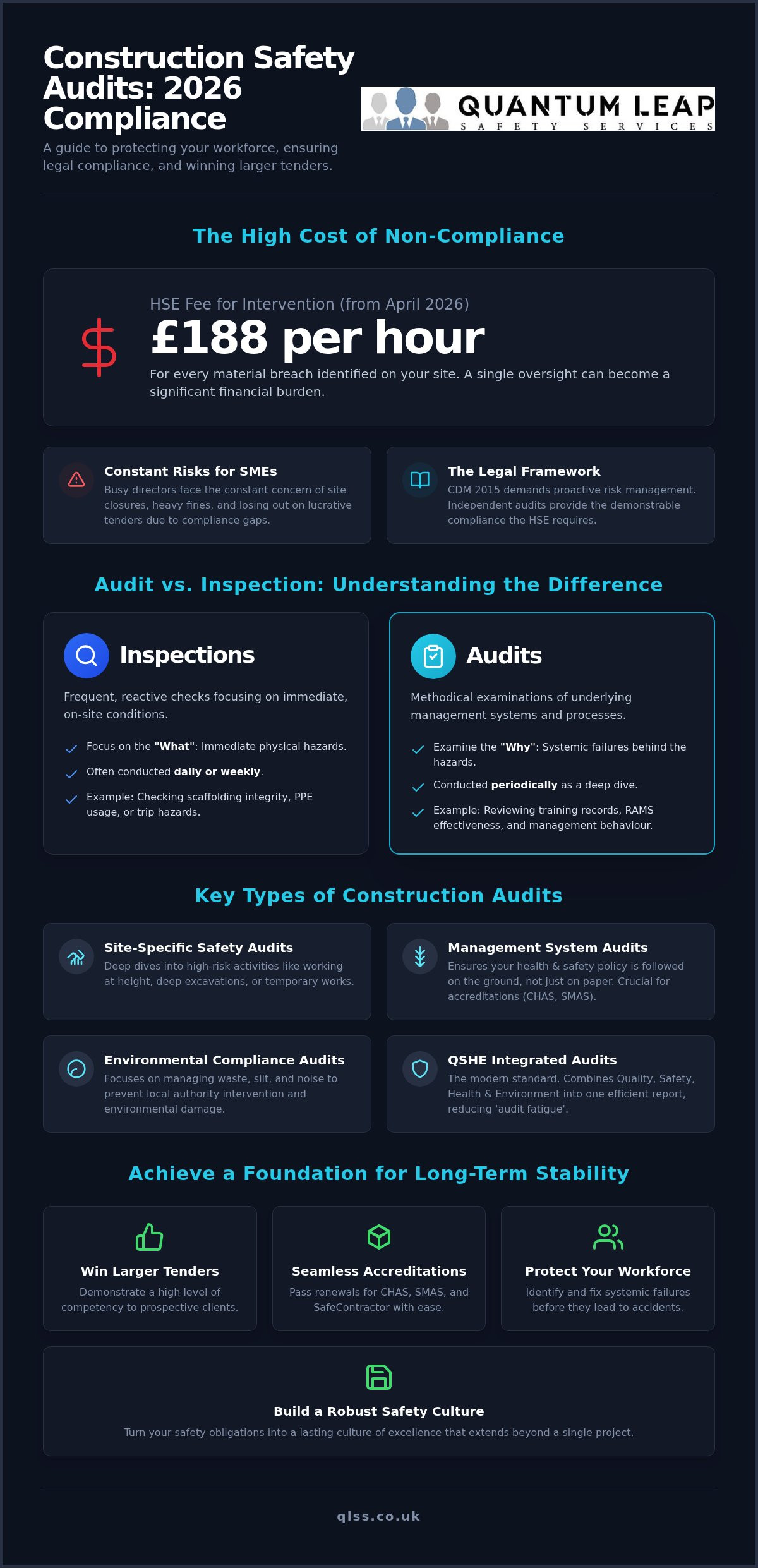
Did you know that as of April 2026, the HSE Fee for Intervention has risen to £188 per hour for every material breach identified on your site? For an SME, a single oversight isn't just a safety risk; it's a significant financial burden that can stall your progress. You likely feel the pressure of keeping up with the Building Safety Regulator's latest transitions whilst managing the complexities of CDM 2015. Utilising professional construction safety audit services ensures you aren't caught off guard by changing regulations or losing out on lucrative tenders due to gaps in your documentation.
It's a challenge to maintain high standards across multiple sites, and the fear of site closures or fines is a constant concern for busy directors. This article promises to show you how professional audits protect your workforce, ensure CDM compliance, and help your business win larger tenders. We'll explore the path to total legal compliance, improved subcontractor safety culture, and the steps to achieving seamless accreditation renewals for 2026 and beyond. By choosing a methodical approach, you can turn your safety obligations into a steady foundation for long-term stability.
Table of Contents
What are Construction Safety Audit Services?
Professional construction safety audit services represent a methodical, independent examination of both the physical site conditions and the underlying management systems that govern them. Unlike a casual site visit, an audit is a structured process designed to verify that your safety protocols align with your written policies and current UK legislation. It provides a clear, evidence-based snapshot of how well your organisation manages Construction site safety risks on a daily basis.
Under UK law, the auditor acts as a "competent person", providing the technical expertise required to identify gaps that internal teams might overlook. As we move through 2026, the standard for what constitutes a "basic" check has shifted. With the Building Safety Regulator transitioning to the Ministry of Housing, Communities and Local Government (MHCLG) in January 2026, the focus has intensified on the "golden thread" of information. A construction safety audit serves as a critical mechanism for legal protection and a rigorous benchmark for operational excellence across all your projects.
The Legal Framework: CDM 2015 and Beyond
The Construction (Design and Management) Regulations 2015 (CDM 2015) remain the bedrock of site safety, placing specific duties on Clients and Principal Contractors. Audits help you satisfy these duties by providing "demonstrable compliance". If the HSE visits your site, having a paper trail of independent audits shows you've taken proactive steps to manage risk. This is especially vital given the HSE Fee for Intervention rate of £188 per hour, effective from April 2026. Regular audits ensure that your Construction Phase Plan (CPP) isn't just a document in a drawer, but a living safety system that adapts to new requirements like the 2026 Building Safety Levy or updated fire safety staircase rules.
Audit vs. Inspection: Clearing the Confusion
It's easy to confuse these two terms, but they serve different purposes within a robust safety culture. Inspections are frequent, often daily, checks that focus on immediate physical hazards like scaffolding integrity, PPE usage, or trip hazards. They are reactive and situational. In contrast, construction safety audit services look deeper into the "why" behind the "what".
Inspections: Focus on the immediate environment and equipment.
Audits: Examine training records, management behaviour, and the effectiveness of your RAMS.
SMEs need both to stay protected. While an inspection might fix a loose guardrail today, an audit identifies why that guardrail wasn't checked in the first place, allowing you to fix the systemic failure before it leads to an accident or a costly site closure.
Key Types of Construction Audits for UK Builders
Every construction project has a unique risk profile, meaning a one-size-fits-all approach to compliance rarely works. Construction Safety Audits vary in scope depending on the project phase and the specific hazards present. For instance, site-specific safety audits perform deep dives into high-risk activities like working at height or deep excavations. These are essential because falls from height remain a leading cause of workplace fatalities, requiring constant vigilance and methodical oversight.
Management system audits ensure your health and safety policy is actually being followed on the ground, rather than just existing as a digital file. This is crucial for accreditation-readiness. Many SMEs struggle to maintain CHAS, SMAS, or Alcumus SafeContractor status because their documentation doesn't match their site reality. Professional construction safety audit services bridge this gap, providing the evidence needed for seamless renewals and helping you demonstrate a high level of competency to prospective clients.
Environmental compliance audits have also become a priority for the modern builder. These assessments focus on managing waste, silt, and noise levels to prevent local authority intervention or environmental damage. It's about being a "safe pair of hands" for the environment whilst protecting your business from the reputational damage of a pollution incident.
QSHE Integrated Audits: The Modern Standard
Modern standards favour efficiency. Combining Quality, Safety, Health, and Environment (QSHE) into a single report reduces "audit fatigue" for site managers. Instead of four separate visits, one comprehensive check covers every obligation. This integrated approach is a hallmark of outsourced QSHE managed services, allowing your team to focus on project delivery while we handle the technical compliance details. It's a disciplined way to ensure total compliance without duplicating effort.
Specialised Audits for Renewable Energy Projects
The renewables sector presents unique challenges that standard site checks might miss. Wind farm and solar infrastructure projects often involve remote locations, high-voltage risks, and complex lifting operations. These audits focus on environmental sensitivity and specialised plant safety. If you're operating in this space, our health and safety for construction sites guide offers deeper insight into project-specific risks. If you need a methodical review of your current site protocols, exploring our audit and inspection services can provide the clarity your business needs to grow safely.
The Construction Safety Audit Process: What to Expect
A professional audit isn't a surprise "gotcha" exercise. It's a structured journey from planning to resolution. Using professional construction safety audit services provides a clear roadmap, starting with pre-audit preparation. We begin by reviewing your Construction Phase Plan (CPP) and Risk Assessments and Method Statements (RAMS). This ensures your core safety documents actually reflect the specific work happening on the ground rather than being generic templates.
Once the groundwork is laid, the on-site execution begins. This involves a mix of observations, interviews with staff, and rigorous document checks. The goal is to verify that the safety culture described in your office is the same one being practised on the tools. It's a methodical approach that identifies gaps before they become material breaches or accidents.
Documentation Review: The Paper Trail
The "golden thread" of safety starts with records. We verify training matrices and CSCS card validity to ensure every person on site is competent and qualified for their specific role. We also check plant inspection records and weekly fire alarm tests to confirm maintenance schedules are being met. A key focus is the Health and Safety File; we ensure it's maintained whilst the project progresses, preventing a last-minute scramble at the end of the build. This disciplined record-keeping is vital for demonstrating compliance during an HSE inspection.
Physical Site Observations
On-site execution involves more than just checking equipment. We assess high-risk work such as work at height, excavations, and electrical safety. We evaluate the effectiveness of site inductions and toolbox talks by interviewing staff to see if the message is actually getting through. This helps identify "unconscious" unsafe behaviours amongst subcontractors that might otherwise go unnoticed. It's about spotting the subtle risks that standard checklists often miss.
After the site walk-round, we hold a closing meeting. This provides immediate, verbal feedback on any "Red Flag" issues that require urgent attention. You won't be left waiting for weeks to know if your site is safe. The process concludes with a formal report and action plan. These reports offer practical, prioritised steps for improvement, focusing on "safe systems of work" rather than just highlighting paperwork errors. This ensures your site remains a safe environment for everyone involved.
Selecting a Construction Safety Audit Partner
Choosing the right partner for construction safety audit services involves looking beyond a simple list of certifications. You need a consultant who prioritises pragmatism over pedantry. In the real world of construction, a pedantic auditor who focuses on minor, non-critical clerical errors can disrupt site progress without actually improving safety. A pragmatic partner understands the operational constraints of an SME whilst ensuring that high-risk activities remain strictly controlled.
Technical authority is non-negotiable. Ensure your chosen consultant holds CMIOSH status, indicating they are a Chartered Member of IOSH. This level of qualification, combined with sector-specific experience in areas like renewables or commercial build, provides the "safe pair of hands" your business needs. A national provider with local knowledge is often the ideal choice, as they understand the specific regional priorities of the HSE, which can vary between different parts of the UK.
Cost structures are another vital consideration. Whilst one-off project fees might seem attractive for smaller builds, a monthly retainer often provides superior long-term value. Retainers allow for a methodical, steady approach to compliance rather than a reactive scramble when an accreditation renewal or an HSE visit looms. This stability helps you manage budgets whilst maintaining a consistent safety culture.
Internal vs. External Auditing
Many SMEs consider using in-house staff to conduct audits to save on costs. However, internal staff often lack the necessary impartiality and can become "blind" to recurring site hazards through over-familiarity. External audits carry significantly more weight with insurers and accreditation bodies like Alcumus SafeContractor. An external auditor brings the "Fresh Eyes" advantage, spotting unconscious unsafe behaviours that site regulars might have overlooked for months. This independent perspective is essential for identifying systemic failures before they lead to accidents.
Evidence of Industry Accreditation Support
Your audit report should be a strategic asset, not just a list of faults. A high-quality auditor understands the specific requirements of CHAS, Constructionline, or other SSIP schemes. They will ensure that your audit report serves as acceptable evidence for your next application, streamlining the renewal process. If you are also looking for more frequent site checks, our workplace safety inspection services guide explains how regular visits complement the broader audit process. To ensure your business remains totally compliant and tender-ready, you can book a consultation for our audit and inspection services today.
How Quantum Leap Safety Services Protects Your Site
Quantum Leap Safety Services (QLSS) provides a solution that respects both your site’s safety and your business’s bottom line. Our construction safety audit services are specifically designed for the SME budget and risk profile, ensuring you receive high-level consultancy without the overheads of a large-scale firm. We don't just identify problems; we provide the pragmatic, technical solutions required to resolve them.
We focus on "safe systems of work" rather than just checking boxes. By adopting an integrated QSHE approach, we cover Quality, Safety, Health, and Environment in a single visit. This efficiency is vital for busy site managers who need to maintain compliance across four different areas without enduring four separate inspections. It’s a methodical way to ensure your project meets every obligation whilst keeping your team focused on the build.
A significant hurdle for many UK builders is the complexity of SSIP applications. We provide direct, hands-on support for CHAS and Alcumus SafeContractor applications. Our auditors ensure that every report generated during our visit serves as the robust evidence these bodies require. This proactive support turns a stressful renewal process into a routine administrative task, helping you win larger tenders with confidence.
A "Safe Pair of Hands" for Your Construction Business
Since our establishment in 2012, we’ve acted as a steady, reliable expert for businesses across the UK and EU. Our methodical approach isn't just about avoiding fines; it’s about building a safety culture that makes your business more attractive to high-calibre talent and larger clients. When your subcontractors see a disciplined safety regime, their behaviour improves, and your operational stability grows. We act as your "safe pair of hands", navigating complex 2026 requirements so you don't have to.
National Coverage with National Standards
Whether you’re managing a single development or a diverse UK project portfolio, QLSS provides consistent auditing standards across every site. This national coverage ensures that your company’s safety protocols are applied uniformly, regardless of the project location. As your business grows, we remain your steady, professional partner, providing the technical authority needed to navigate the evolving regulatory environment. You can rely on us for a disciplined and process-driven approach to consultancy that supports your long-term stability.
Contact Quantum Leap Safety Services to organise your site audit and ensure your business is fully prepared for the 2026 compliance landscape.
Future-Proofing Your Construction Projects
Maintaining total compliance in an evolving regulatory landscape doesn't have to be a source of stress for your business. By moving beyond basic walkthroughs and investing in professional construction safety audit services, you protect your workforce whilst building the robust documentation needed to win larger tenders. A methodical approach ensures that your safe systems of work are both pragmatic and legally defensible against rising HSE intervention fees.
Quantum Leap Safety Services acts as a steady partner, providing the technical authority your business requires. Established in 2012, our CMIOSH qualified consultants are specialists in SME construction compliance, offering a "safe pair of hands" for every project. Whether you need to secure a CHAS renewal or integrate your quality and environmental standards, we provide the disciplined oversight that allows your team to focus on delivery. Take the next step towards operational stability and Book a Professional Construction Safety Audit with QLSS today. We look forward to supporting your long-term success on site.
Frequently Asked Questions
How often should a construction site safety audit be conducted?
A site safety audit should be conducted at intervals that reflect the project's specific risk profile and duration. For high-risk construction projects, monthly audits are often the standard to ensure continuous compliance with safety systems. Smaller or lower-risk sites might opt for quarterly reviews. Regular scheduling helps you maintain a steady safety culture and ensures that your Construction Phase Plan remains relevant as the project evolves through different stages.
What is the difference between a safety audit and an HSE inspection?
A safety audit is a proactive, systematic review of your management systems and site behaviours, whereas an HSE inspection is a regulatory visit focused on identifying material breaches of the law. Audits look at the "why" behind your safety performance, helping you fix systemic issues before they lead to an accident. An HSE inspection can result in a Fee for Intervention if a breach is found, making internal auditing a vital financial safeguard.
Can a safety audit help my business achieve CHAS accreditation?
Professional construction safety audit services are a critical tool for achieving and maintaining CHAS or Alcumus SafeContractor accreditation. These schemes require demonstrable evidence that your health and safety policies are being actively implemented on-site. The detailed reports generated during an audit provide the high-quality, verified data that assessors look for, significantly streamlining your application process and helping your business win larger tenders with confidence.
What are the most common failings found during construction safety audits?
Common failings often include a disconnect between written Risk Assessments and Method Statements (RAMS) and the actual work being performed on the tools. Other frequent issues involve expired training records, inadequate fire safety provisions, and poor control over subcontractor behaviours. Audits identify these gaps early, allowing you to update your documentation and training matrices before they result in a site closure or a material breach during a regulatory visit.
Do I need a safety audit if I already have a full-time Site Manager?
Even with a competent full-time Site Manager, an independent audit is essential to provide an impartial perspective. Site Managers are often focused on project delivery and can become "blind" to recurring hazards through over-familiarity with the environment. An external auditor brings "fresh eyes" and technical authority, ensuring that your site remains compliant with the latest 2026 standards whilst supporting the Site Manager in their daily safety duties.
How much do construction safety audit services typically cost for an SME?
The cost of construction safety audit services varies depending on whether you choose a project-based fee or a managed service retainer. Factors such as site complexity, project duration, and the frequency of visits will influence the final cost. Retainer models often provide better value for SMEs, as they offer continuous access to competent advice and predictable monthly budgeting, whereas one-off audits are suitable for specific, short-term project needs.
What happens if an audit identifies a major safety breach on my site?
If a major safety breach is identified, your auditor will provide immediate verbal feedback during the closing meeting on-site. This allows you to take urgent corrective action to protect your workforce. Following the visit, you will receive a prioritised action plan that categorises risks by severity. This methodical approach ensures that the most critical issues are resolved first, helping you avoid potential HSE fines or site accidents before they occur.
Are safety audits mandatory under the CDM 2015 regulations?
Whilst the term "audit" isn't explicitly used in the text of CDM 2015, the regulations mandate that Principal Contractors and Clients must monitor and review health and safety arrangements. A structured audit is the most effective way to satisfy these legal duties. It provides a clear paper trail of demonstrable compliance, which is essential for fulfilling your statutory obligations and protecting your business during an investigation or a competitive tender process.


Comments