
Fire Risk Assessment Cost: The 2026 UK Commercial Pricing Guide
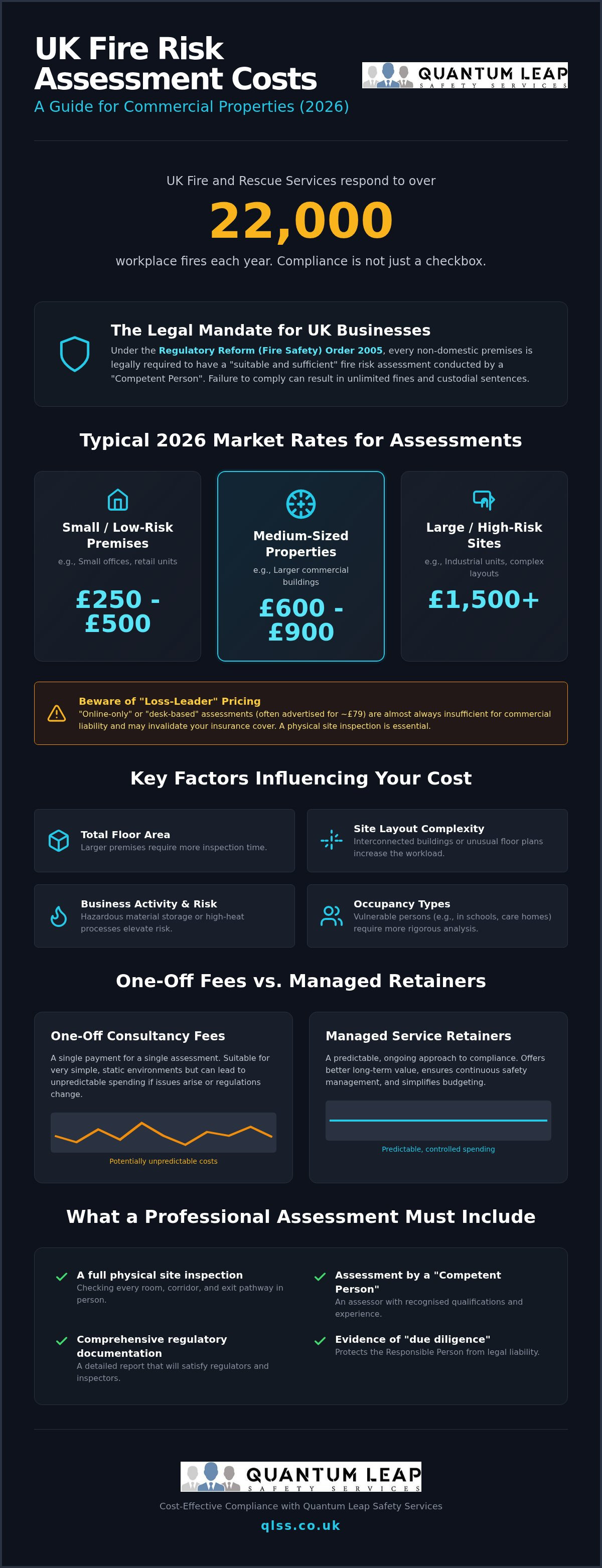
UK Fire and Rescue Services respond to over 22,000 workplace fires each year, yet many businesses still treat safety compliance as a mere box-ticking exercise. It's a common frustration for duty holders to receive multiple quotes for the same building with a fire risk assessment cost that varies by hundreds of pounds. You need to ensure your premises are compliant and your staff are safe, yet the lack of pricing transparency makes it difficult to set a predictable safety budget. Professional auditing is about more than just a fee; it's about protecting your legal liability and operational stability.
This guide provides a clear breakdown of the 2026 UK market rates and the specific factors that influence professional pricing for commercial properties. You'll discover how a thorough audit can reduce insurance premiums and help you avoid the pitfalls of low-cost reports that fail to satisfy regulators. We'll also examine the impact of the latest Building Safety Act requirements and how a managed approach to compliance offers the best long-term value for your organisation. By the end of this article, you'll have the data needed to make an informed, cost-effective decision for your fire safety strategy.
Table of Contents
Understanding the Legal Mandate and Market Rates for Fire Risk Assessments
Key Factors Influencing Fire Risk Assessment Pricing in the UK
Comparing One-Off Consultancy Fees vs. Managed Safety Retainers
Avoiding Hidden Costs: What Should a Professional Assessment Include?
Securing Cost-Effective Compliance with Quantum Leap Safety Services
Understanding the Legal Mandate and Market Rates for Fire Risk Assessments
Every non-domestic premises in the UK is legally required to conduct a thorough fire risk assessment. This isn't an optional safety measure; it's a statutory obligation that applies to offices, shops, factories, and warehouses. Under the Regulatory Reform (Fire Safety) Order 2005, the "Responsible Person" must ensure that a suitable and sufficient assessment is carried out to identify fire hazards and protect occupants. Failure to comply doesn't just lead to minor penalties. Courts now have the power to issue unlimited fines and even custodial sentences for serious safety breaches that put lives at risk.
When you consider the potential financial impact of a workplace fire or a regulatory prosecution, the initial fire risk assessment cost is a modest investment in business continuity. In the current 2026 market, UK SMEs are finding that regulators are prioritising the technical quality of reports over simple documentation. A professional audit provides the legal "due diligence" defence that's essential if an incident occurs or an inspector arrives at your door.
The Legal Requirement for a "Competent Person"
The law stipulates that the individual carrying out the assessment must be a "competent person." Whilst some business owners attempt to "do it yourself" to save on consultancy fees, this often fails the legal test of competence. An amateur assessment frequently misses complex risks like hidden fire spread or specific compartmentation issues. Using an unqualified assessor might reduce your immediate spend, but it leaves the Responsible Person personally liable for any oversights. For a deeper look at your specific duties, our Fire Risk Assessment for Businesses: 2026 Compliance Guide provides a detailed breakdown of duty holder responsibilities.
Average Ballpark Costs for UK Businesses in 2026
Typical market rates vary based on the size and complexity of your building. For a small, low-risk office or retail unit, you can expect to pay between £250 and £500. Medium-sized commercial properties often fall within the £600 to £900 range, whilst larger industrial units or high-risk sites can exceed £1,500. You might encounter "online-only" assessments for as little as £79, but these are almost always insufficient for commercial liability. Insurers generally require a physical site inspection by a qualified professional; an amateur or "desk-based" report could lead to a declined claim in the event of a fire.
Key Factors Influencing Fire Risk Assessment Pricing in the UK
Understanding why quotes vary is essential for accurate budgeting. A standard office doesn't present the same challenges as a chemical plant or a high-rise residential block. The fire risk assessment cost reflects the time and technical expertise required to evaluate specific hazards. According to official government guidance, your assessment must be "suitable and sufficient," which means the larger and more complex your site, the more intensive the audit must be. This isn't just about the physical size of the building; it's about the depth of the investigation required to ensure every occupant remains safe.
Several core variables dictate the final price of a professional assessment:
Total floor area: Increased square meterage requires more physical inspection time to check every room, corridor, and exit.
Site layout: Interconnected buildings or complex floor plans increase the workload compared to simple, open-plan spaces.
Business activity: High-heat manufacturing or hazardous material storage carries a much higher risk profile than standard retail or office work.
Occupancy types: Buildings housing vulnerable persons, such as schools or care homes, require more rigorous evacuation analysis and specialised safety protocols.
High-Risk Sites and Specialist Infrastructure
Certain sectors demand specialist knowledge that goes beyond general fire safety. For instance, renewable energy projects or active construction sites involve dynamic hazards and complex infrastructure. Conducting a health and safety audit for renewable projects requires an understanding of specific electrical and environmental risks. Similarly, multi-storey complexes require significant on-site time to verify compartmentation and vertical escape routes, which naturally increases the overall investment. These environments often require the assessor to have specific industry-specific accreditations to navigate the site safely.
Travel, Reporting, and Remedial Consultation
The fee you pay covers much more than the hours spent on your premises. A professional assessor spends significant time drafting a technical report and creating a prioritised action plan. This documentation is your primary evidence of compliance. It must be clear enough for you to act upon and robust enough to stand up to legal scrutiny. Additionally, pricing often accounts for travel and logistics, especially for providers offering national coverage. For businesses with multiple sites, seeking audit and inspection services from a single partner can often lead to greater pricing consistency and streamlined reporting across your entire portfolio.
Comparing One-Off Consultancy Fees vs. Managed Safety Retainers
Many business owners approach compliance as a single hurdle to clear. However, fire safety is a continuous obligation that requires regular attention to remain legally valid. Choosing the right fee structure is just as important as the fire risk assessment cost itself. Most providers offer two primary commercial models: the project-based fixed fee and the managed service retainer. Understanding the difference is vital for maintaining long-term building safety without overstretching your budget.
The project-based model involves a one-off fee for a single assessment. This is a straightforward transaction where a consultant conducts a site visit and delivers a technical report. In contrast, a managed service retainer provides ongoing monthly support. Bundling fire safety with broader QSHE managed services often yields significant operational savings. It prevents the duplication of administrative work and ensures all safety protocols are aligned. A professional audit should follow the standard 5-step checklist, but a managed service ensures those steps are revisited whenever your business environment evolves.
The Benefits of a Managed Service for SMEs
Small and medium enterprises often struggle with the "spike" in expenditure associated with annual safety audits. A retainer model transforms your fire risk assessment cost into predictable monthly outgoings. It also provides a "safe pair of hands" for ongoing technical advice. If building regulations change mid-year, you aren't left searching for a new consultant or worrying about sudden compliance gaps. Your partner is already across the details. Most importantly, it automates the review process. An assessment is only valid whilst it reflects the current state of the building. A managed service ensures your documentation remains a "live" record of safety.
When is a Fixed-Price Project More Suitable?
There are specific scenarios where a one-off consultancy fee is the more pragmatic choice. If you've just acquired new premises or are managing a specific construction project, a fixed-price audit provides a clear, immediate snapshot of your requirements. It's also suitable for very low-risk, stable environments where changes to layout or occupancy are rare. Some businesses use a one-off project fee as a way to "audit the auditor." It allows you to evaluate the depth of the report and the professionalism of the consultant before deciding whether to commit to a long-term safety partnership.
Avoiding Hidden Costs: What Should a Professional Assessment Include?
Low-cost providers often use a minimal fire risk assessment cost as a "loss-leader" to gain entry to your premises. Once on-site, these individuals frequently focus on upselling high-margin hardware like fire extinguishers or signage rather than conducting a rigorous safety audit. This tactic creates a significant hidden cost. You might save £100 on the assessment but end up paying £500 for equipment you don't actually need. A professional consultant prioritises your safety and legal compliance over product sales.
It's also vital to check if your quote includes an emergency evacuation plan. Cheap assessments often omit this critical document, leaving you to draft it yourself or pay an additional fee later. Always clarify if follow-up support is included in the initial price. If a fire officer visits and questions the report, you need an expert who will stand by their findings without charging extra for every phone call. A truly professional service provides a "safe pair of hands" throughout the entire compliance process.
The Anatomy of a Compliant Fire Risk Report
A robust report is more than a simple checklist. It must provide a detailed hazard identification and a clear risk rating, categorised as Low, Medium, or High. This allows you to prioritise resources effectively. The assessor should evaluate your existing fire detection and suppression systems, ensuring they are fit for purpose and properly maintained. Most importantly, the report must contain a prioritised "Action Plan." This plan should offer realistic timeframes for any necessary improvements, giving you a clear roadmap for compliance that satisfies both the law and your budget.
Insurance and Legal Defence Requirements
A professional report serves as your primary evidence of "due diligence." If a fire occurs, your insurer will scrutinise your documentation. If the FRA is deemed inadequate or amateurish, they may reject your claim entirely. The value of a professional audit lies in its ability to withstand legal scrutiny. Having a consultant who can defend their findings to the Fire Authority is invaluable. This professional backing ensures that your fire risk assessment cost provides a genuine safety net for your business, protecting you from the unlimited fines associated with non-compliance.
For a comprehensive solution that covers all your safety obligations, consider our Business Total Compliance Solutions to ensure every aspect of your premises is protected.
Securing Cost-Effective Compliance with Quantum Leap Safety Services
Since 2012, Quantum Leap Safety Services has acted as a pragmatic partner for UK SMEs, providing the technical expertise required to navigate complex safety legislation. We understand that managing a fire risk assessment cost is about balancing regulatory necessity with commercial reality. Our approach focuses on delivering straightforward, functional advice that avoids unnecessary expenditure on redundant hardware or services. By integrating our fire safety management plans with your broader QSHE goals, we ensure that compliance becomes a seamless part of your daily operations rather than a disruptive annual event. Our national reach allows us to support businesses across the UK whilst maintaining the high standards of a dedicated, hands-on partner.
Tailored Pricing for Your Specific Industry
We adjust our methods based on the unique demands of your sector. Whether you operate in the high-stakes environment of renewable energy or manage a traditional commercial property portfolio, our consultants possess the specific cross-sector expertise needed to identify relevant hazards. There is a clear advantage in using a single provider for both your ISO 9001 management systems and your fire safety audits. This unified approach reduces administrative overhead and ensures that your safety protocols are consistent across all departments. We prioritise operational efficiency alongside safety to ensure your business remains both protected and productive. Our experience in high-risk sectors like construction means we're equipped to handle complex infrastructure that standard assessors might overlook.
Next Steps: Getting a Transparent Quote
Obtaining an accurate fire risk assessment cost requires a clear understanding of your premises. To provide a transparent quote, we typically require information regarding your building's total floor area, the nature of your business activities, and the number of occupants on-site. This data allows us to allocate the correct resources and technical expertise for your audit. The transition from an initial audit to a state of managed safety peace of mind is designed to be methodical and stress-free. We move beyond the one-off report to provide a continuous safety framework that evolves with your organisation. Our goal is to provide a "safe pair of hands" that stays with you as your business grows. Contact Quantum Leap for a professional fire safety consultation to secure your building's future.
Securing Your Commercial Future with Professional Safety Management
Managing your fire safety obligations requires a balance between regulatory necessity and financial efficiency. You've seen that the true fire risk assessment cost involves more than just an initial audit fee; it's an investment in your business's legal and operational resilience. By choosing a competent partner, you ensure that your documentation stands up to the scrutiny of both fire authorities and insurers, protecting your organisation from unlimited fines and declined claims.
Quantum Leap Safety Services has provided pragmatic QSHE consultancy since 2012, offering managed services tailored specifically for UK SMEs. We provide expert support for high-risk renewable and construction projects, ensuring that even the most complex sites remain fully compliant with the latest 2026 regulations. Whether you require a one-off project audit or an ongoing safety retainer, our focus remains on functional advice that protects your staff without inflating your budget. Professional auditing is the most reliable way to achieve predictable safety spending and long-term peace of mind.
Don't leave your liability to chance with a low-quality assessment that misses critical hazards. Request a bespoke fire risk assessment quote from our experts today. Taking this step ensures your premises are safe, your budget is predictable, and your business is prepared for the years ahead.
Frequently Asked Questions
How often should a fire risk assessment be reviewed to remain compliant?
A fire risk assessment should be reviewed annually or immediately following any significant changes to the building's layout, occupancy, or purpose. Legislation requires the assessment to be "live" and reflective of current risks. If a fire-related incident occurs, an immediate review is mandatory. For businesses on a managed service retainer, these reviews are often scheduled automatically to maintain continuous compliance without the stress of manual tracking.
Is a fire risk assessment a legal requirement for a small office with only 3 employees?
Yes, every UK business, regardless of size, must have a fire risk assessment under the Regulatory Reform (Fire Safety) Order 2005. Whilst businesses with fewer than five employees are not legally required to document the findings in writing, it is highly recommended to do so. Having a written record provides essential evidence of due diligence if you are visited by the fire authority or need to make an insurance claim.
Can I carry out my own fire risk assessment to save on consultancy costs?
You can legally conduct your own assessment if you are a "competent person" with the necessary training and experience. However, most SME owners find that the risk of missing complex hazards outweighs the potential saving on the initial fire risk assessment cost. Professional consultants provide a "safe pair of hands," ensuring that your audit meets the technical standards required by regulators and provides a robust legal defence.
What is the typical turnaround time for a professional fire risk assessment report?
Most professional fire risk assessment reports are delivered within five to ten working days following the physical site inspection. This timeframe allows the auditor to accurately document hazards, evaluate existing suppression systems, and draft a prioritised action plan. If you are managing a high-risk renewable or construction project, the reporting phase may take slightly longer due to the complexity of the specialist infrastructure involved.
Does the fire risk assessment cost include the price of fire extinguishers or alarms?
No, a professional fire risk assessment cost covers the expert audit and technical report rather than physical hardware. Beware of "loss-leader" quotes that seem unusually cheap; these are often used by companies looking to upsell expensive fire extinguishers or alarm systems. A pragmatic consultancy focuses on providing functional advice and identifying necessary improvements, allowing you to source equipment independently and maintain a predictable safety budget.
Will a fire risk assessment help to lower my business insurance premiums?
Maintaining a current and thorough fire risk assessment can lead to reduced insurance premiums for many UK businesses. Insurers view a professional audit as evidence of proactive risk management and due diligence. In the event of a fire, having a robust report from a competent professional is often a prerequisite for a successful claim. It demonstrates that you have fulfilled your legal obligations to protect the premises and its occupants.
Are fire risk assessments different for construction sites compared to offices?
Fire risk assessments for construction sites are significantly more complex than those for stable office environments. Construction sites are dynamic, with hazards changing as the project progresses, requiring more frequent reviews and specialist knowledge of site-specific risks. Offices generally present a lower risk profile and more consistent layouts. Our expertise in construction QSHE services ensures that high-risk sites receive the rigorous technical scrutiny required for complex infrastructure projects.
What happens if the Fire and Rescue Service finds my assessment is inadequate?
If the Fire and Rescue Service deems your assessment inadequate, they can issue enforcement notices requiring immediate improvements. In more serious cases, they may pursue prosecutions leading to unlimited fines or custodial sentences. An insufficient assessment also leaves the "Responsible Person" personally liable for safety breaches. Using a professional consultant ensures your report is suitable and sufficient, providing the legal protection necessary to satisfy regulatory inspections.


Comments