
Fire Risk Assessment for Businesses: 2026 Compliance Guide
With fire safety prosecutions rising by 79% in recent years, the margin for error in your workplace safety strategy has effectively disappeared. It's understandable if you feel a sense of unease regarding the distinction between a "Responsible Person" and a "Competent Person," particularly whilst managing the daily pressures of running a company. You're likely aware that a single oversight in your fire risk assessment for businesses could lead to heavy fines or even custodial sentences, yet finding the time to navigate complex safety documentation remains a constant challenge.
We understand that you want legal peace of mind and a demonstrably safe environment for your staff. This definitive guide is designed to help you master your legal fire safety obligations and protect your workforce with confidence. We'll examine the September 2026 amendments to Approved Document B, the implications of the 2025/2026 residential evacuation regulations for mixed-use premises, and provide a clear, methodical framework for your commercial assessments. By the end of this article, you'll have a practical roadmap to ensure your organisation remains compliant, protected, and prepared for any inspection.
Table of Contents
Understanding Fire Risk Assessment for Businesses in 2026
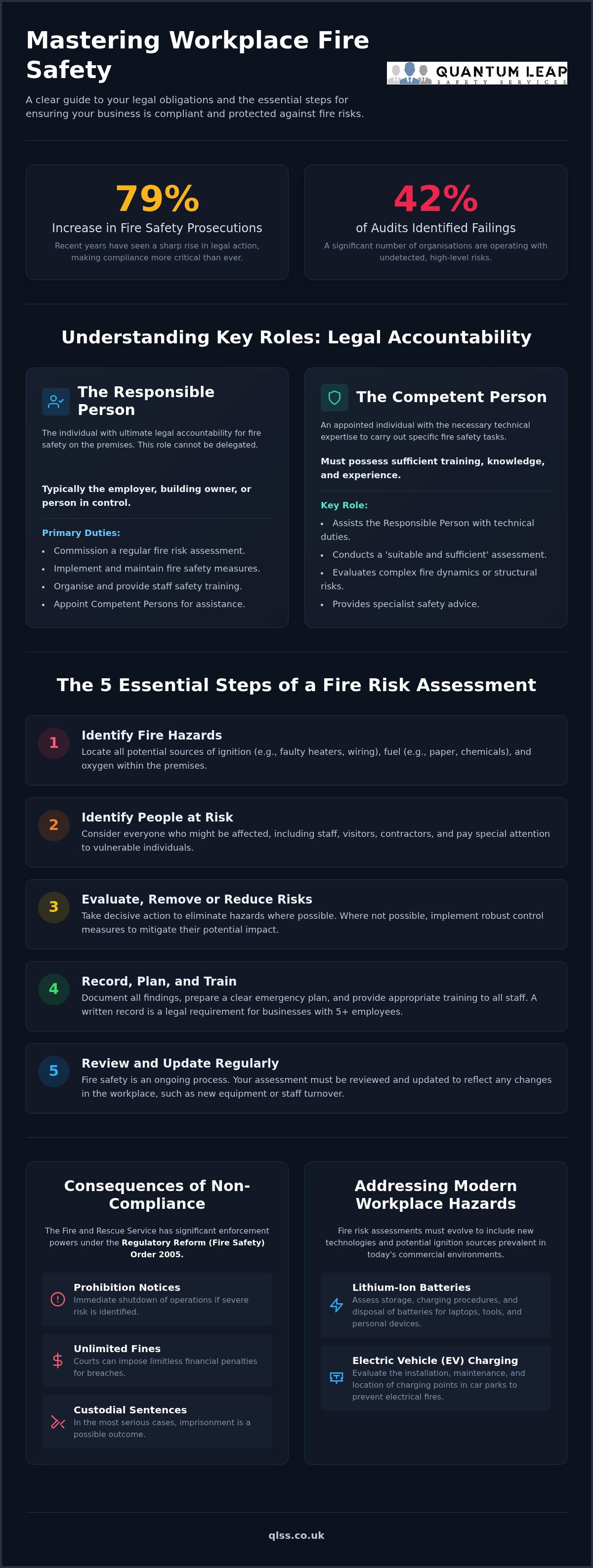
A fire risk assessment for businesses is far more than a tick-box exercise. It's a systematic evaluation of your workplace designed to identify potential hazards, determine who might be at risk, and implement measures to reduce that risk to an acceptable level. By Understanding Fire Safety as a foundational pillar of operational resilience, you move beyond mere compliance. The legal framework is primarily governed by the Regulatory Reform (Fire Safety) Order 2005. Recent 2023 amendments have tightened these rules, specifically requiring that all findings from an assessment are recorded. Whilst previous iterations allowed smaller teams more leeway, current standards dictate that any business with five or more employees must maintain a detailed, written record to satisfy inspectors and ensure total transparency.
The Legal Necessity: Why Compliance Cannot Be Ignored
The consequences of neglecting your fire safety duties are severe. The Fire and Rescue Service acts as the enforcing authority and possesses the power to issue formal notices or shut down operations entirely via prohibition notices. In the most serious cases, non-compliance leads to unlimited fines or custodial sentences for those in charge. Beyond the legal threat, a robust fire safety management plan is a safeguard for your business continuity. Statistics from April 2026 show that 42% of fire safety audits identified failings, which suggests that many organisations are operating under significant risk. Ensuring your documentation is airtight is a pragmatic necessity to protect your staff and your assets.
Who is the "Responsible Person" in Your Organisation?
The law places ultimate accountability on the "Responsible Person." This is typically the employer, the building owner, or the person in control of the premises. If you operate in a shared building, you must coordinate with other tenants and the landlord to ensure the entire site is protected. This role cannot be delegated away; the legal liability remains with you even if you hire external help.
Your primary duties include:
Conducting or commissioning a regular fire risk assessment for businesses.
Implementing and maintaining physical fire safety measures.
Ensuring all staff receive appropriate safety training.
Appointing "Competent Persons" to assist with technical safety tasks.
Whilst the Responsible Person holds the legal liability, they often lack the technical expertise to evaluate complex fire dynamics or structural risks. In these instances, you're required to appoint a Competent Person. This individual must have sufficient training, knowledge, and experience to ensure the assessment is suitable and sufficient for the specific needs of your organisation.
The 5 Essential Steps of a Professional Fire Risk Assessment
A professional fire risk assessment for businesses follows a disciplined, five-step methodology. This structured approach ensures that no detail is overlooked, from the smallest electrical fault to the most complex evacuation route. It's a process that demands both technical knowledge and a practical understanding of your specific operational environment. By following these steps, you create a robust safety culture that prioritises life safety over mere paperwork.
Step 1: Identify the fire hazards. This involves locating sources of ignition, fuel and oxygen within your premises, such as faulty heaters or chemical stores.
Step 2: Identify people at risk. You must consider everyone on the premises, including staff, visitors and those who may be particularly vulnerable.
Step 3: Evaluate, remove or reduce the risks. Take action to eliminate hazards where possible or implement control measures to mitigate the potential impact of a fire.
Step 4: Record findings, prepare an emergency plan and provide training. Documentation is a legal requirement for most UK companies and serves as your primary evidence of compliance during an inspection.
Step 5: Review and update the assessment regularly. Fire safety is not a static state; you must update your fire risk assessment for businesses to reflect structural changes, new equipment or staff turnover.
Hazard Identification: Beyond the Obvious
Identifying hazards requires a clear distinction between ignition sources, such as faulty wiring, and combustible materials like paper or chemicals. Fire load is the total amount of combustible material in a defined space, which determines the potential severity and risk level of a fire. You must also scrutinise hidden hazards in plant rooms and server hubs. Consulting official guidance on risk assessment helps identify these infrastructure vulnerabilities whilst ensuring your records remain comprehensive.
Protecting Vulnerable Persons and Staff
Your assessment must account for every individual on-site, including contractors and the public. For those with mobility issues, you're required to develop Personal Emergency Evacuation Plans (PEEPs). These tailored strategies ensure assistance is available and escape routes are accessible. Clear signage must take centre-stage in your safety strategy. To ensure your documentation integrates seamlessly with your broader fire safety management plans, consider a professional audit of your current evacuation procedures.
Professional vs DIY: Choosing a Competent Fire Risk Assessor
The legal requirement to appoint a "Competent Person" is often where business owners feel the most pressure. Under current UK regulations, the person carrying out your assessment must have sufficient training, experience, and knowledge to identify risks accurately. Whilst a small, low-risk office might manage with a basic DIY template, most modern commercial environments are too complex for a non-specialist. Choosing a professional to conduct your fire risk assessment for businesses ensures that technical nuances, such as smoke travel or fire resistance of partition walls, aren't overlooked. It's a pragmatic choice that shifts the burden of technical accuracy from your shoulders to a qualified expert.
A third-party audit offers an objective perspective that internal staff simply cannot provide. Professional assessors bring a wealth of experience from varied sectors, allowing them to spot emerging hazards and suggest cost-effective mitigation strategies. This external validation is particularly valuable for SME owners who need to demonstrate due diligence to stakeholders, local authorities, and insurers alike. When evaluating a potential partner, you should prioritise those with a proven track record in your specific industry and robust professional credentials.
The Risks of Inadequate Internal Assessments
Familiarity often breeds complacency in the workplace. When staff members walk past a wedged-open fire door or a blocked exit every day, they eventually stop seeing these as hazards. This "confirmation bias" is a primary reason why DIY assessments fail. Common mistakes include missing faulty fire doors or failing to assess the integrity of compartmentation in ceiling voids. The implications extend beyond physical safety. If a fire occurs and your documentation is found to be shallow or invalid, your insurance provider may refuse to pay out. Citing OSHA fire safety standards as a benchmark for international best practice, it's clear that rigorous, detailed inspection is the only way to ensure true operational safety.
What to Look for in a Safety Consultant
A reliable safety consultant acts as a "safe pair of hands" for your organisation. You must verify that they hold adequate professional indemnity insurance and have a documented history of safety experience. We believe that fire safety shouldn't exist in isolation. Our approach focuses on providing common-sense advice that integrates with your existing workflows. For many clients, this involves aligning fire safety protocols with broader quality standards, such as those found in our ISO 9001 implementation services UK. This holistic method ensures that your fire risk assessment for businesses supports a wider culture of excellence and operational stability.
Modern Workplace Hazards: Fire Safety in 2026
Workplace safety requirements in 2026 have shifted significantly as technology evolves. Traditional hazards like paper storage and old wiring remain, but the rapid adoption of lithium-ion technology and electric vehicles has introduced volatile risks that older assessments don't address. A modern fire risk assessment for businesses must account for these high-energy density sources to ensure your workforce is protected and your insurance remains valid. Failure to recognise these emerging threats is a common reason why 42% of safety audits identified failings in the last year.
The rise of hybrid working also presents a logistical challenge for fire safety management. With staff presence fluctuating throughout the week, maintaining consistent fire warden coverage and effective drill frequencies is harder than ever. Additionally, the post-Grenfell regulatory landscape continues to evolve. The amendments to Approved Document B, coming into force on 30 September 2026, place even greater emphasis on structural safety and evacuation provisions, particularly for businesses operating within mixed-use or high-rise developments.
Lithium-Ion Batteries and Electrical Safety
Lithium-ion batteries are now ubiquitous, powering everything from laptops to e-bikes. These devices carry the risk of "thermal runaway," a process where a battery enters an uncontrollable, self-heating state that's notoriously difficult to extinguish. You should establish safe charging protocols that prohibit personal e-mobility devices from being charged in office areas. Commercial equipment requires dedicated, ventilated charging zones. Staff must be trained to recognise the early signs of battery failure, such as bulging, hissing, or unusual heat, to prevent a localised fault from becoming a major incident.
Evolving Office Layouts and Fire Compartmentation
Modern "open-plan" designs and "breakout" spaces can significantly alter smoke travel patterns. Without the traditional "cellular" office structure, fire can spread more rapidly across a large floor plate. It's vital to maintain fire door integrity, especially in high-traffic commercial centres where doors are often illegally wedged open. If you've recently completed internal office renovations, you have a legal duty to review your fire risk assessment for businesses. This ensures that your fire compartmentation strategy hasn't been compromised by new partitions or altered escape routes.
If you're unsure whether your current safety protocols account for these 2026 risks, our fire safety management experts can provide a comprehensive audit to secure your premises.
Integrating Fire Safety into Total Business Compliance
Fire safety is frequently isolated as a standalone task, yet it functions best when woven into the fabric of your daily operations. A fire risk assessment for businesses should never be a document that sits on a shelf until the next audit. It's a living strategy that informs your equipment maintenance, staff training, and capital expenditure. By treating fire safety as a core component of your broader QSHE framework, you ensure that safety becomes a shared responsibility rather than a burden for a single individual. This methodical approach ensures that your organisation remains resilient against both physical risks and legal scrutiny.
Linking your findings to comprehensive fire safety management plans allows for a more disciplined approach to risk. This integration prevents "compliance drift," a common phenomenon where safety standards gradually decline as other business priorities take precedence. Regular audits and inspections act as a necessary reset, ensuring that your protocols remain as sharp as they were on the day they were first drafted. When fire safety is integrated into total business compliance, you create a demonstrably safe environment that satisfies insurers and regulators alike.
From Documentation to Safety Culture
A true safety culture begins when staff members recognise hazards as part of their routine behaviour. It's not enough to have a written plan; your team must know how to act upon it. This requires regular fire warden training and evacuation drills that reflect your actual working patterns, including hybrid schedules. You can use safety software to track review dates and remedial actions, which helps automate the administrative side of compliance. This ensures you never miss a critical update whilst keeping your documentation organised and accessible for any snap inspections.
The Managed Service Advantage for SMEs
For many SMEs, the complexity of 2026 regulations can feel overwhelming. A managed service retainer model provides the "safe pair of hands" you need to navigate these requirements whilst you focus on growth. It gives the Responsible Person immediate access to competent advice whenever the business changes, whether you're moving premises or adopting new technology. This proactive approach is far more cost-effective than reacting to an enforcement notice or an insurance dispute. It provides the long-term stability needed to manage corporate responsibility with confidence.
To secure your organisation's future and ensure your documentation is airtight, contact Quantum Leap Safety Services for a comprehensive audit of your current fire risk assessment for businesses and management protocols.
Securing Your Workplace Future in 2026
Maintaining a compliant fire risk assessment for businesses is no longer a static requirement; it's a dynamic part of operational resilience. Navigating the technical shifts of 2026, from lithium-ion battery storage to the latest amendments in building regulations, confirms that safety requires constant vigilance. By moving beyond basic templates and adopting a systematic management approach, you protect your workforce whilst insulating your organisation from the rising tide of enforcement actions and insurance disputes.
Quantum Leap Safety Services acts as your dedicated partner in this journey. Our expert consultants provide national coverage and deliver pragmatic advice tailored specifically to the needs of UK SMEs. Whether you require a one-off audit or comprehensive QSHE managed services, we offer the steady hand needed to navigate intricate legal duties. It's time to transform your safety documentation from a source of anxiety into a robust asset for business continuity.
Don't leave your compliance to chance. Secure your business with a professional Fire Risk Assessment from Quantum Leap Safety Services and gain the legal peace of mind your organisation deserves. We're here to help you build a safer, more stable future for your entire team.
Frequently Asked Questions
How often should a business fire risk assessment be reviewed?
You should review your assessment at least every 12 months or whenever a significant change occurs within your workplace. This includes structural alterations, changes in staff numbers, or the introduction of new equipment like EV charging points. Regular reviews prevent "compliance drift" and ensure your safety protocols remain effective against evolving hazards. If a fire incident or a "near miss" happens, you must update the document immediately to reflect any lessons learned.
Is it a legal requirement to have a written fire risk assessment?
It's a strict legal requirement to maintain a written fire risk assessment for businesses if you employ five or more people. Following the 2023 legislative amendments, the threshold for recording findings has become more stringent for UK organisations. Even if you employ fewer than five staff, keeping a written record is a pragmatic way to demonstrate due diligence to the Fire and Rescue Service and your insurance provider during an inspection.
Can I carry out my own fire risk assessment for my small business?
You can perform the assessment yourself if you're a "competent person" with the necessary training, knowledge, and experience. However, for most modern commercial environments, a DIY approach carries significant risks. It's easy to overlook technical details like fire compartmentation or the specific storage requirements for lithium-ion batteries. Appointing a professional consultant provides a "safe pair of hands" and ensures your documentation meets the high standards expected by enforcing authorities.
What happens if my business fails a fire safety inspection?
If your premises fail an inspection, the Fire and Rescue Service can issue an informal notice, an enforcement notice, or a prohibition notice. An enforcement notice requires you to fix specific failings within a set timeframe. A prohibition notice is more severe and can shut down your operations immediately if there's an imminent risk to life. Repeated failure to comply can lead to unlimited fines or custodial sentences for the Responsible Person.
Do I need a separate fire risk assessment for a home office?
You generally don't need a formal commercial assessment for a standard home office used only by yourself. However, if you employ staff who work at your property or if you regularly host business visitors, your home becomes a place of work under the law. You must then evaluate the risks to ensure the safety of anyone entering the premises. This is particularly important for businesses that store commercial stock or equipment in residential settings.
How much does a professional fire risk assessment cost for a UK business?
The cost varies significantly based on the size, complexity, and risk level of your specific premises. A small retail unit or a simple office will naturally require less time to evaluate than a large industrial warehouse or a high-rise commercial centre. You should always seek a tailored quote that reflects your building's unique infrastructure. Investing in a professional evaluation ensures your fire risk assessment for businesses is suitable, sufficient, and legally robust for 2026 standards.
What is the difference between a fire safety audit and a fire risk assessment?
A fire risk assessment is a systematic evaluation of physical hazards and the people at risk within your building. A fire safety audit is a broader examination of your entire management system. It checks whether you're actually following your safety plan by reviewing training records, maintenance logs, and evacuation drill results. Whilst the assessment identifies what needs to be done, the audit verifies that those actions are being performed consistently and correctly.
Who is responsible for fire safety in a multi-tenant office building?
Responsibility is shared between the landlord and the individual business tenants. The landlord or building owner is typically the "Responsible Person" for common areas like lobbies, stairwells, and shared plant rooms. Each tenant is responsible for fire safety within their own leased office space. You have a legal duty to coordinate with other occupiers and the landlord to ensure the building's overall emergency plan and fire alarm systems are fully integrated.


Comments