
Fire Safety Audit for Commercial Property: The 2026 Compliance Checklist
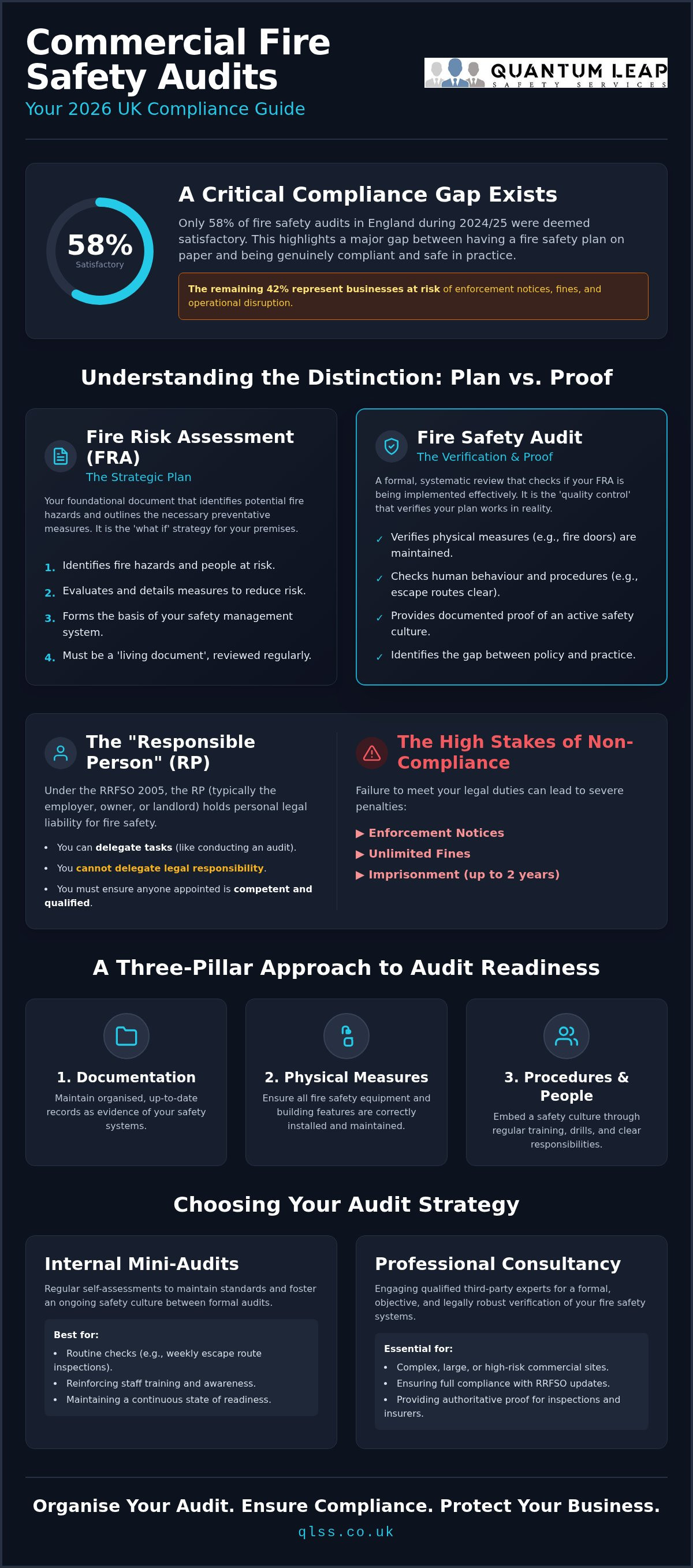
Did you know that only 58% of fire safety audits conducted in England during 2024/25 were deemed satisfactory? This statistic highlights a significant gap between simply having a fire plan and actually being compliant. For many business owners, the process remains shrouded in confusion, particularly when trying to distinguish a standard Fire Risk Assessment from a formal fire safety audit for commercial property.
It's understandable to feel anxious about potential enforcement notices or the prospect of unlimited fines, especially when managing compliance whilst overseeing multiple sites. You want to ensure your premises are safe without the constant worry of legal penalties or business interruption. This article provides the clarity you need to master the 2026 regulatory landscape with a pragmatic, step-by-step approach.
We've compiled an expert-led checklist and regulatory guide specifically for UK businesses. You'll learn how to organise your documentation, meet your obligations under the Regulatory Reform (Fire Safety) Order 2005, and approach your next inspection with absolute confidence. We preview the essential checks required to maintain a steady, professional grip on your organisation's fire safety management and ensure you remain audit-ready 365 days a year.
Table of Contents
Fire Safety Audit vs. Fire Risk Assessment: Understanding the Distinction
Legal Obligations and the Role of the Responsible Person in 2026
Internal Self-Assessment vs. Professional Third-Party Audits
The Comprehensive Fire Safety Audit Checklist for Commercial Premises
Implementing Audit Findings: From Compliance Gaps to Managed Safety
Fire Safety Audit vs. Fire Risk Assessment: Understanding the Distinction
Many commercial property owners use the terms "Fire Risk Assessment" and "Fire Safety Audit" interchangeably. This is a mistake that can lead to significant compliance gaps. Whilst they are related, they serve two distinct purposes in your safety management system. An FRA identifies what could go wrong and how to prevent it. A fire safety audit for commercial property confirms that those preventative measures actually work in the real world. Think of the FRA as your strategy and the audit as your quality assurance.
Having a documented FRA is not enough to satisfy the Fire and Rescue Service if the controls it specifies are not being audited regularly. An audit checks the behaviour of the building and its occupants, not just the hardware. It is one thing to have a fire alarm system installed; it is another to ensure that staff don't ignore it or that fire doors aren't wedged open with extinguishers. The audit identifies the difference between what is written in your policy and what is happening on the shop floor.
The Planning Phase: The Fire Risk Assessment
The FRA is your foundational planning document. It typically follows a structured five-step process: identifying fire hazards, identifying people at risk, evaluating and reducing risks, recording significant findings, and reviewing the document. It is not a "set and forget" file. Because buildings, occupancy levels, and staff change, your fire risk assessment for businesses must remain a living document that evolves with your operations. You need this baseline to establish your Fire safety policies and determine which physical controls are necessary for your specific site.
The Verification Phase: The Fire Safety Audit
If the FRA is the plan, the audit is the verification. It tests the reality of your safety management by looking for evidence of compliance. A Fire Safety Audit is a formal review of an organisation's fire safety records and physical measures. This process clarifies whether your fire doors are actually maintained and kept shut, rather than just noting their existence on a floor plan. It acts as the "quality control" for your entire fire safety management plan. By conducting a fire safety audit for commercial property, you ensure that the promises made in your risk assessment are being kept by everyone on site, every day. It provides the documented proof that your safety culture is active and effective.
Legal Obligations and the Role of the Responsible Person in 2026
The legal landscape for fire safety in the UK has shifted significantly since the introduction of the Regulatory Reform (Fire Safety) Order 2005 (RRFSO). Recent amendments in 2021 and 2023 have tightened these requirements, placing a heavier burden on those in control of premises. It's no longer enough to merely "have" a plan; you must demonstrate active, documented management. Regulatory bodies are increasingly aligned on the need for rigorous oversight. For example, specific Federal fire safety regulations highlight how critical it is for responsible entities to document every safety measure, a principle that is now central to the UK's 2026 compliance landscape. For UK businesses, a fire safety audit for commercial property is now a critical tool for proving legal adherence.
At the heart of this framework is the "Responsible Person" (RP). This individual, typically the employer, owner, or landlord, carries the legal weight of ensuring the building is safe. In 2026, personal liability is a reality. Failure to comply can result in formal enforcement notices, unlimited fines, or even imprisonment for up to two years. The Fire and Rescue Service has increased its inspection frequency, focusing on whether the RP has taken "reasonably practicable" steps to protect occupants. A key focus this year is the concept of competence. The RP doesn't have to conduct the audit personally, but they are responsible for ensuring the person they appoint is qualified. You can't delegate the legal responsibility, only the task. This is why many organisations choose professional fire safety management to ensure their audits stand up to scrutiny.
Identifying the Responsible Person
In multi-tenanted commercial properties, identifying the RP can be complex because there is often more than one. Each tenant is responsible for their demised area, whilst the landlord handles common parts and the building structure. The law demands a duty to cooperate and coordinate. If one tenant's actions compromise the fire exit of another, both parties must resolve it together. For those running smaller firms, our guide on small business fire safety compliance provides a clearer breakdown of these shared roles and obligations.
Statutory Duties Under the 2026 Framework
The 2026 framework requires all fire safety arrangements to be recorded, regardless of the number of employees. This removes the previous "five employee" threshold for written documentation. Additionally, the Fire Safety Act 2021 expanded the scope of a fire safety audit for commercial property to include the building’s external walls and structure. There is a clear move towards the "golden thread" of information. This involves maintaining digital, easily accessible records of every inspection, maintenance check, and risk assessment review to ensure transparency throughout the building's lifecycle.
Internal Self-Assessment vs. Professional Third-Party Audits
Effective fire safety management relies on a two-tier approach. While a professional fire safety audit for commercial property is a cornerstone of compliance, it shouldn't be the only time you examine your safety systems. A robust strategy balances frequent internal vigilance with periodic external expertise. This ensures that safety is a continuous process rather than a once-a-year event. Relying solely on internal staff can sometimes lead to "familiarity blindness," where hazards are overlooked because they've become part of the furniture. Professional third-party audits provide the technical depth and unbiased perspective needed for high-level assurance.
Internal mini-audits help maintain a safe culture by making compliance part of the daily routine. They allow you to catch minor issues, like a faulty door closer or a blocked extinguisher, before they become significant hazards. Professional audits then act as the "stress test" for these internal systems, providing a "defence of due diligence" in legal proceedings. If an incident occurs, having a record of professional verification proves that you took all reasonable steps to meet your duties under the RRFSO 2005.
The Case for Monthly Internal Checks
Monthly internal checks are essential for maintaining the "hardware" of your building. Routine testing of fire alarms, emergency lighting, and fire door functionality should be recorded clearly in your fire logbook. An up-to-date logbook is often the first thing an inspector asks for; if it's incomplete, you're likely to fail a formal audit before the physical inspection even begins. These routine checks don't just keep you compliant. They also empower staff to take ownership of their immediate work environment, which fosters proactive safety behaviour amongst the entire team.
Why Professional Audits are Essential
Professional audits go beyond the visible surface to assess deep-dive technical compliance. Auditors examine complex elements like compartmentation, which involves checking that walls and ceilings can contain a fire for a specific duration. They also verify the condition of fire dampers and other hidden systems that internal staff aren't typically trained to assess. This level of detail is vital for providing an unbiased report that satisfies insurers and stakeholders.
When considering the fire risk assessment cost, it's vital to view it in the context of professional value and risk mitigation. A professional fire safety audit for commercial property offers the "fresh pair of eyes" needed to spot subtle risks that internal teams might miss. This professional oversight provides the steady, reliable guidance required to navigate complex corporate responsibilities and ensure long-term operational stability.
The Comprehensive Fire Safety Audit Checklist for Commercial Premises
A successful fire safety audit for commercial property requires a systematic approach to both physical checks and paperwork. To maintain a disciplined safety regime, you should categorise your efforts into three distinct pillars: Documentation, Physical Measures, and People. By treating this checklist as a working document, you can identify gaps before they result in enforcement action. The fire logbook remains the single most important document in this process; it serves as the primary evidence that your safety systems are functional and managed.
If you find the breadth of these requirements challenging to manage internally, our Audit & Inspection Services act as a safe pair of hands to ensure every detail is accounted for. We help you move from a reactive state to a position of managed safety and operational efficiency.
Pillar 1: Documentation and Record Keeping
Documentation provides the audit trail that proves your commitment to safety. Ensure the following records are organised and accessible:
Valid Fire Risk Assessment: Verify that your FRA has been reviewed within the last 12 months or following any significant building changes.
Fire Logbook: Check for consistent records of weekly fire alarm tests and six-monthly emergency lighting services.
Maintenance Certificates: Collate up-to-date service records for fire extinguishers, dry risers, and sprinkler systems.
Training Evidence: Maintain a clear register of staff fire safety training and logs of recent fire evacuation drills.
Pillar 2: Physical Fire Protection Measures
Physical measures are the hardware that protects your premises and occupants. Regular inspections should include these actionable steps:
Fire Doors: Check for physical damage; ensure they close fully into the frame and that intumescent seals are intact.
Escape Routes: Verify that all corridors and stairwells are completely clear of obstructions and combustible materials like waste packaging.
Signage and Lighting: Ensure all fire exits are clearly marked with compliant signage and that emergency lighting units are operational.
Compartmentation: Inspect fire-resisting walls for breaches, particularly where new cable runs or pipes have been installed by contractors.
Pillar 3: Operational Procedures and Training
The human element is often where safety systems fail. A fire safety audit for commercial property must scrutinise your operational readiness:
Evacuation Planning: Confirm you have a clear plan in place, including Personal Emergency Evacuation Plans (PEEPs) for individuals with specific needs.
Fire Wardens: Verify that a sufficient number of trained wardens are present during all shifts to manage an evacuation.
Arson Prevention: Check that external waste bins are secured in a designated area away from the building structure to reduce fire risk.
The Responsible Person is the individual accountable for ensuring these checks are completed.
Implementing Audit Findings: From Compliance Gaps to Managed Safety
Receiving the results of a fire safety audit for commercial property is only the beginning of the process. The real value lies in how you translate those findings into a safer, more resilient working environment. Without a structured plan for remediation, the audit remains a list of vulnerabilities rather than a roadmap for stability. You must categorise every "Significant Finding" to ensure that resources are allocated where they are most needed. This methodical approach ensures your business remains operational, safe, and legally protected from the scrutiny of the Fire and Rescue Service.
Prioritising Remedial Actions
Findings from a professional audit are typically ranked by risk level: High, Medium, and Low. High-risk items represent immediate threats to life safety. These might include a blocked fire exit, a non-functional alarm, or a significant breach in compartmentation. Such issues require immediate intervention, often within 24 to 48 hours. Medium-risk items, such as a damaged fire door seal or an outdated training record, should be addressed within a clearly defined window, usually a few weeks. Low-risk findings often involve administrative improvements or long-term maintenance suggestions.
Setting realistic timescales for these works is a pragmatic necessity. Whilst a door closer can be replaced quickly, complex installations like a new sprinkler system or smoke ventilation upgrades require significant lead times and capital investment. If an action cannot be completed immediately due to logistical constraints, it is vital to document the "why" and implement temporary mitigating measures. This demonstrates to inspectors that you are managing the risk proactively. It proves you aren't simply ignoring the findings but are working through them in a disciplined manner.
The Advantage of Managed Fire Safety
Navigating these remedial actions can be overwhelming for busy decision-makers managing multiple sites. A professional fire safety management plan ensures that audit findings are seamlessly integrated into your daily operations. This creates a "closed-loop" system where every identified gap is tracked until completion. If it isn't recorded, it didn't happen in the eyes of the law. Having a safety consultant act as a "safe pair of hands" to liaise with enforcement officers can also prevent unnecessary penalties or business interruptions.
A managed service takes the burden of audit-readiness off your shoulders. It ensures your fire safety audit for commercial property results in long-term compliance rather than a one-off fix. This steady, reliable oversight allows you to focus on your core business whilst we handle the complexities of corporate responsibility and regulatory adherence.
Enquire about our Fire Safety Management services to ensure your property is always audit-ready.
Securing Your Premises Through Proactive Fire Safety Management
Navigating the 2026 regulatory landscape requires more than just a static file on a shelf. A robust fire safety audit for commercial property ensures that your identified controls are functioning in practice, protecting both your occupants and your legal standing. By distinguishing between your foundational risk assessment and the systematic verification of an audit, you move from simple awareness to active, managed safety. This disciplined approach clarifies the duties of the Responsible Person and ensures that every remedial action is tracked to completion.
Quantum Leap Safety Services has provided steady, expert guidance since 2012, helping businesses simplify complex fire safety legislation with pragmatic solutions. Our comprehensive QSHE managed services for SMEs provide the reliable oversight needed to maintain audit-readiness throughout the year. Secure your business with a professional Fire Safety Audit from Quantum Leap Safety Services. Building a resilient safety culture supports your long-term operational stability and provides peace of mind for everyone on site.
Frequently Asked Questions
What is the difference between a fire risk assessment and a fire safety audit?
A fire risk assessment is a foundational document that identifies hazards and control measures. Conversely, a fire safety audit for commercial property is a systematic review that verifies those controls are actually being implemented. The assessment sets the strategy; the audit tests the execution. In 2026, regulators expect to see that the audit process validates the real-world behaviour of both the building and its occupants, ensuring plans aren't just theoretical.
How often should a commercial property have a fire safety audit?
Best practice suggests that a fire safety audit should be conducted at least annually to ensure your management systems remain effective. However, you must also trigger an audit following significant building alterations, changes in occupancy, or after any fire-related incident. For high-risk premises or complex multi-tenanted sites, more frequent reviews are often necessary to maintain a steady approach to compliance. This ensures your safety culture remains robust and your legal obligations are fulfilled.
Who is legally allowed to conduct a fire safety audit in the UK?
The law requires the Responsible Person to ensure that whoever conducts the audit is competent. Whilst internal staff can perform basic monthly checks, a professional fire safety audit for commercial property should be conducted by someone with appropriate training and technical knowledge. For complex sites, third-party consultants are often employed to provide an unbiased deep-dive into areas like compartmentation. This professional oversight ensures your business remains audit-ready and avoids the risk of significant legal penalties.
What happens if a business fails a fire safety audit by the Fire and Rescue Service?
If the Fire and Rescue Service deems your premises unsatisfactory, they may issue an informal notice or a formal enforcement notice. Serious breaches can lead to prohibition notices, which prevent you from using all or part of your building. Since October 2023, the maximum fine for specified offences is unlimited. In severe cases, non-compliance can result in imprisonment for up to two years. These penalties highlight the serious responsibility of managing fire safety in modern enterprises.
Do small shops and offices really need a full fire safety audit?
Every non-domestic premises must have a fire risk assessment and a method for verifying its effectiveness. The 2026 framework requires all fire safety arrangements to be recorded, regardless of business size. Whilst a small shop might require a less complex audit than a large warehouse, the legal duty to ensure safety measures are functioning remains identical. Small businesses often use managed services to keep these processes simple, ensuring they meet their obligations without diverting essential resources.
What are the most common reasons for failing a fire safety audit?
Common failures include incomplete fire logbooks, wedged-open fire doors, and obstructed escape routes. Auditors also frequently find outdated fire risk assessments that don't reflect current building layouts or staff numbers. Other issues include poor maintenance of emergency lighting and a lack of documented fire warden training. These administrative and physical oversights are often signs of a safety culture that has become reactive. A methodical audit identifies these gaps before they lead to formal enforcement action.
How long does a professional fire safety audit typically take to complete?
The duration depends on the size and complexity of the premises. A small, single-storey office might be audited in two to three hours. Larger industrial sites or multi-tenanted buildings can take a full day or more to complete properly. This time includes a physical inspection of the site and a thorough review of your documentation, such as maintenance certificates and training logs. The process is designed to be thorough, ensuring every safety measure is checked.
Is a digital fire logbook legally acceptable during an audit in 2026?
Digital fire logbooks are fully acceptable and increasingly encouraged in 2026. They align with the golden thread principle of maintaining accessible, transparent safety records throughout a building's lifecycle. A digital system ensures that records cannot be lost or damaged and allows for easy sharing with Fire and Rescue Service officers during an inspection. It provides a steady, reliable way to track weekly tests and maintenance schedules across multiple sites, ensuring you are always prepared for an official visit.


Comments