
Health and Safety Retainer Fees: A 2026 Guide to QSHE Managed Service Costs
A "cheap" safety helpline often becomes the most expensive mistake a small business can make when a tender deadline looms or an HSE inspector arrives at the gate. While many providers lead with low entry prices, the reality of health and safety retainer fees is often obscured by hidden charges for site visits or document reviews. You need a partner that acts as a steady, reliable extension of your team, providing the technical authority required to pass complex PQQ requirements without the unpredictability of hourly billing.
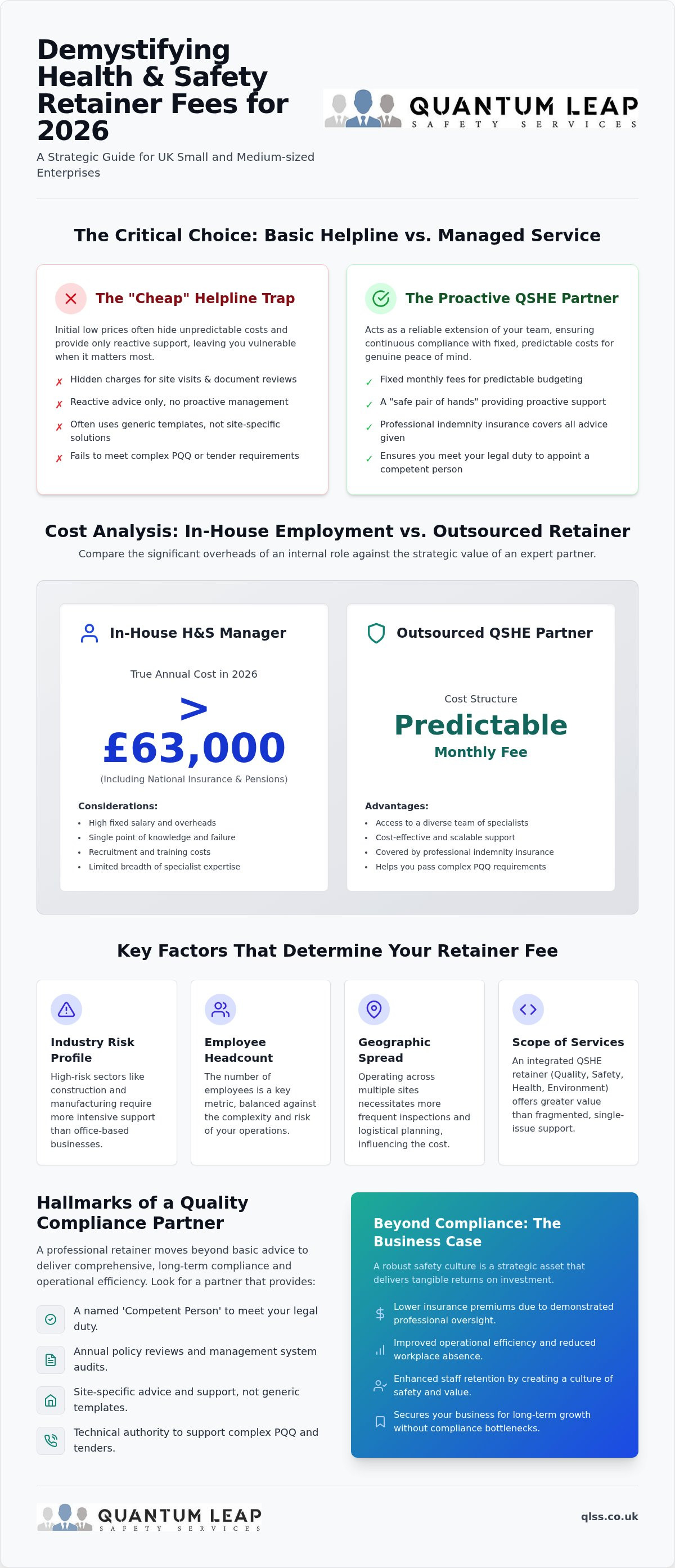
It's understandable to feel anxious about non-compliance fines or the sheer complexity of modern safety regulations. The true annual cost to employ a mid-level in-house health and safety manager now often exceeds £63,000 when accounting for National Insurance and pensions, making outsourced support a pragmatic choice for many. This guide demystifies how health and safety retainer fees are structured in 2026, moving beyond basic advice lines to explore the value of a fully managed QSHE service. You'll discover how to secure fixed, predictable monthly costs while ensuring you always have access to a competent person who understands your operational constraints. We will examine the differences between entry-level support and comprehensive compliance solutions, helping you choose a partner that offers genuine peace of mind.
Table of Contents
Understanding the Legal Requirement for Competent Safety Advice
Regulation 7 of the Management of Health and Safety at Work Regulations 1999 creates a clear statutory duty for every UK employer. You must appoint one or more "competent persons" to assist in undertaking the measures required by law. Whilst the regulation suggests looking internally first, most SMEs lack the technical depth to manage complex Occupational safety and health requirements without external support.
Investment in health and safety retainer fees provides a structured way to meet this duty. Unlike a basic helpline that only reacts when you call, a proactive managed service acts as a "safe pair of hands" for your compliance needs. This professional partnership also provides a layer of protection through professional indemnity insurance. When you rely on external consultants, their insurance covers the advice they provide; this is a safeguard that "DIY" safety management simply cannot offer.
The Consequences of Non-Compliance
Relying on luck or outdated templates is a high-risk strategy. The Health and Safety Executive (HSE) operates a "Fee for Intervention" (FFI) scheme, where businesses found in material breach of health and safety law are charged for the inspector's time. In 2026, these costs escalate rapidly, often exceeding the price of an annual retainer within a few hours of an inspection. Beyond financial penalties, directors face personal liability. Proving you have access to competent advice via a formal retainer is a primary defence against claims of negligence or corporate manslaughter.
Beyond Legal Minimums: The Business Case
Safety management is about operational excellence, not just avoiding fines. Implementing outsourced QSHE managed services helps create a culture where employees feel valued and secure. This stability directly impacts staff retention and reduces the hidden costs of workplace absence.
A documented safety record also carries weight with insurers. Many providers offer lower premiums to businesses that can demonstrate consistent, professional oversight. By integrating fire safety and occupational health into your health and safety retainer fees, you transform a legal obligation into a strategic asset that secures your business for the long term. This approach ensures you're prepared for tenders and ready to grow without the fear of compliance bottlenecks.
Factors That Influence Health and Safety Retainer Fees
Determining the right budget for compliance requires a nuanced understanding of your operational footprint. Whilst many providers offer "per employee" pricing, this model often fails to account for the actual complexity of the work involved. A small firm in a high-risk sector often requires more intensive support than a large office-based enterprise. Consequently, health and safety retainer fees are typically calculated based on a combination of headcount, industry risk, and the physical location of your operations.
Geographic spread plays a significant role in cost. If your business operates across multiple sites, the frequency of required inspections and associated travel costs will naturally increase the monthly fee. A comprehensive managed service ensures these visits are scheduled logically to maintain a steady rhythm of compliance. It's also vital to consider the scope of the service; a retainer that integrates fire safety management and environmental protocols offers better long-term value than a fragmented approach. Meeting the Legal Requirement for a Competent Person is the baseline, but the fee reflects the technical authority provided to your team.
Sector-Specific Fee Drivers
High-risk sectors demand specialised expertise that commands a different fee structure. For example, a health and safety audit for renewable projects involves navigating complex technical standards and environmental regulations that aren't present in standard commercial settings. Similarly, construction QSHE requires a deep understanding of CDM 2015 regulations and frequent site-level inspections. Manufacturing and warehousing also face unique challenges, such as workplace transport and machinery safety, which dictate a more rigorous audit schedule compared to low-risk environments.
Variable vs. Fixed Retainer Elements
Clarity on what is included in your fixed monthly fee prevents budget creep. Standard maintenance of your safety management system is typically a core element, but larger projects like ISO 45001 implementation are often treated as separate, fixed-fee exercises. Adding occupational health surveillance or bespoke training management can also adjust the baseline. If you're looking for a "safe pair of hands" to manage these variables, you might consider a Business Total Compliance Solution that consolidates these requirements into one predictable cost. This approach ensures your technical support scales alongside your business without hidden surprises during tender season.
Comparing Retainers: Outsourced Safety vs. In-House Hiring
Deciding between hiring an internal manager and outsourcing is a critical financial decision for any growing enterprise. In 2026, the average salary for a mid-level in-house health and safety manager in the UK is approximately £50,000. However, the total cost of employment, which includes National Insurance, pension contributions, and holiday pay, typically ranges between £63,000 and £75,000 annually. For many SMEs, health and safety retainer fees represent a fraction of this expenditure whilst providing broader technical coverage.
An in-house hire offers dedicated time, but they are often a generalist. A managed service provides a collective knowledge base that no single individual can match. If you face a complex environmental audit or a niche renewable project requirement, a single hire might struggle to keep pace with changing legislation. A retainer scales with your needs. When project volumes fluctuate, you aren't tied to a fixed salary; you have a partner that adjusts to your operational pace without the overhead of a full-time headcount.
The Hidden Costs of In-House Compliance
Beyond the basic salary, several "invisible" costs accompany an internal hire. You must fund mandatory Continuing Professional Development (CPD) and professional memberships, such as IOSH or IEMA, to ensure their advice remains valid. There's also the investment in safety software, equipment, and audit tools. Perhaps most critically, a single hire creates a "single point of failure." If your manager is away on holiday or sickness leave during an HSE inspection, your business is left vulnerable. A managed service ensures constant availability and a "safe pair of hands" at all times.
When to Move from Ad-hoc to a Retainer
Many businesses start with ad-hoc support, but this often leads to the "day rate trap." With generalist consultant rates in the UK typically ranging from £250 to £700 per day, costs can spiral quickly during busy periods or tender seasons. Predictable health and safety retainer fees eliminate the uncertainty of these daily charges, allowing for better financial planning.
Transitioning to a retainer also ensures long-term continuity. Your consultant learns your site culture, understands your historical risks, and builds a relationship with your team. Working with established health and safety consultants UK ensures you receive consistent advice that builds on previous audits, rather than starting from scratch with a new contractor every time a need arises.
What Should Be Included in a Professional QSHE Retainer?
A basic advice line often leaves the heavy lifting to the business owner. A professional managed service should handle the technical burden instead. When evaluating health and safety retainer fees, it's essential to look beyond the monthly price and scrutinise the service level agreement. A robust retainer provides a comprehensive safety net that covers policy updates, site inspections, and the critical support needed to win new business through tenders.
A standard professional package should include the following core elements as a minimum:
Annual Policy Reviews: Ensuring your Health and Safety Policy and Management Systems reflect current operations and the latest UK legislation.
Competent Advice: Unlimited telephone and email support to satisfy your legal duty for access to expert guidance.
Documented Inspections: Scheduled on-site audits that result in actionable, professional reports to prove compliance to stakeholders.
Accreditation Support: Practical assistance with PQQ submissions and industry-standard accreditations such as CHAS, SafeContractor, or Alcumus.
Integrated Management Systems Support
Maintaining high standards across quality, environmental, and safety protocols requires constant vigilance. Many businesses utilise ISO 9001 implementation services UK to establish a foundation for growth, but a retainer ensures these systems don't gather dust. An integrated approach includes oversight for ISO 14001 (Environmental) and ISO 45001 (Occupational Health), keeping your management system "audit-ready" throughout the year. This prevents the frantic rush often seen before external certification visits and ensures your processes remain efficient and compliant.
Fire Safety and Emergency Planning
Fire safety is a critical component that shouldn't be managed in isolation. A professional retainer incorporates fire safety management plans into your broader compliance strategy. This includes coordinating fire risk assessments, organising staff warden training, and updating emergency procedures as your workplace evolves. By including these services in your health and safety retainer fees, you ensure that emergency planning is proactive rather than a reactive response to a near-miss.
If you need a partner to manage these complexities and secure your business's future, contact us for managed compliance support today.
Choosing the Right Retainer Structure for Your Business
Selecting a compliance partner based solely on the lowest monthly cost often results in significant hidden expenses. The "cheap helpline" model typically relies on call centre staff reading from scripts rather than qualified consultants who understand your specific operational risks. When evaluating health and safety retainer fees, the priority must be the quality and technical authority of the advice provided. A low-cost service that provides generic templates instead of site-specific risk assessments will likely fail to protect your directors during an HSE inspection or a complex tender process.
A transition from fragmented, reactive safety tasks to a managed service model requires a strategic shift. Rather than treating safety as a series of isolated hurdles, a managed service integrates compliance into your daily operations. To ensure ongoing value, you should set clear Key Performance Indicators (KPIs) for your consultant. These might include maintaining a specific audit score, achieving a 100% success rate in PQQ safety submissions, or ensuring all policy reviews are completed at least 30 days before their expiry. These metrics transform your retainer from a passive insurance policy into an active driver of business efficiency.
The Quantum Leap Approach to Managed Services
Since our establishment in 2012, we've operated on a "safe pair of hands" philosophy. We understand that SMEs don't just need a phone number; they need a dedicated partner who can navigate the intricacies of quality, safety, health, and environmental management. Our QSHE managed services consolidate these requirements into a single, predictable monthly fee, eliminating the administrative burden of managing multiple contractors.
Our national network of qualified auditors and consultants ensures that you receive expert support regardless of your location in the UK. We don't believe in generic solutions. Whether you're managing high-risk renewable projects or complex construction sites, our team provides the technical depth required to secure your operations and your reputation. This integrated approach ensures that your fire safety, occupational health, and ISO management systems work in harmony rather than in silos.
Next Steps: Securing Your Compliance Partner
The first stage in securing a reliable partner is conducting a thorough gap analysis. This process identifies exactly where your current safety management system falls short of legal requirements or industry standards. Once this baseline is established, you can request a bespoke proposal that reflects your specific risk profile and business objectives. Avoid providers who offer "one size fits all" packages without first understanding your site-specific challenges.
If you're ready to move away from unpredictable costs and generic advice, it's time to invest in a solution that scales with your ambitions. Contact Quantum Leap Safety Services for a transparent compliance quote and discover how our managed services provide the stability your business needs to thrive.
Securing Business Growth Through Professional Managed Services
Managing complex compliance requirements doesn't have to be a source of financial anxiety or administrative frustration. Transitioning to a managed service model provides the technical authority needed to navigate HSE inspections and rigorous tender processes without the high overheads of internal recruitment. By establishing predictable health and safety retainer fees, your business gains access to a collective knowledge base that scales alongside your operational needs.
Quantum Leap Safety Services acts as a steady, reliable partner for SMEs across the UK. We provide pragmatic, professional advice and specialise in high-risk renewable and construction sectors. Our national coverage ensures that your sites remain compliant and your teams stay protected through every stage of your project lifecycle. Get a transparent QSHE retainer quote from Quantum Leap Safety Services and take the first step towards a more resilient, compliant future. Taking control of your safety obligations today builds a stronger foundation for the opportunities of tomorrow.
Frequently Asked Questions
What is the average cost of a health and safety retainer in the UK for 2026?
UK health and safety retainer fees vary significantly based on company size, headcount, and operational risk profile. Fees are typically structured to provide a fixed, predictable monthly cost that reflects the frequency of site inspections and the level of technical authority required. Comprehensive managed services for medium-sized enterprises include regular audits and documentation reviews, ensuring that the cost of compliance scales proportionally with the complexity of your business operations.
Is a health and safety retainer a legal requirement for small businesses?
Whilst the law doesn't specifically use the word "retainer," every employer must appoint a "competent person" under the Management of Health and Safety at Work Regulations 1999. For many small businesses, an external retainer is the most pragmatic way to meet this statutory duty. It ensures you have continuous access to professional advice without the overhead of a full-time hire, fulfilling your legal obligation to manage workplace risks effectively.
How do retainer fees differ between low-risk offices and high-risk construction sites?
Higher-risk environments like construction sites or renewable energy projects require more intensive oversight than low-risk office spaces. These sectors demand specialised knowledge of regulations such as CDM 2015 and involve more frequent site inspections. Consequently, the technical depth and time commitment required for these industries naturally influence health and safety retainer fees, ensuring that the level of support matches the complexity of the hazards being managed.
Can a health and safety retainer help my business achieve CHAS or SafeContractor accreditation?
Yes, a professional retainer is specifically designed to assist businesses in securing and maintaining industry accreditations like CHAS, SafeContractor, or Alcumus. Your consultant manages the administrative burden of the application process and ensures your safety documentation meets the rigorous standards required by these schemes. This support is vital for SMEs looking to pass PQQ requirements and win new contracts in competitive sectors like construction and renewables.
What is the difference between a monthly retainer and project-based consultancy fees?
A monthly retainer provides ongoing, proactive support and a fixed point of contact for competent advice, whereas project-based fees cover specific, one-off deliverables. Retainers are ideal for maintaining long-term compliance and system maintenance. Project fees are better suited for defined tasks, such as initial ISO management system implementation or a specific fire risk assessment, where the scope of work has a clear beginning and end.
Are ISO internal audits usually included in a standard QSHE retainer fee?
Inclusion of ISO internal audits depends on the specific structure of your managed service agreement. Whilst basic health and safety packages might focus solely on statutory compliance, a comprehensive QSHE managed service often integrates quality and environmental audits. This ensures your ISO 9001, 14001, or 45001 systems remain "audit-ready" year-round. It's best to check if these are bundled into your core fee or offered as an additional service.
How much notice is typically required to cancel a health and safety retainer contract?
Notice periods for health and safety consultancy contracts typically range between one and three months, depending on the provider's terms. This allows for a structured handover of documentation and ensures continuity of the "competent person" role. Professional partners focus on building long-term relationships based on value and stability rather than restrictive long-term lock-ins, giving you the flexibility to adjust your support level as your business grows or changes.
Will a safety retainer cover me in the event of an HSE investigation?
Having a safety retainer ensures you have professional support and documented evidence of compliance during an HSE investigation. Your consultant acts as a "safe pair of hands," helping you respond to inspector queries and address any identified breaches. It's important to note that whilst a retainer provides technical guidance and audit trails, it does not replace legal defence representation, which is a separate professional service not provided by safety consultancies.


Comments