
How to Organise Mandatory Safety Training Coordination for UK SMEs in 2026
What if your next safety audit wasn't a source of dread, but a routine confirmation of your business's operational excellence? For many UK SMEs, the reality is often a frantic scramble to renew high-risk certifications or a desperate search for training providers at the eleventh hour. Effective mandatory safety training coordination shouldn't feel like a constant battle against expiring spreadsheets and rising emergency booking costs.
We understand that managing a diverse workforce whilst maintaining strict compliance is a significant administrative challenge. It's common to feel overwhelmed by the complexity of health and safety obligations; maintaining an up-to-date training matrix is often the difference between a seamless site inspection and a costly work stoppage. This guide offers a clear, repeatable process to master these requirements. You'll learn how to reduce administrative hours, secure reliable training partners, and guarantee compliance during every audit. We'll move from the basics of training matrices to advanced strategies for long-term operational efficiency in 2026.
Table of Contents
Understanding the Scope of Mandatory Safety Training Coordination
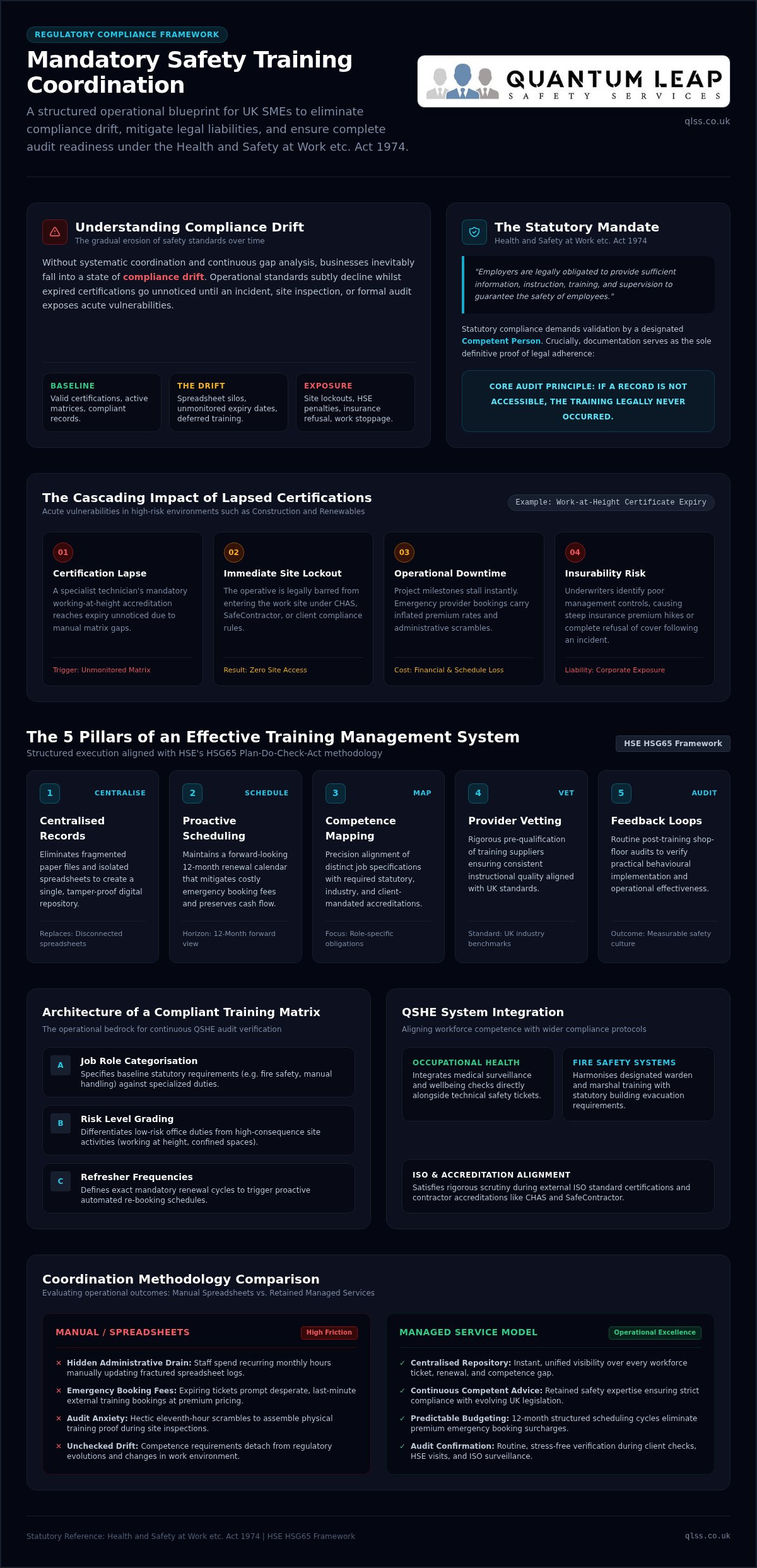
Mandatory safety training coordination is the systematic management of employee competence across an organisation. It's a structured approach that ensures every individual holds the necessary certifications to perform their duties whilst maintaining compliance. Coordination is far more than a simple administrative task of booking courses. It involves a continuous gap analysis to align current staff skills with evolving regulatory requirements. Without this oversight, businesses often fall into a state of "compliance drift," where safety standards gradually decline until a serious oversight occurs.
The primary driver for this activity is the Health and Safety at Work etc. Act 1974. This legislation mandates that employers provide sufficient information, instruction, and training to ensure the health and safety of their employees. When coordination is poor, the resulting lack of oversight increases corporate liability and leaves the business vulnerable during HSE inspections or internal audits.
The Legal Framework for Workplace Training
UK SMEs must distinguish between statutory requirements, such as fire safety or manual handling, and industry-specific certifications like those required for CHAS or SafeContractor accreditations. A "Competent Person" within the business or an external consultant must determine these specific needs based on the work environment. Documentation serves as the only definitive proof of compliance. If a training record isn't easily accessible during an audit, the training effectively hasn't happened in the eyes of the law.
Common Risks of Uncoordinated Training
In high-risk sectors like construction or renewables, the danger of lapsed certifications is acute. If a technician's work-at-height certificate expires, they're legally barred from the site. This leads to immediate operational downtime and project delays. Beyond the site, poor mandatory safety training coordination can trigger a rise in insurance premiums. Insurers view uncoordinated training as a sign of weak management, often leading to higher costs or even the refusal of cover following an incident. By centralising this process, businesses protect their workforce and their bottom line.
The 5 Pillars of an Effective Training Management System
Building a resilient framework for mandatory safety training coordination requires more than a reactive approach to expiring certificates. To maintain high standards, SMEs must adopt a structured methodology that aligns with HSE's HSG65 guidance. This "Plan, Do, Check, Act" cycle ensures that safety becomes an integrated part of business operations rather than an afterthought. An effective system relies on five core pillars: centralised records, proactive scheduling, competence mapping, provider vetting, and feedback loops.
Centralised records provide a single source of truth, replacing fragmented paper files that often lead to administrative errors. Proactive scheduling involves building a 12-month calendar based on specific certification expiry dates, allowing for better budget management and reduced last-minute booking fees. Competence mapping ensures that job roles are precisely aligned with required safety accreditations, whilst provider vetting guarantees that training delivery meets UK industry standards. Finally, feedback loops through post-training audits help measure the actual effectiveness of the programme on the shop floor. For businesses looking to scale without increasing overheads, a managed approach to safety compliance often provides the necessary stability.
Creating a Robust Training Matrix
A training matrix is the bedrock of QSHE compliance. This document should categorise training requirements by job role, risk level, and the required frequency of refreshers. For a comprehensive approach, businesses should also incorporate occupational health services for SMEs into the matrix to monitor long-term employee wellbeing alongside technical safety skills. By mapping these requirements early, you ensure no individual is deployed to a site without the necessary legal authorisations.
Standardising Training Delivery
Consistency in training providers improves the overall safety culture across the organisation. When every employee receives the same high-quality instruction, it establishes a common language and set of expectations. Whilst e-learning offers flexibility for theoretical knowledge, it must be balanced with practical, hands-on safety assessments for high-risk tasks. Always verify that providers hold relevant accreditations from bodies such as CITB, IOSH, or NEBOSH to ensure the training is recognised by principal contractors and insurers. This rigorous selection process is a vital component of successful mandatory safety training coordination.
Evaluating Coordination Methods: Manual vs. Managed Services
Choosing the right method for mandatory safety training coordination is a pivotal decision for growing SMEs. Whilst manual tracking might seem cost-effective initially, the hidden expenses of administrative time and human error quickly accumulate. Under Regulation 13 of the Management of Health and Safety at Work Regulations 1999, employers must provide adequate training when employees are exposed to new or increased risks. Meeting this statutory duty requires a level of precision that manual systems often lack. As a business expands beyond 20 employees, the complexity of managing diverse expiry dates and certification levels makes manual oversight increasingly unsustainable.
Dedicated software can automate alerts, yet it still requires a level of human oversight to interpret data and ensure training quality. Without a professional at the helm, automated systems can become a source of "alert fatigue," where critical warnings are ignored amongst a sea of notifications. For many businesses, the most reliable solution lies in a hybrid approach that combines technology with expert consultancy to maintain total compliance.
The Limitations of Spreadsheet-Based Tracking
Many businesses rely on static spreadsheets, yet these files are prone to version control issues and data corruption. If multiple staff members access the same document, the risk of accidental deletion or incorrect entry increases significantly. Without automated reminders, managers often miss critical refresher windows, leading to last-minute compliance panics and inflated training costs. Generating an audit-ready report from a spreadsheet is a labour-intensive process that risks inaccuracies, potentially damaging your standing with accrediting bodies like CHAS or SafeContractor during a review.
Why Managed Training Coordination is More Cost-Effective
Transitioning to outsourced QSHE managed services allows SMEs to leverage external expertise without the overhead of a full-time safety officer. A dedicated consultant identifies training efficiencies, ensuring that staff aren't over-trained or booked onto redundant courses. This approach significantly reduces the burden on internal HR teams, allowing them to focus on core business activities. Additionally, professional coordination ensures your training programme remains aligned with ISO 9001 implementation services UK goals, fostering a culture of continuous improvement and operational excellence. By moving to a managed model, you secure a "safe pair of hands" that guarantees compliance whilst protecting your bottom line.
How to Organise Your Safety Training Programme: A 6-Step Guide
Moving from a reactive approach to a disciplined system requires a clear logistical framework. Effective mandatory safety training coordination relies on a repeatable six-step process that prevents administrative bottlenecks and ensures your workforce remains legally compliant at all times. By following this sequence, SMEs can transform safety from a source of stress into a streamlined operational routine.
Step 1: Conduct a comprehensive Training Needs Analysis (TNA) across the entire business.
Step 2: Establish a centralised digital repository to store and track all current certificates.
Step 3: Map specific training requirements to individual job descriptions and risk profiles.
Step 4: Select and vet training partners who demonstrate a deep understanding of your specific industry.
Step 5: Schedule training in blocks to minimise travel costs and operational disruption.
Step 6: Review and update the training matrix quarterly to reflect staff turnover and new regulations.
Conducting a Training Needs Analysis (TNA)
A TNA is the first step in identifying the gap between your staff's current skills and your legal obligations. This process involves more than just checking boxes; it requires consultation with site managers to identify practical safety needs that might not be obvious from an office-based perspective. For those in high-risk sectors, ensuring your analysis covers the specifics of health and safety for construction sites is vital. By identifying these gaps early, you can plan your budget and training calendar with precision, avoiding the high costs associated with last-minute emergency bookings.
Managing the Certification Lifecycle
Maintaining compliance is an ongoing task that requires constant vigilance. Implementing a tiered alert system is the most effective way to manage certification lifecycles. We recommend setting automated reminders at 90, 60, and 30-day intervals before a qualification expires. This window provides ample time to book refreshers without rushing. It's also important to distinguish between a "proof of attendance" and a "certificate of competence," as only the latter provides the legal assurance required during an audit. New starter inductions must be integrated into this coordination plan to ensure no recruit enters a high-risk environment without the necessary safety foundations.
For SMEs struggling to maintain this cycle internally, our Training Management services provide a hands-on solution that removes the administrative burden entirely.
Optimising Compliance with Quantum Leap’s Training Management
Effective mandatory safety training coordination is a continuous cycle that requires professional oversight to remain effective. At Quantum Leap Safety Services, we provide a managed service retainer that acts as a strategic extension of your business. By outsourcing this function, you ensure that training management is never sidelined by day-to-day operational pressures. Our approach moves beyond simple record-keeping; we integrate your training needs with broader safety objectives, such as your fire safety management plans, to create a unified compliance framework.
This partnership ensures your safety culture evolves alongside your business growth. We specialise in supporting SMEs through complex industry-specific accreditations, including CHAS and Alcumus SafeContractor. By maintaining a structured training matrix, we provide the technical authority required to satisfy principal contractors and regulatory bodies. This methodical coordination reduces the risk of administrative gaps that could otherwise lead to failed audits or lost contract opportunities.
Tailored Solutions for UK SMEs
We provide pragmatic, professional advice that respects the budget and operational constraints of a modern enterprise. Our consultants act as your dedicated outsourced training department, handling everything from provider vetting to certificate verification. Having a "safe pair of hands" manage your compliance provides the reassurance needed to focus on your core commercial activities. We don't just book courses; we ensure every training event adds tangible value to your workforce and strengthens your overall safety standing.
Preparing for Future Safety Accreditations
A well-coordinated training programme serves as the foundation for higher-level certifications, such as ISO 45001. When your records are centralised and your competence mapping is precise, the transition to international safety standards becomes a logical next step rather than a daunting hurdle. This level of organisation significantly improves your standing during client safety audits, demonstrating a disciplined approach to corporate responsibility. Ready to streamline your safety training? Contact Quantum Leap Safety Services today to discuss how our managed solutions can protect your business and your people.
Securing Your Business Continuity Through Managed Compliance
Mastering mandatory safety training coordination is about shifting from a reactive culture of last-minute bookings to a proactive, methodical system. By centralising your records and implementing a tiered alert system, you protect your business from the operational and legal risks of lapsed certifications. A structured training matrix doesn't just ensure compliance; it builds the foundation for higher accreditations like CHAS or ISO 45001. Whether you choose to refine your internal processes or partner with an expert, the result is a workforce that is competent and ready for any audit.
Established in 2012, Quantum Leap Safety Services provides pragmatic and professional consultancy to help SMEs navigate these complex requirements. With over a decade of expertise, we act as a "safe pair of hands" for your safety and accreditation support. Discover how our Training Management Services can protect your business and ensure your safety culture supports your long-term growth. Investing in structured coordination today ensures your enterprise remains resilient and compliant for years to come.
Frequently Asked Questions
What is mandatory safety training coordination?
Mandatory safety training coordination is the systematic management of employee competence and certification lifecycles. It involves mapping specific job roles to required safety training, tracking expiry dates, and ensuring all personnel are legally qualified for their tasks. Effective coordination prevents compliance gaps and reduces the administrative burden on internal staff. It ensures that every individual holds the correct, up-to-date qualifications required by both UK law and industry-specific standards.
How often should mandatory safety training be refreshed in the UK?
Refresh frequencies vary depending on the specific certification and industry standards. For instance, first aid at work typically requires a refresher every three years, whilst forklift or high-risk height training might follow a three to five year cycle. It's essential to check the specific guidance from awarding bodies like IOSH or CITB. A robust training matrix helps you stay ahead of these varying timelines and prevents last-minute booking panics.
Is it better to use software or a consultant for training management?
A hybrid approach often yields the best results for UK SMEs. Software provides automated alerts and data storage, but it lacks the professional insight needed to interpret complex regulatory changes. A consultant offers the "safe pair of hands" required to ensure your training programme aligns with broader QSHE goals. This expert oversight ensures your mandatory safety training coordination remains accurate, audit-ready, and tailored to your specific operational risks.
What training is mandatory for all employees under UK law?
Basic requirements include fire safety awareness, manual handling, and general health and safety inductions. Specific industries require additional statutory training, such as COSHH or Display Screen Equipment (DSE) assessments. Employers have a legal duty under the Health and Safety at Work etc. Act 1974 to provide adequate information and instruction to all staff. This applies regardless of their specific role, ensuring everyone can work without undue risk to themselves or others.
How do I track safety training for a remote or mobile workforce?
Digital centralised repositories are the most effective way to manage mobile teams. Cloud-based systems allow managers to access training records from any location, ensuring that staff on remote sites are fully certified before starting work. This avoids the risk of personnel using outdated paper records or missing critical refreshers whilst working away from the main office. Real-time access is vital for maintaining site safety and verifying competence during unannounced inspections.
Can I coordinate my own safety training using spreadsheets?
Whilst spreadsheets are common for small teams, they often lead to version control issues and human error as a business grows. They lack the automated notification features necessary to prevent compliance gaps. For companies with more than 20 employees, manual tracking becomes a significant administrative drain. Professional mandatory safety training coordination through a managed service provides a more reliable and scalable alternative that ensures your data remains accurate and audit-ready.
What happens if an employee’s mandatory safety training expires?
An expired certificate means the employee is no longer legally competent to perform high-risk tasks. This can lead to immediate operational downtime, project delays, and increased corporate liability. In the event of an incident, insurers may refuse to cover claims if certifications aren't valid. It also leaves the business vulnerable to HSE fines and prohibition notices during inspections. Maintaining an active training matrix is the only way to avoid these severe consequences.
How does training coordination affect CHAS accreditation applications?
Evidence of structured training management is a core requirement for CHAS and SafeContractor accreditations. Assessors look for a clear training matrix that demonstrates how the business identifies and addresses competence gaps. Coordinated records show that your organisation takes its safety duties seriously and has a system for continuous improvement. Having audit-ready documentation significantly speeds up the application process and increases your chances of achieving a successful, first-time accreditation.


Comments