
ISO 14001 for Renewable Energy Projects: A Comprehensive Guide for 2026
What if the most significant barrier to securing your next tier-1 contract isn't your technical capacity, but the transparency of your environmental reporting? In the UK's rapidly evolving energy market, simply being green by nature is no longer enough to satisfy investors or planning authorities. Implementing ISO 14001 for renewable energy projects has transitioned from a competitive advantage to a fundamental operational requirement. With the updated National Planning Policy Framework (NPPF) as of August 2026 placing substantial weight on low-carbon schemes, the pressure to demonstrate rigorous environmental stewardship is at an all-time high.
We understand that navigating the shift to the ISO 14001:2026 standard whilst managing complex biodiversity and land-use requirements can feel overwhelming. This guide provides a pragmatic roadmap to achieving UKAS-accredited certification and streamlining your environmental audits. You'll discover how a structured management system helps you meet Net Zero obligations, satisfy investor demands, and maintain a steady course through the UK's regulatory landscape. We will examine the specific requirements of the 2026 revision, practical strategies for construction-phase impacts, and the steps needed to position your business as a reliable, compliant partner in the renewable sector.
Table of Contents
What is ISO 14001 for Renewable Energy Projects?
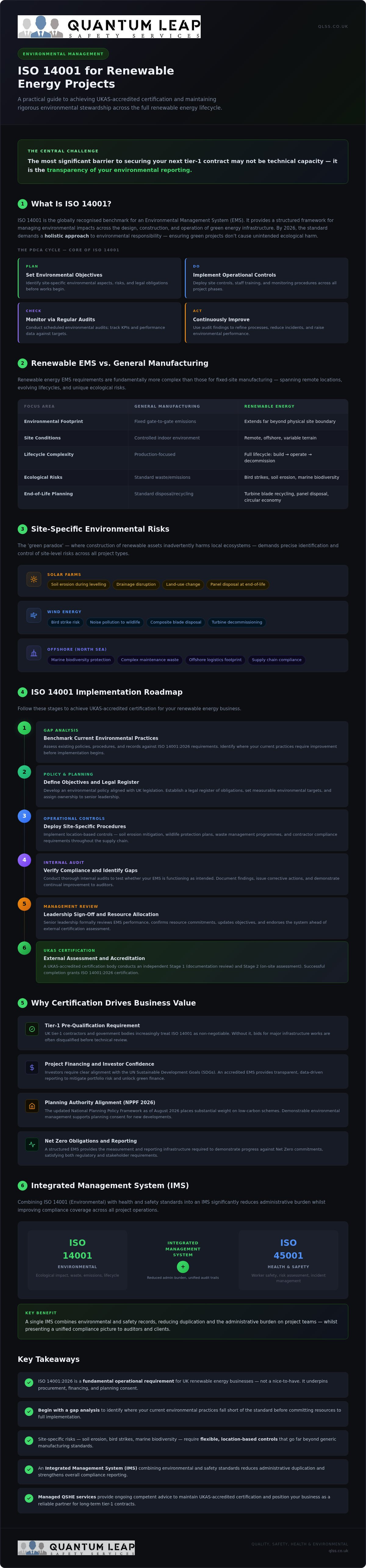
ISO 14001 is the globally recognised benchmark for an Environmental Management System (EMS). While it belongs to the wider ISO 14000 family of standards, its application within the renewable sector is uniquely specific. It provides a structured framework for managing the environmental impacts associated with the design, construction, and operation of green energy infrastructure. By 2026, the standard has evolved to move beyond basic energy generation. It now demands a holistic approach to environmental responsibility, ensuring that green projects don't cause unintended ecological harm during their lifecycle.
The core of ISO 14001 for renewable energy projects is the Plan-Do-Check-Act (PDCA) cycle. Developers use this to set environmental objectives, implement operational controls on site, monitor performance through regular audits, and continuously improve their processes. This systematic approach ensures that wind, solar, and hydro developments remain compliant with UK legislation whilst reducing waste and enhancing their reputation with local communities and regulatory bodies.
The Role of ISO 14001 in Modern Procurement
In the UK, tier-1 contractors and government bodies increasingly view ISO 14001 as a non-negotiable pre-qualification requirement. It serves as a shorthand for reliability and technical competence. If you're bidding for major infrastructure work, holding this certification proves you have the systems in place to manage complex environmental risks. Beyond winning tenders, it's also a critical factor in securing project financing. Investors now look for clear alignment with the UN Sustainable Development Goals (SDGs). An accredited EMS provides the transparent, data-driven reporting they require to mitigate their own portfolio risks.
Key Differences Between General Manufacturing and Renewable EMS
Establishing an EMS for a renewable project differs significantly from traditional manufacturing. While a factory focuses on fixed gate-to-gate emissions and waste, renewable energy requires site-specific management that changes as the project moves from construction to operation. You're often dealing with remote or offshore environments where the footprint extends far beyond a physical building.
Site-specific impacts: Managing soil erosion on a solar farm or bird strike risks at a wind site requires flexible, location-based controls that general manufacturing standards don't cover in detail.
Offshore logistics: Infrastructure in the North Sea involves marine biodiversity protections and complex waste management during maintenance cycles.
Life-cycle thinking: The 2026 standard emphasises the entire lifespan. This includes the environmental impact of decommissioning turbines and the eventual recycling of composite blades or solar panels.
By focusing on these nuances, businesses can transform their EMS from an administrative exercise into a strategic tool that drives long-term stability and project value.
Environmental Risks and Compliance in Renewable Infrastructure
Implementing ISO 14001 for renewable energy projects requires a deep understanding of the specific ecological risks associated with large-scale infrastructure development. The transition to a low-carbon economy creates a unique challenge often described as the 'green paradox', where the construction of renewable assets can inadvertently harm local ecosystems. Identifying these environmental aspects is a core requirement of an effective environmental management system (EMS). For solar developments, this might involve managing soil erosion and drainage issues during site levelling. Wind projects, conversely, must address the risk of bird strikes and noise pollution affecting local wildlife.
Waste management remains a critical pillar of compliance, particularly regarding the decommissioning and disposal of turbine blades. As we move through 2026, the industry is shifting towards circular economy models to ensure that the end-of-life phase of renewable components doesn't negate their carbon-saving benefits. Developers must account for the entire supply chain, ensuring that contractors adhere to the same rigorous environmental standards. This level of oversight prevents the displacement of environmental impacts to third-party suppliers and ensures that the project's sustainability claims are verifiable.
Biodiversity Net Gain (BNG) is a mandatory requirement for UK planning permission in 2026.
Managing Biodiversity and Land-Use Impacts
During the site preparation phase, developers must implement a strict mitigation hierarchy: avoid, minimise, restore, and offset. This methodical approach helps in monitoring long-term ecological changes around renewable installations. It ensures that the project remains a net benefit to the local environment over its entire lifespan. Robust land-use planning prevents the fragmentation of habitats, which is essential for maintaining the ecological integrity of the site. Developers often use remote sensing and regular ecological surveys to track these changes and adjust their management plans accordingly.
Pollution Prevention and Resource Efficiency
Operational phases bring different risks. Maintenance of turbines and substations requires careful control of chemical leaks and spillages. An ISO-aligned system ensures that emergency response plans are robust and that staff are trained to handle environmental incidents on-site immediately. Construction teams should also focus on reducing carbon emissions and optimising water usage during the initial build phase. Using low-carbon materials and electric plant machinery can significantly lower the project's initial footprint. Securing professional renewable projects support ensures these technical details are managed without disrupting project timelines.
ISO 14001 Implementation Guide for Renewable SMEs
For small and medium-sized enterprises (SMEs), implementing ISO 14001 for renewable energy projects shouldn't be an exercise in generating excessive bureaucracy. It's a strategic process designed to align your operational reality with your environmental obligations. A successful implementation begins with a thorough gap analysis. This involves identifying where your current environmental practices fall short of the standard's requirements, allowing you to focus your resources on the areas that matter most. By establishing a clear Environmental Policy with measurable objectives, you create a roadmap that guides your project team toward sustainable outcomes.
Documentation control is often where SMEs feel the most pressure. The goal is to organise necessary records, such as waste transfer notes and training logs, without creating a system that's too complex to maintain. A pragmatic approach focuses on records that prove compliance and support decision-making. This documentation becomes the backbone of your management system, providing the evidence needed for both internal reviews and external audits.
Step 1: Gap Analysis and Aspect Identification
Start by identifying the 'environmental aspects'-the specific activities on your project that interact with the environment. This includes everything from site preparation and land disturbance to energy consumption and waste disposal. You must engage with stakeholders, including local planning authorities and communities, to understand their environmental expectations. Setting the scope of your EMS is vital; it should cover not only your direct employees but also sub-contractors and all on-site activities to ensure total project compliance.
Step 2: Developing Your Environmental Management System
Your EMS needs to be functional for on-site teams rather than just living in an office folder. It involves creating practical procedures for spill response, waste segregation, and resource efficiency. Training staff and sub-contractors on their specific environmental responsibilities is essential to ensure these procedures are followed correctly. You should also establish clear communication channels so that environmental issues can be reported and addressed immediately, preventing minor incidents from becoming significant liabilities.
Step 3: Monitoring, Measurement, and Internal Audit
Defining key performance indicators (KPIs) allows you to track project sustainability in real-time. These might include metrics for carbon emission reductions, percentage of waste diverted from landfill, or successful biodiversity enhancements. Before seeking external validation, a robust internal audit is required to identify any non-conformities and ensure the system is working as intended. UKAS-accredited certification is the gold standard for ISO 14001 in the UK because it provides independent verification that your management system meets the highest international requirements. This internal review process facilitates continual improvement, allowing you to use project data to refine your environmental performance year-on-year.
Integrating Environmental Standards with Health and Safety
Combining environmental management with health and safety is a logical step for any renewable development. An Integrated Management System (IMS) allows businesses to manage ISO 14001 for renewable energy projects alongside safety standards like ISO 45001. This approach reduces the paperwork burden by using shared documentation for leadership commitments, legal registers, and training records. Instead of managing two separate silos, site managers can use a single set of procedures that address both ecological protection and worker safety.
Cross-functional audits provide a significant efficiency gain. During a single site visit, an inspector can evaluate spill kit locations and turbine safety harnesses simultaneously. This methodical approach ensures that environmental risks don't get overlooked in favour of safety, or vice versa. A unified QSHE (Quality, Safety, Health, and Environment) strategy eventually transforms project culture. When workers see that environmental stewardship is treated with the same seriousness as physical safety, their behaviour on site shifts toward total responsibility.
Synergy Between ISO 14001 and ISO 45001
Both standards share a common high-level structure, making it easier to map requirements for leadership, planning, and performance evaluation. You can streamline the risk assessment process by evaluating how a single activity impacts both people and the planet. For instance, a chemical spill is both a safety hazard for technicians and a major environmental incident. For more detail on managing operational risks, see our Renewable Energy Health and Safety: Project Success Guide.
The Role of a QSHE Advisor in Integrated Compliance
SMEs often lack the resources to employ separate experts for every standard. A dedicated QSHE advisor acts as a single point of contact, ensuring that Construction Design and Management (CDM) duties are fulfilled whilst environmental goals are met. They bridge the gap between complex legal requirements and practical site work. This "safe pair of hands" approach helps businesses navigate UKAS audits with confidence. You can learn more about how this works through our Outsourced QSHE Managed Services: The SME Advantage.
If you need help aligning your systems, our team provides expert ISO Management Systems support to simplify your certification journey.
Maximising Project Value with Managed ISO Solutions
Achieving certification is a significant milestone, but the real commercial value lies in moving from a one-off project to a 'business as usual' model. For many SMEs, the challenge isn't just getting the certificate; it's keeping the system alive amidst the daily pressures of site management. Managed services provide a solution by embedding environmental stewardship into your standard operating procedures. A retainer-based consultancy offers continuous competent advice, ensuring your management system evolves alongside your project's lifecycle without the overhead of a full-time environmental manager.
This managed approach directly reduces the long-term cost of compliance. Efficient system maintenance prevents the 'audit panic' that often occurs when documentation is left to gather dust between annual reviews. By conducting regular, smaller inspections, you ensure that your ISO 14001 for renewable energy projects remains robust and ready for scrutiny at any time. This steady, methodical oversight future-proofs your business, providing a solid foundation to expand into other standards such as ISO 50001 for energy management as your portfolio grows.
The QLSS Approach to ISO 14001 Implementation
Quantum Leap Safety Services (QLSS) provides a pragmatic, fixed-price support model tailored specifically for renewable SMEs. We understand that site-based work requires more than just digital tracking; it needs a hands-on partner who can identify real-world improvements during physical audits. Our team acts as a "safe pair of hands," offering national UK coverage whilst bringing experience from EU renewable markets. We focus on creating lean, functional systems that protect your business and the planet without adding unnecessary complexity to your daily operations.
Next Steps: Starting Your ISO 14001 Journey
The first step toward a robust environmental management system is an initial consultation. We assess your project's current compliance status against the 2026 standards and identify the specific gaps that need addressing. Once we have a clear picture of your operational reality, we set a realistic timeline for implementation and certification. This structured process ensures your team remains focused on energy generation whilst we handle the intricacies of the ISO framework.
Ready to secure your next contract and demonstrate your commitment to Net Zero? Contact Quantum Leap Safety Services for expert ISO 14001 support to begin your assessment today.
Securing Long-Term Success in the Renewable Sector
The transition to the ISO 14001:2026 standard represents a shift from simple tick-box compliance to a strategic, risk-based approach to environmental stewardship. Implementing ISO 14001 for renewable energy projects ensures that your operations align with the UK's stringent Net Zero targets and planning requirements. By integrating these environmental standards with your existing health and safety protocols, you create a lean, efficient management system that reduces administrative burden whilst enhancing project culture.
Quantum Leap Safety Services acts as a safe pair of hands for SMEs navigating these complex requirements. Our pragmatic QSHE managed services and expert ISO consultancy provide national UK coverage, ensuring your infrastructure projects remain compliant and competitive. We specialise in construction safety and renewable energy infrastructure, offering the steady guidance needed to maintain UKAS-accredited certification. It's time to transform your environmental obligations into a distinct business advantage.
Secure your project's future with our ISO 14001 implementation services and ensure your business is ready for the challenges of 2026 and beyond.
Frequently Asked Questions
Is ISO 14001 mandatory for renewable energy projects in the UK?
ISO 14001 is not a legal mandate in the UK, but it is effectively a commercial requirement for most large-scale infrastructure. Tier-1 contractors and government bodies often include UKAS-accredited certification as a mandatory pre-qualification criterion. Without it, your business may be excluded from significant procurement opportunities. It serves as a standardised method to prove your environmental management system meets international expectations, ensuring you stay compliant with the 2026 National Planning Policy Framework requirements.
How much does it cost to implement ISO 14001 for a small renewable energy business?
The cost of implementation depends on the size of your organisation, the complexity of your site activities, and your existing environmental records. Expenses typically include the initial gap analysis, system development, staff training, and the external UKAS audit fees. Whilst specific costs vary, many SMEs find that the investment is offset by reduced waste, lower insurance premiums, and the ability to secure higher-value contracts that require a robust environmental framework.
Can ISO 14001 help my business win government renewable energy tenders?
Yes, holding certification in ISO 14001 for renewable energy projects significantly improves your scoring in government tenders. Public sector procurement in the UK places high value on social value and environmental stewardship. Demonstrating a certified commitment to the UN Sustainable Development Goals provides the evidence that procurement officers need to justify awarding contracts. It positions your business as a low-risk partner capable of managing the complex ecological impacts of green infrastructure.
What is the difference between ISO 14001 and ISO 50001 for energy companies?
ISO 14001 is a broad framework for managing all environmental impacts, such as waste, biodiversity, and pollution. In contrast, ISO 50001 focuses specifically on improving energy efficiency and reducing consumption. For renewable energy companies, ISO 14001 is usually the priority as it covers the ecological footprint of construction and site operations. Many businesses later add ISO 50001 to refine their internal energy performance and further demonstrate their commitment to a low-carbon future.
How long does it typically take to achieve ISO 14001 certification?
Achieving certification typically takes between three and six months. This timeline depends on the maturity of your current practices and the availability of resources to implement necessary changes. The process involves a Stage 1 audit to review documentation and a Stage 2 audit to verify that the system is functioning on-site. Working with an experienced consultant can often accelerate this process by providing structured templates and expert guidance during the initial gap analysis phase.
Do I need a full-time environmental manager to maintain ISO 14001?
You don't necessarily need a full-time environmental manager to maintain the standard. Many SMEs successfully manage their obligations by appointing a QSHE advisor or using outsourced managed services. This approach provides the competent advice required for continuous compliance without the overhead of a permanent staff member. The key is to have a dedicated individual or partner who ensures that regular audits, training, and record-keeping are performed consistently throughout the project lifecycle.
What happens if our project fails an environmental audit?
Failing an audit usually results in the auditor raising 'non-conformities'. A minor non-conformity might involve a missing record; whereas a major non-conformity suggests a systemic failure in your environmental management. You will be given a specific timeframe to implement corrective actions. Once these issues are addressed and verified, your certification can proceed. It is a process of continual improvement rather than a punitive measure, designed to strengthen your operational resilience and compliance.
How does ISO 14001 relate to the Net Zero transition?
ISO 14001 provides the operational framework needed to achieve Net Zero. It requires businesses to identify their carbon footprint and set measurable objectives for reduction. By implementing ISO 14001 for renewable energy projects, you establish a baseline for your environmental performance. This data-driven approach allows you to track progress accurately and demonstrate to investors and stakeholders that your business is taking tangible, verifiable steps toward the UK's 2050 climate goals.



Comments