
ISO 14001 Implementation UK: The Step-by-Step Guide for SMEs in 2026
In 2026, an ISO 14001 certificate is no longer just a green badge to hang in your reception area; it is a vital tool for commercial resilience and securing high-value UK government tenders. You likely recognise that staying compliant with evolving environmental legislation feels like a moving target, especially with the publication of the ISO 14001:2026 standard and new digital waste tracking regulations. It's natural to feel concerned about a lack of internal expertise or the potential for high certification costs to drain your resources. We understand that SMEs need a steady, methodical approach to compliance that does not disrupt daily operations.
This guide provides a practical roadmap for ISO 14001 implementation UK, helping you master the complexities of Environmental Management Systems through a structured, common-sense process. By focusing on genuine operational efficiency rather than just ticking boxes, you can turn your environmental obligations into a competitive advantage. We will walk you through the transition from the 2015 version, the integration of biodiversity net gain requirements, and the specific steps needed to build a streamlined system that delivers long-term stability for your business.
Table of Contents
The UK Landscape for ISO 14001 Implementation in 2026
The ISO 14001 implementation UK landscape has evolved significantly following the publication of the revised 2026 standard. This framework, which belongs to the broader ISO 14000 family of standards, serves as a comprehensive blueprint for an Environmental Management System (EMS). It allows organisations to identify, manage, and monitor their environmental impacts through a structured approach. Whilst some directors still believe this certification is reserved for heavy manufacturing or high-polluting sectors, the reality in 2026 is that service-based SMEs are adopting it at record rates. This shift is driven by a fundamental change in how UK commercial contracts are awarded, where environmental accountability is now a core requirement rather than an optional extra.
Commercial Benefits of Implementation for UK SMEs
For many small businesses, the primary driver for certification is commercial resilience. ISO 14001 is increasingly a mandatory prerequisite for winning high-value contracts, particularly within public sector tenders and tier-one supply chains. Beyond securing new work, a functional EMS identifies operational inefficiencies that often go unnoticed. By reducing waste and improving energy consumption patterns, businesses can lower their overheads whilst enhancing their reputation amongst climate-conscious stakeholders and investors. It's about proving that your company is a reliable partner in a market that prioritises sustainability and long-term stability.
Navigating UK Environmental Regulations
Compliance with UK legislation is a complex task for any business owner. The Environment Agency and local regulatory bodies have intensified their focus on enforcement, particularly following the introduction of the Digital Waste Tracking Regulations 2026. A successful ISO 14001 implementation UK strategy provides the necessary structure to demonstrate legal "due diligence" and avoid the significant financial penalties associated with accidental non-compliance. The system ensures your growth aligns with the UK’s broader Net Zero 2050 targets. It prepares your organisation for specific regulatory shifts, such as the mandatory Biodiversity Net Gain requirements that now influence a wide range of commercial infrastructure projects. By integrating these requirements into your daily operations, you move from a reactive stance to a proactive, managed position of compliance.
Core Components of an Effective Environmental Management System
The engine of any successful ISO 14001 implementation UK is the Plan-Do-Check-Act (PDCA) cycle. It's a logical, four-stage process that ensures your environmental performance doesn't just plateau but improves over time. Under the BS EN ISO 14001:2026 standard, this cycle begins with a deep dive into the "Context of the Organisation". This requires your team to look beyond the office walls and consider external factors, such as shifting climate change legislation or the availability of natural resources, that could disrupt your operations. It's a pragmatic way to align your environmental goals with your broader business strategy.
Top management commitment is the cornerstone of this process. It isn't enough for a director to sign off on a policy; they must actively lead the environmental programme and ensure that resources are available for the system to thrive. When leadership is visible and accountable, the culture of the business shifts. This ensures that the environmental management system (EMS) becomes a functional part of your daily operations rather than a secondary concern for a single staff member.
Identifying Aspects and Impacts
To build a compliant system, you must distinguish between environmental aspects and impacts. An "aspect" is an element of your activities that interacts with the environment, whilst the "impact" is the actual effect on the planet. Understanding this relationship is critical for creating a robust Aspect and Impact Register. Consider these common examples in the UK market:
Construction: The aspect is the removal of topsoil during site prep; the impact is the loss of local biodiversity and potential soil erosion.
Professional Services: The aspect is the procurement of electronic hardware; the impact is the depletion of finite natural resources and the generation of electronic waste.
Manufacturing: The aspect is the discharge of wastewater; the impact is the potential contamination of local watercourses and ecosystems.
The Integrated Management System (IMS) Advantage
Most UK businesses don't operate in a vacuum and may already utilise ISO 9001 implementation services UK to manage their quality standards. It's a sensible move to merge these requirements into an Integrated Management System (IMS). By understanding what is ISO 9001 and how it shares the same high-level structure as environmental standards, you can share documentation for internal audits and management reviews. This streamlined approach reduces "audit fatigue" and ensures your compliance processes aren't duplicated across different departments. If you're looking for a safe pair of hands to guide this process, our ISO management systems support can help you build a unified, efficient framework that supports long-term stability.
Conducting a Gap Analysis and Resource Planning
Before you can build your system, you need to know exactly where you stand. A gap analysis acts as the baseline for your ISO 14001 implementation UK journey. It's a methodical review of your current environmental behaviours compared to the strict requirements of the ISO 14001:2026 standard. This assessment isn't just about paperwork; it's about identifying where your existing processes already align with best practice and where you're falling short. Referencing the UK government environmental permit guidance can help you understand how a formal management system supports legal compliance for specific activities, ensuring your baseline covers both standard requirements and UK law.
Effective planning requires a realistic look at your available resources. You'll need "Competent Persons" to lead the project, whether you choose to develop this expertise internally through intensive training or partner with an external consultant who understands the SME landscape. Budgeting for implementation is a multifaceted exercise. You must account for several key areas: specialised software for tracking environmental metrics, comprehensive staff training, professional consultancy support, and the unavoidable fees charged by a UKAS-accredited certification body. Investing time in this preparation phase prevents costly delays later in the process.
Setting Environmental Objectives and Targets
Successful environmental management relies on setting SMART (Specific, Measurable, Achievable, Relevant, and Time-bound) goals that align with your broader business strategy. In 2026, UK SMEs are expected to move beyond simple recycling initiatives. Your objectives should target significant carbon reduction, improved resource management, and the protection of local ecosystems. An environmental objective is a measurable goal derived from the environmental policy. By setting clear targets, such as reducing site electricity consumption by 15% within twelve months, you provide your team with a tangible goal to work towards.
Training and Competence
A management system is only as effective as the people running it. You must identify the training needs for staff at every level of the organisation, from the boardroom to the shop floor. It's equally important to ensure that contractors and supply chain partners align with your EMS requirements, especially when they're working on your behalf. General "Environmental Awareness" training is essential for the entire workforce. This ensures everyone understands their role in maintaining compliance and knows how their daily actions contribute to the company's environmental performance.
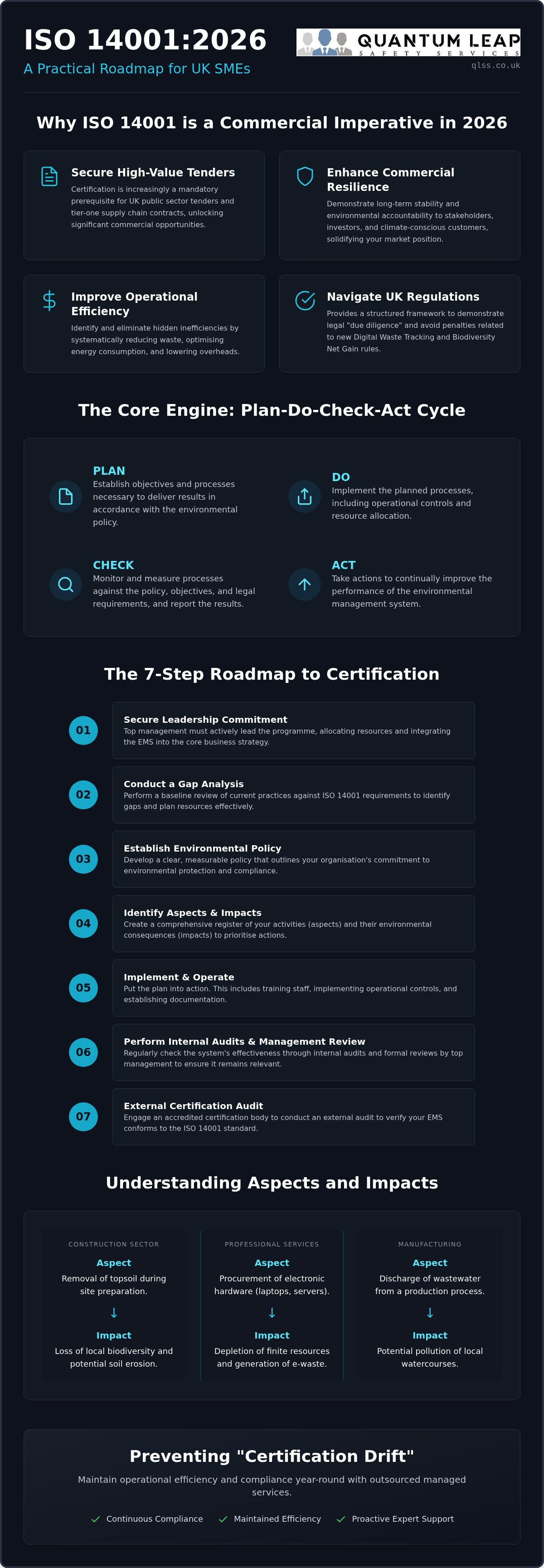
The 7-Step Roadmap to ISO 14001 Certification
Achieving certification requires a disciplined, step-by-step approach that moves your business from initial commitment to external recognition. This roadmap provides a clear path for ISO 14001 implementation UK, ensuring you don't miss critical regulatory or operational requirements along the way. Following this sequence helps build a system that is both compliant and practical for an SME environment.
Step 1: Secure Leadership Buy-in and Define Scope. Establish the boundaries of your EMS and ensure management is ready to provide the necessary resources.
Step 2: Establish Environmental Policy and Objectives. Formulate a high-level commitment to environmental protection and set measurable targets.
Step 3: Document Core Processes and Operational Controls. Create the procedures that guide your daily activities and manage your environmental risks.
Step 4: Implementation and Staff Training. Roll out the system across the business and ensure every employee understands their specific duties.
Step 5: Internal Audit and Compliance Evaluation. Conduct a thorough "dry run" to verify that the system works as intended.
Step 6: Management Review. Top management evaluates the audit results and confirms the system's ongoing suitability.
Step 7: External Certification Audit. A UKAS-accredited body performs a Stage 1 readiness review followed by a Stage 2 effectiveness audit.
Operational Controls and Emergency Preparedness
Operational controls are the specific procedures you develop to manage the significant environmental aspects identified earlier in your journey. Whether it's a protocol for hazardous waste storage or an energy-saving checklist for office closures, these controls ensure consistency. You must also prepare for the unexpected by creating emergency response plans for incidents like chemical spills or fuel leaks. It's vital to test these procedures through drills to ensure your team can react effectively in a real-world scenario. If you need support in developing these rigorous checks, our Audit & Inspection Services provide the expert oversight required to ensure your controls are fit for purpose.
The Internal Audit and Management Review
The internal audit is perhaps the most critical milestone before the external assessor arrives. It's a methodical check to identify any non-conformities or weaknesses in your system. Rather than seeing these findings as failures, you should treat them as opportunities for "continual improvement", which is a core requirement of the standard. Management reviews then take these audit findings and use them to drive strategic changes. By addressing non-conformities with robust corrective actions, you ensure the system remains resilient and ready for the final certification audit. This process guarantees that your ISO 14001 implementation UK isn't just a one-off exercise but a permanent part of your operational excellence.
Maintaining Compliance: Outsourced QSHE Managed Services
Achieving certification is a significant milestone, yet the real challenge for many SMEs begins the day after the external auditor leaves. "Certification drift" occurs when the initial momentum of the implementation project fades and the management system becomes a static set of documents rather than a driver of performance. To prevent this, many organisations opt for a managed service retainer. This approach ensures that your ISO 14001 implementation UK remains a living process, with a dedicated partner acting as your "Competent Person" to oversee ongoing compliance and system health.
An outsourced QSHE managed service provides the technical authority needed to navigate shifting UK environmental legislation. As new rules regarding biodiversity net gain or digital waste tracking come into force, your consultant ensures your system is updated accordingly. This proactive management keeps your business ready for the annual surveillance audits required to maintain your certificate, protecting your investment and your commercial reputation. It's a pragmatic way to maintain stability without the overhead of a full-time internal QSHE manager.
Audit and Inspection Services
Regular site inspections are the most effective way to verify that your environmental procedures are working in practice. These visits allow for an unbiased evaluation of how staff handle waste, manage energy, or respond to potential spill risks. By conducting these checks throughout the year, you identify minor issues before they escalate into non-conformities during an official audit. This methodical approach provides peace of mind and ensures that your environmental performance remains consistent across all sites, regardless of your sector.
Why Partner with Quantum Leap Safety Services?
We specialise in providing a pragmatic, "safe pair of hands" for SMEs that need to maintain high standards without the burden of excessive paperwork. Our team brings deep expertise in high-stakes sectors, including providing a health and safety audit for renewable projects and construction sites. We offer fixed-price project fees and transparent managed service costs, giving you budget certainty and a clear return on investment. By partnering with us, you gain a dedicated compliance ally focused on operational efficiency and long-term business stability.
Building Long-Term Environmental Resilience for Your Business
Developing a robust Environmental Management System is a strategic investment that goes far beyond simple compliance. By following a methodical roadmap, your business can secure its place in competitive UK supply chains and meet the rigorous demands of modern government tenders. Success requires more than just documentation; it demands visible leadership commitment and a process-driven approach to identifying environmental impacts. As we've explored, staying ahead of legislative shifts like the 2026 digital waste tracking rules ensures your organisation remains stable and commercially viable.
Effective ISO 14001 implementation UK doesn't have to be an unmanageable burden for your internal team. With over 14 years of compliance expertise, Quantum Leap Safety Services acts as a safe pair of hands to guide you through every stage of the process. We specialise in pragmatic, SME-focused support and the development of Integrated Management Systems that streamline your operations. To take the first step towards a more efficient and sustainable future, you can book an ISO 14001 Gap Analysis with our expert consultants. We're here to help you turn complex environmental obligations into a genuine competitive advantage.
Frequently Asked Questions
How long does ISO 14001 implementation take for a UK SME?
Typically, it takes between 3 to 6 months for a small to medium-sized enterprise to fully implement the system. This duration depends on the complexity of your current processes and the resources you can dedicate to the project. Larger organisations or those with multiple sites may require up to 12 months. Starting with a gap analysis helps define a realistic timeline and ensures you have a clear roadmap for the journey ahead.
Is ISO 14001 mandatory for businesses in the UK?
No, ISO 14001 isn't a legal requirement for UK businesses. However, it's often a commercial necessity for those bidding on public sector contracts or working within large supply chains. Whilst the standard itself is voluntary, it provides a structured way to manage the legal obligations that are mandatory, such as the Environmental Permitting Regulations 2016 and the new Digital Waste Tracking Regulations 2026.
What is the difference between ISO 14001 and ISO 9001?
ISO 14001 focuses on environmental management and reducing your impact on the planet, whilst ISO 9001 centres on quality management and customer satisfaction. Both standards share the same High-Level Structure, which makes them easy to integrate into a single management system. While 9001 ensures you deliver consistent products, 14001 ensures your operational processes are sustainable and compliant with environmental laws.
Can a small business implement ISO 14001 without a consultant?
Yes, it's possible for a small business to implement the standard using internal resources if they have the necessary expertise. However, many SMEs find that the complexity of the 2026 standard and the time required for documentation are significant hurdles. Partnering with a consultant provides a safe pair of hands to navigate the gap analysis and ensures your ISO 14001 implementation UK project stays on track without draining your team's time.
How much does ISO 14001 certification cost in 2026?
Costs are split between implementation support and external audit fees. In 2026, UKAS-accredited auditor day rates typically range from £850 to £1,500 depending on the provider's size. The cost for implementation varies significantly based on your sector's risk level and the number of employees. Most SMEs find that a fixed-price project or a managed service retainer provides the best value, offering budget certainty whilst ensuring all technical requirements are met without hidden expenses.
What are the most common non-conformities in ISO 14001 audits?
Auditors frequently identify several recurring issues during assessments. These common non-conformities include:
Incomplete Aspect and Impact Registers that miss key operational risks.
Lack of documented evidence for staff competence and environmental training.
Failing to update legal registers following UK regulatory changes.
These gaps usually occur when a system is treated as a one-off project. Regular internal audits are the best way to catch these errors before the external assessor arrives at your site.
How does ISO 14001 help with UK government tenders?
Having a certified EMS is often a core requirement for UK government tenders, particularly under the Social Value Model. It demonstrates that your business has a verified system for managing environmental risks and reducing carbon emissions. This certification gives you a competitive edge over non-certified rivals by providing immediate proof of your commitment to sustainability and legal compliance, which are high-priority factors for public sector procurement teams.
Does ISO 14001 cover carbon footprinting and Net Zero?
Whilst ISO 14001 doesn't specifically mandate a Net Zero target, the 2026 standard places a much stronger emphasis on climate change and resource efficiency. It provides the ideal framework for tracking your carbon footprint and setting measurable objectives for reduction. By integrating carbon management into your EMS, you create a structured path towards the UK’s 2050 Net Zero goals, ensuring your environmental strategy is both credible and verifiable.


Comments