
ISO 9001 Implementation Services UK: The 2026 SME Buying Guide
Why do so many UK business owners view ISO 9001 as a mountain of pointless paperwork rather than a competitive engine for growth? It's a common frustration when searching for ISO 9001 implementation services UK. You want the prestige of UKAS-accredited certification and the ability to win high-value tenders, but you don't want your best staff buried in spreadsheets for months. You likely worry that the time commitment will stall your actual work or that you'll end up with a system that exists only to satisfy an auditor.
This 2026 guide helps you find a partner that builds a lean, pragmatic Quality Management System (QMS) instead of a bureaucratic nightmare. We'll examine how to distinguish between basic training and full implementation, the realistic time commitments involved, and how a Business Total Compliance approach manages your obligations whilst you focus on scaling. By the end, you'll know exactly how to select a "safe pair of hands" to streamline your operations and secure your company's future. This methodical approach ensures your certification adds real value to your bottom line rather than just another layer of administration.
Table of Contents
What are ISO 9001 Implementation Services and Why Do UK SMEs Need Them?
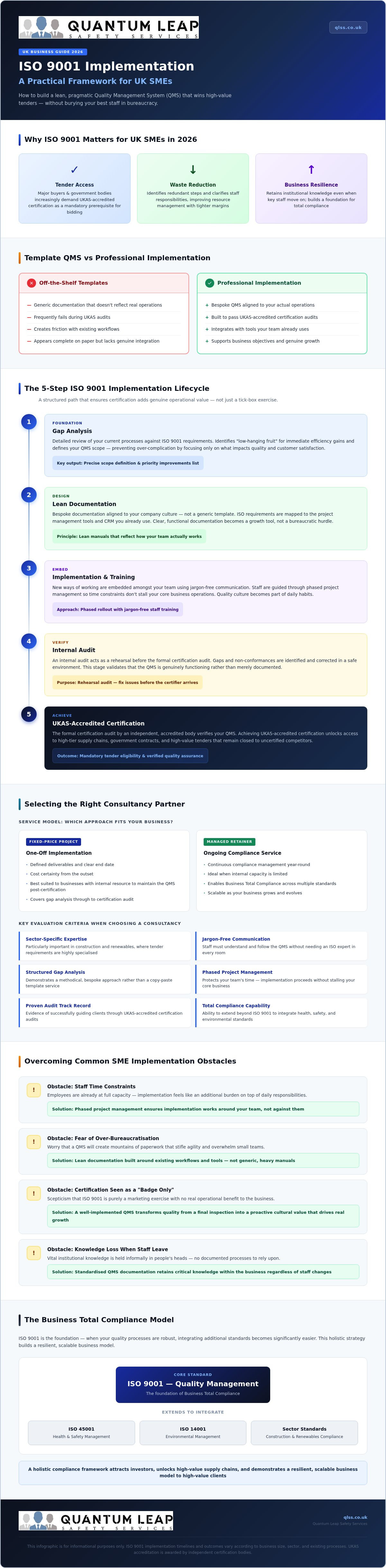
ISO 9001 implementation services UK provide a methodical framework for building a bespoke Quality Management System (QMS). This process is far more than a simple exercise in writing manuals; it's about aligning your daily operations with a globally recognised standard for excellence. Many SMEs fall into the trap of purchasing "off-the-shelf" templates to save costs. While these might look complete on paper, they often fail during audits because they don't reflect how your team actually works. Professional implementation focuses on integration, ensuring the system supports your business objectives rather than creating unnecessary friction.
By 2026, the landscape for UK tenders has shifted significantly. Major buyers and government bodies increasingly demand UKAS-accredited certification as a mandatory prerequisite for bidding. This ensures that an independent, accredited body has verified your QMS. A pragmatic system reduces waste by identifying redundant steps and clarifying staff responsibilities. This leads to better resource management and more predictable results, which are essential for small businesses operating with tight margins.
The Meaning of ISO 9001 in a Modern Business Context
ISO 9001 is the international standard for quality management, providing a framework for organisations to deliver consistent products and services that meet customer and regulatory requirements. Modern implementation moves beyond simply "getting the badge" for marketing purposes. It organises business logic so that every department understands its specific role in driving customer satisfaction. Instead of reactive firefighting, a well-implemented QMS encourages proactive improvement. It transforms quality from a final inspection check into a fundamental part of your company culture.
Commercial Advantages of Professional Implementation
Professional implementation opens doors to high-tier supply chains and lucrative government contracts that remain closed to uncertified competitors. It provides a level of risk mitigation that informal, undocumented systems cannot match. By standardising internal behaviours, you ensure that vital institutional knowledge stays within the company even if key staff members move on. This approach also builds a solid foundation for Business Total Compliance. When your quality processes are robust, it's far easier to integrate other essential standards like health, safety, and environmental management. This holistic strategy creates a resilient, scalable business model that attracts investors and high-value clients alike.
The 5-Step Lifecycle of ISO 9001 Implementation
Professional ISO 9001 implementation services UK follow a structured path to ensure certification isn't just a tick-box exercise. This journey involves five distinct stages, each designed to build a resilient Quality Management System (QMS) that fits your specific operational needs. By following a methodical lifecycle, you avoid the common pitfall of rushing into documentation before understanding your actual requirements. It's about building a system that works for you, not the other way around.
Gap Analysis: Setting the Foundation
An honest gap analysis is the cornerstone of a cost-effective project. It involves a detailed review of your current processes against the standard's requirements. This stage identifies "low-hanging fruit"; these are immediate improvements that can boost efficiency before the formal system is even live. Defining the scope here is vital. It prevents over-complicating the QMS by focusing only on the relevant parts of your business. A precise scope ensures you don't waste time documenting processes that don't impact quality or customer satisfaction.
Documentation Without the Bureaucracy
Effective systems rely on lean documentation rather than heavy, dusty manuals. Your QMS should reflect your company culture, not a generic template. We aim to align ISO requirements with the business tools you already use, such as your existing project management software or CRM. This makes the system easier for employees to follow in their daily tasks. When documentation is clear and functional, it becomes a tool for growth rather than a bureaucratic hurdle. If you're looking for a "safe pair of hands" to guide this process, exploring professional ISO management systems support can provide the clarity you need.
Once the design is finalised, the implementation and training phase begins. This is where new ways of working are embedded amongst your team. It's followed by an internal audit, which acts as a "dry run" to ensure the system is robust and compliant. This internal check identifies any minor non-conformities before the final step: the certification audit. During this stage, an external UKAS-accredited body assesses your system. Having a partner to support you through this assessment provides the reassurance needed for a successful outcome.
Selecting an ISO 9001 Consultancy Partner in the UK
Selecting a partner for ISO 9001 implementation services UK requires a balance between technical expertise and practical business sense. You need a "safe pair of hands" that understands your specific industry rather than a consultant who only quotes the standard. Many providers offer a one-size-fits-all approach; however, for SMEs in the construction or renewables sectors, this often leads to bloated systems that are difficult to manage. The personality of your consultant matters as much as their credentials. You want a seasoned professional who values straightforwardness and long-term stability over academic theory. This pragmatic approach ensures that your QMS is a tool for efficiency, not a source of frustration for your team.
Ensure your chosen partner prioritises UKAS-accredited certification. Non-accredited "certificates" might appear cost-effective initially, yet they are frequently rejected by procurement teams during high-value UK tenders. A reputable consultant will guide you toward an accredited body, ensuring your investment is recognised by clients and stakeholders across the country.
Project-Based vs. Retainer-Based Support
Businesses usually choose between two main engagement models. A fixed-price project is ideal if you have a clear deadline for certification and want to control costs from the start. This model focuses on the initial implementation lifecycle, from gap analysis to the final audit. Alternatively, a managed service retainer provides ongoing support to maintain and update the QMS. This is particularly useful for integrated compliance, such as aligning quality standards with a 2026 Health and Safety Audit for Renewable Projects. Retainers ensure that your system evolves as your business grows, preventing the "compliance drift" that often happens after the initial certificate is issued.
Questions to Ask Your Potential ISO Consultant
Evaluating a consultant's suitability involves looking past their marketing materials. Ask these direct questions to gauge their pragmatic value:
What is your success rate with UKAS-accredited bodies? A consultant should be confident in their ability to meet the rigorous standards of accredited auditors.
How do you ensure the system stays simple for my staff? Look for answers that mention lean documentation and integration with existing tools.
Do you offer support during the actual audit day? A dedicated partner will be present during the certification audit to help you navigate the process and address any auditor queries.
The right partner acts as a steady guide, translating complex requirements into clear actions that add genuine value to your operations. This methodical approach allows you to focus on growth whilst they handle the intricacies of compliance.
Overcoming Common Implementation Obstacles
The primary barrier to successful certification isn't the complexity of the standard itself; it's often the internal perception of the workload involved. Many SMEs fall victim to the "Too Busy to Implement" myth, viewing quality management as an additional burden rather than a core business function. Professional ISO 9001 implementation services UK address this by using phased project management. This approach breaks the requirements into manageable tasks, ensuring that daily operations continue without disruption whilst the system is built in the background.
Jargon-busting is another critical component of a pragmatic implementation. Clauses like "Context of the Organisation" or "Documented Information" can sound intimidating, yet they simply refer to understanding your market and keeping clear records. Translating these requirements into plain business English helps remove the fear of the unknown. When staff understand that the QMS is there to support their workflows, cultural resistance diminishes. Managing this change requires consistent communication to show that the system is a living tool for improvement, not a static folder on a server.
Managing Time and Resource Constraints
External consultants take the heavy lifting off internal managers by handling the technical documentation and process mapping. Whilst the timeline varies depending on the size of the business, a realistic period for implementation is typically three to six months. This duration allows for the new behaviours to become habitual before the final audit. Senior leadership plays a vital role here; their visible commitment to the quality agenda signals to the rest of the team that these improvements are a priority for the company's long-term growth.
Integrating ISO 9001 with 14001 and 45001
For businesses looking to maximise efficiency, an Integrated Management System (IMS) is the most logical choice. By combining ISO 9001 with environmental (14001) and occupational health and safety (45001) standards, you create a single framework for your entire organisation. This significantly reduces audit fatigue, as you can often combine several assessments into a single visit. This approach is the cornerstone of Business Total Compliance, ensuring all your obligations are met through one streamlined process. If you want to simplify your journey toward these standards, contact us for expert QSHE managed services that align with your operational reality.
Pragmatic ISO 9001 Solutions with Quantum Leap Safety Services
Quantum Leap Safety Services (QLSS) provides a grounded, professional approach to quality management. Since 2012, we've acted as a steady guide for UK enterprises, helping them move beyond basic compliance to operational excellence. Our ISO 9001 implementation services UK focus on creating systems that reflect your actual work habits. We avoid high-pressure tactics; opting instead for a calm, matter-of-fact delivery that suggests stability. This ensures your Quality Management System (QMS) remains a valuable asset rather than a burdensome administrative task.
We specialise in integrating quality standards with broader Business Total Compliance strategies. This means your QMS doesn't sit in isolation; it works alongside your health, safety, and environmental protocols. Our QSHE managed services address the common gap between initial certification and long-term maintenance. We provide the competent advice needed to keep your system robust whilst you focus on scaling your business. By acting as a "safe pair of hands", we help you navigate intricate legal and technical requirements without over-complicating your daily routines.
Tailored Support for Construction and Renewables
Our team brings specific expertise to high-risk infrastructure and green energy projects. In these sectors, quality isn't just about documentation; it's about aligning standards with site safety and environmental duties. We support UK-wide projects from our centre of excellence, ensuring that your QMS meets the rigorous demands of principal contractors and energy developers. This methodical approach helps you secure high-value contracts by proving you can handle the complexities of modern construction and renewable projects safely and efficiently. Our ISO 9001 implementation services UK are designed to respect the unique resource constraints of SMEs whilst meeting international benchmarks.
The Next Steps to Certification
Initiating your journey begins with a comprehensive gap analysis. Our consultancy team reviews your current processes to identify exactly what's needed to meet the standard. In the first 30 days of implementation, you can expect a clear project roadmap, a defined QMS scope, and the start of your bespoke documentation design. We provide the reassurance you need to face the certification audit with confidence, acting as a dedicated partner throughout the entire lifecycle.
If you're ready to streamline your operations and win more tenders, contact our experts for a pragmatic ISO 9001 consultation. We'll help you build a system that adds real value to your bottom line.
Securing Your Competitive Edge with Strategic Quality Management
Building a robust Quality Management System is a strategic investment that prepares your business for the high-tier tenders of 2026. By choosing professional ISO 9001 implementation services UK, you ensure your processes are lean, compliant, and ready for UKAS-accredited certification. A pragmatic approach removes the fear of excessive paperwork; instead focusing on operational value and the integration of quality with your existing health, safety, and environmental obligations.
Moving forward with a reliable partner allows your management team to focus on growth whilst we handle the technical complexities of compliance. Our experience across UK and EU markets ensures your business meets every regulatory requirement with common-sense solutions tailored specifically for SMEs. This methodical approach creates a resilient business model that attracts investors and high-value clients alike.
Book your ISO 9001 Gap Analysis with Quantum Leap Safety Services today to begin your journey toward a more efficient, competitive future. We are ready to help you build a stable foundation for long-term success.
Frequently Asked Questions
How much do ISO 9001 implementation services cost in the UK?
Costs for ISO 9001 implementation services UK vary based on your organisation's size and the complexity of your existing processes. A bespoke quote is necessary to reflect your specific operational reality, as fixed-price projects and managed service retainers offer different levels of support. Investing in professional guidance ensures your system is lean and effective, ultimately saving money by reducing operational waste and opening doors to high-value tenders that require accredited certification.
How long does it typically take to achieve ISO 9001 certification?
Achieving certification typically takes between three and six months for most UK SMEs. This timeframe allows for a thorough gap analysis, system design, and the necessary training to embed new behaviours amongst your staff. Rushing the process often leads to a "paperwork only" system that fails to add real value. A steady, methodical approach ensures that your Quality Management System is robust enough to pass the external UKAS-accredited audit on the first attempt.
Can a small business implement ISO 9001 without a consultant?
It is possible to implement the standard internally; however, many small businesses find the time commitment for internal staff becomes a significant obstacle. Without expert guidance, there is a higher risk of over-complicating the system with excessive bureaucracy or "paperwork for the sake of it". Professional ISO 9001 implementation services UK provide a "safe pair of hands" to translate complex clauses into practical actions, allowing your management team to stay focused on business growth.
What is the difference between ISO 9001 implementation and certification?
Implementation is the internal process of building and embedding a Quality Management System that meets the standard's requirements. This involves gap analysis, documentation, and staff training. Certification is the final step where an independent, UKAS-accredited body audits your system to verify it complies with ISO 9001. You must successfully implement the system and demonstrate its use in daily operations for a period of time before the certification body can grant your certificate.
Is ISO 9001 still relevant for UK businesses in 2026?
Yes, the standard remains highly relevant as procurement requirements for government contracts and high-tier supply chains continue to tighten. In 2026, buyers increasingly view UKAS-accredited certification as a non-negotiable proof of reliability and risk management. Beyond marketing, the standard's focus on evidence-based decision-making and continuous improvement helps businesses navigate the economic challenges of the modern market. It provides a stable framework for scaling operations whilst maintaining consistent quality levels.
What happens if we fail our ISO 9001 certification audit?
If an auditor identifies non-conformities, you aren't immediately disqualified. Instead, the auditor will issue a report detailing the areas where your system fails to meet the standard. You are typically given a specific period, such as 90 days, to implement corrective actions and provide evidence of improvement. Having a consultant present during the audit helps you understand these findings and develop a pragmatic plan to address them quickly, ensuring your eventual certification is successful.
Does ISO 9001 require us to change our existing business software?
No, the standard does not mandate the use of specific software or tools. A pragmatic implementation partner will align the QMS requirements with the tools you already use, such as your existing CRM, project management platforms, or cloud storage. The goal is to integrate quality management into your current workflow rather than forcing your team to learn entirely new systems. This approach reduces friction and makes it much easier for employees to follow the system daily.
How often do we need to perform internal audits for ISO 9001?
You must conduct internal audits at planned intervals to ensure the system remains effective and compliant. Most SMEs find that an annual cycle covering all parts of the QMS is sufficient; however, higher-risk processes might require more frequent checks. These audits act as a dry run for the external certification assessment and help identify opportunities for operational improvement. Regular internal reviews ensure that your system evolves alongside your business rather than becoming a static, forgotten folder.


Comments