
Renewable Energy Construction Safety: 2026 Compliance Guide
Meeting a net-zero deadline is an outright failure if the cost is the safety of your workforce on a remote wind farm or battery storage site. As the 2026 National Electrical Code updates and new BESS regulations take hold, the margin for error in construction safety management for renewable energy projects has never been smaller. You're likely managing a complex web of subcontractors across isolated locations, all whilst trying to decipher how CDM 2015 duties apply to non-traditional infrastructure like Battery Energy Storage Systems (BESS). It's a heavy responsibility that requires more than just a standard safety checklist.
We understand that the rapid pace of the green energy transition often feels at odds with rigorous QSHE compliance. You want to avoid HSE intervention and keep projects moving without compromising on your legal obligations or site standards. This guide provides the expert precision needed to handle the evolving landscape of QSHE frameworks and CDM roles with confidence. We'll outline how to streamline your safety protocols, define duty holder responsibilities clearly, and ensure your 2026 projects remain both compliant and efficient from the first spade in the ground to final commissioning.
Table of Contents
The Unique Landscape of Construction Safety Management for Renewable Energy
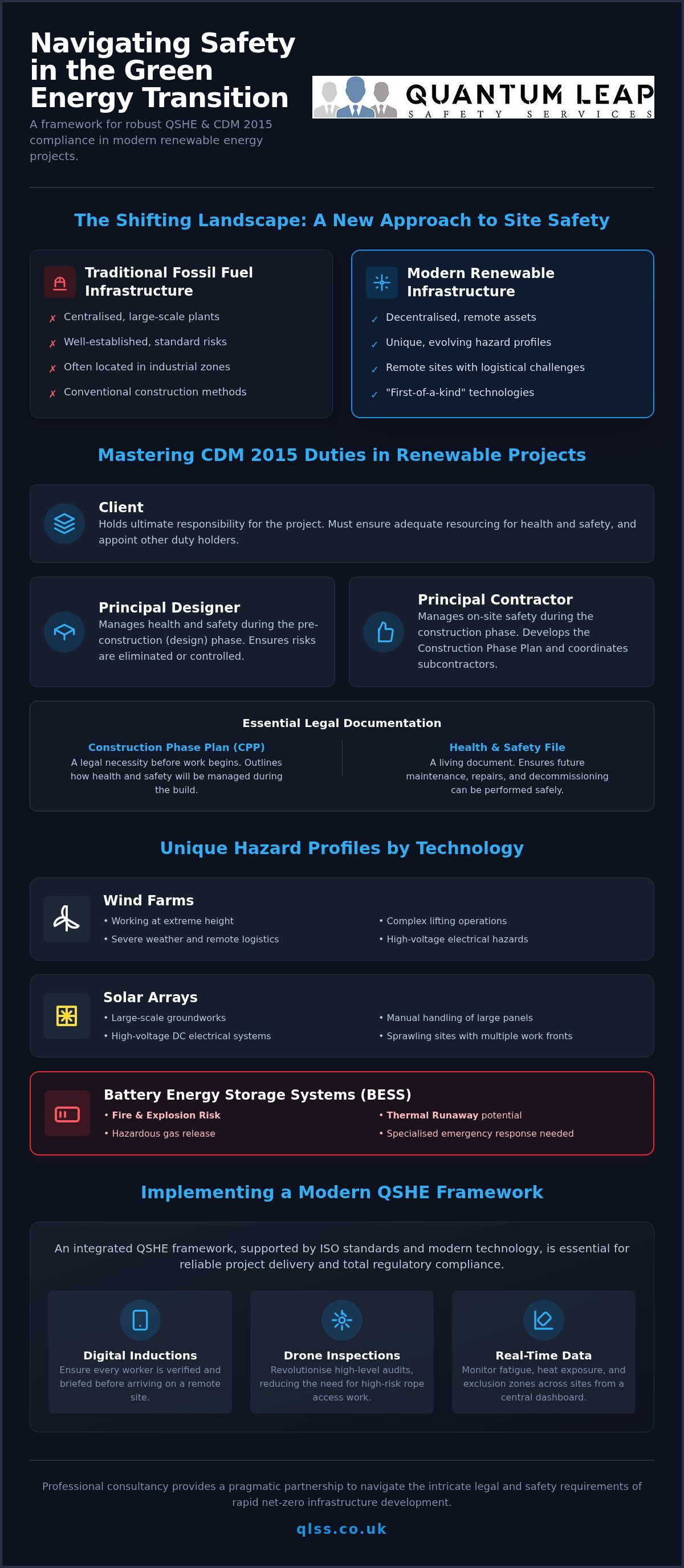
Renewable energy construction is no longer a niche sector; it's a specialised discipline that demands a departure from traditional civil engineering mindsets. Whilst a standard Construction Site Safety Overview provides a foundation of hazard identification and PPE requirements, it often fails to address the specific complexities of decentralised green energy assets. We've moved away from centralised fossil fuel plants toward a landscape of remote wind farms, sprawling solar arrays, and high-density battery storage units. This shift requires a more agile and tech-enabled approach to safety. In 2026, regulatory expectations have sharpened. Project developers and contractors are now held to stricter standards regarding lifecycle safety, particularly as the UK National Planning Policy Framework now gives "substantial weight" to renewable schemes, often accelerating project timelines and increasing the pressure on site teams.
Effective construction safety management for renewable energy projects must account for the unique geographical and technical challenges of these sites. Standard protocols typically struggle in environments where the nearest emergency services are an hour's drive away or where the ground conditions involve unstable peat bogs and steep gradients. By 2026, the industry has recognised that safety isn't just about preventing falls; it's about managing the intersection of high-voltage electricity, environmental stewardship, and extreme weather logistics.
Why Renewables Demand a Different Safety Mindset
The green sector frequently utilises "first-of-a-kind" technologies, which brings inherent risk. For instance, Battery Energy Storage Systems (BESS) now face much stricter requirements following updates to standards like NFPA 855 in 2026. These projects involve specific fire and explosion risks that a general construction manager might not fully grasp. Managing safety on these sites means planning for thermal runaway and gas monitoring from day one. Remote site locations also complicate emergency response logistics. You can't assume local fire crews have the specialist training or equipment to handle a lithium-ion fire or a turbine blade failure. Compliance in 2026 requires a bespoke emergency plan that includes specialised extraction procedures and on-site medical provisions that go far beyond a standard first-aid kit.
The Role of Technology in Modern Site Safety
Digital transformation is the backbone of safe project delivery in 2026. Digital site inductions are now standard, ensuring every worker is verified and briefed before they even step onto a remote site. Drones have revolutionised high-level inspections for wind turbine infrastructure, almost eliminating the need for high-risk rope access during the initial audit phases. We also see the integration of real-time safety data into project management dashboards. This allows QSHE managers to monitor fatigue levels, heat exposure, and exclusion zone breaches across multiple sites simultaneously. These tools don't just tick a compliance box; they provide the pragmatic, data-driven insights needed to keep a fast-paced renewable project on track and incident-free.
Navigating CDM 2015 Duties in Renewable Infrastructure Projects
The Construction (Design and Management) Regulations 2015 (CDM 2015) form the legal backbone of every UK energy development. For developers, understanding these duties is not just about avoiding HSE fines; it's about ensuring the long-term viability of the asset. The Client holds the ultimate responsibility for ensuring that construction safety management for renewable energy projects is sufficiently resourced. This involves appointing a Principal Designer to manage risks during the design phase and a Principal Contractor to oversee site safety. Both roles must produce critical documentation. A robust Construction Phase Plan (CPP) is a legal prerequisite before any work begins on-site. Without it, you're in immediate breach of the law.
Equally vital is the Health and Safety File. Whilst the CPP manages the build, the File ensures that future maintenance, such as turbine blade repairs or battery cell replacements, can be carried out safely. Failing to maintain these standards can lead to costly HSE intervention, project shutdowns, and significant reputational damage. Similar rigour is seen globally, such as through the BSEE renewable energy safety program, which oversees offshore safety standards. Adopting this level of detail helps ensure your project remains compliant from inception to decommissioning.
Appointing Competent Duty Holders
Competence in the renewable sector is highly specialised. You shouldn't assume a contractor with general civil experience understands the complexities of high-voltage DC arrays or the stability requirements for wind turbine foundations. Due diligence must involve rigorous checks of past project performance in niche environments. Using an external partner for Construction QSHE Services can help you verify that your chosen duty holders possess the technical skills required for your specific technology.
Managing the Pre-Construction Information (PCI)
The PCI identifies site-specific hazards long before a spade hits the ground. For wind farms, this might include geotechnical data on peat bogs; for solar, it often involves identifying existing underground services or overhead power lines. Environmental constraints, such as protected habitats or watercourses, must also be integrated into this document to prevent legal breaches. The Pre-Construction Information serves as the foundational safety document that informs the design and planning of every renewable energy project.
Risk Profiles: Wind, Solar, and Battery Energy Storage (BESS)
Every renewable technology carries a distinct risk fingerprint that evolves as a project moves from civil works to commissioning. Developers managing extensive portfolios face a significant "multi-site" challenge; they must maintain consistent safety standards across geographically dispersed assets that often share little in common regarding their hazard profiles. Effective construction safety management for renewable energy projects requires an understanding that risk doesn't end when the build finishes. The transition from construction risks, such as heavy plant movements, to operational risks, like high-voltage electrical discharge, must be managed with a seamless QSHE handover. For a detailed breakdown of site-specific evaluation techniques, you can refer to our 2026 Health and Safety Audit for Renewable Projects.
Wind Energy: Working at Height and Heavy Lifting
Wind projects involve some of the most complex logistics in the construction industry. Managing the transport and assembly of massive turbine components requires meticulous planning to avoid structural failures or transport incidents. Once on-site, the focus shifts to high-altitude maintenance and blade inspections, where fall arrest systems and rescue-from-height protocols are non-negotiable. Weather-related risks also play a critical role; lifting operations must be strictly governed by wind speed thresholds to prevent catastrophic crane failures. In 2026, using drones for initial inspections has reduced the need for rope access, but the fundamental risks of working at height during assembly remain a primary concern for every Principal Contractor.
Solar Farms: Electrical Hazards and Ground Works
Large-scale solar arrays present unique electrical challenges, particularly because DC circuits are energised the moment panels are exposed to daylight. This "always-on" nature requires specialised isolation procedures that differ from traditional AC systems. On the civil side, solar farms often occupy soft terrain or former agricultural land, making pile driving and heavy machinery operation a risk for ground instability. Contractors must also balance safety with environmental mitigation. Protecting biodiversity and managing soil runoff are now core components of the construction safety management for renewable energy projects, ensuring that the installation of solar assets doesn't compromise the local ecosystem.
BESS: Chemical Risks and Fire Suppression
Battery Energy Storage Systems (BESS) represent the most significant shift in the 2026 safety landscape. Unlike wind or solar, BESS projects introduce chemical risks and the potential for thermal runaway events. Fire safety management during the commissioning phase is critical; lithium-ion fires cannot be extinguished with traditional methods and require specialised suppression systems. Compliance now involves consulting with local fire authorities at least 30 days before construction begins to align on emergency response plans. Ensuring your site has gas monitoring and explosion prevention measures in place is no longer optional; it's a fundamental requirement for the safe integration of battery technology into the power grid.
Implementing a Total QSHE Framework for Project Success
Successful project delivery in the green sector relies on more than meeting minimum legal requirements. An integrated Quality, Safety, Health, and Environmental (QSHE) approach ensures that these four pillars work in tandem rather than in silos. In the context of construction safety management for renewable energy projects, a quality failure, such as a poorly secured electrical connection, is often the root cause of a future safety incident or environmental breach. By adopting ISO standards like 45001 for safety, 14001 for environmental management, and 9001 for quality, developers create a robust structure that supports reliable project delivery.
Establishing a "Golden Thread" of compliance data is essential for long-term asset integrity. This involves creating a continuous record of safety decisions, material specifications, and audit results from the initial design through to final commissioning. For developers managing multiple assets, a managed service retainer provides the necessary continuous oversight. This model ensures that QSHE standards don't slip during the high-pressure final stages of a build, providing a "safe pair of hands" to manage the complex documentation and site inspections required for total compliance.
Step 1: Establishing the Governance Structure
Effective governance starts with setting clear QSHE KPIs for all project stakeholders, including every sub-contractor on site. We recommend organising regular safety leadership tours, where senior management visits the site to engage directly with the workforce. This visibility reinforces a positive safety culture and ensures that reporting lines for incidents and near-misses are well-understood. Defining these responsibilities early prevents the confusion that often arises on multi-contractor renewable sites.
Step 2: Continuous Monitoring and Auditing
Unannounced site safety inspections are particularly valuable for remote renewable projects where the "site office" may be miles from the actual work face. These audits should drive "continual improvement" rather than simply checking for non-compliance. When a non-conformance is identified, it must be managed within the fast-moving construction schedule without causing unnecessary delays. A pragmatic approach involves identifying the root cause and implementing corrective actions that prevent recurrence across the entire project portfolio.
Step 3: Training and Competence Management
Ensuring all site personnel have valid GWO (Global Wind Organisation) or equivalent training is a non-negotiable standard in 2026. Managing the training matrix for a diverse, transient workforce requires a disciplined approach to competence management. Regular toolbox talks are vital for maintaining a high safety culture amongst contractors, as they provide a forum to discuss site-specific hazards that may not be covered in general inductions. For a total compliance solution that covers every stage of your build, explore our Business Total Compliance Solutions.
Securing Your Project with Professional QSHE Consultancy
The transition to green energy is fast-paced and technically demanding. For many developers, the internal resource required to maintain total regulatory oversight is a significant burden. Quantum Leap Safety Services (QLSS) acts as a pragmatic partner, providing a "safe pair of hands" to manage the intricate legal and technical requirements of your build. Whether you require project-specific support for a single wind farm or a comprehensive managed service for a national portfolio, professional consultancy ensures that construction safety management for renewable energy projects remains robust and compliant.
Project-based consultancy allows for focused expertise on specific deliverables, such as drafting a Construction Phase Plan or conducting a pre-commissioning fire safety audit. For larger organisations, our QSHE Managed Services provide continuous oversight, ensuring that standards remain consistent across multiple sites and diverse contractor teams. We also specialise in supporting SMEs to achieve vital industry accreditations like CHAS and SafeContractor. These certifications are often a prerequisite for tendering on major infrastructure projects; we provide the methodical guidance needed to secure them without disrupting your daily operations.
Tailored Support for Renewable Energy SMEs
Smaller green energy firms often face significant resource constraints. Hiring a full-time QSHE manager isn't always financially viable, yet the legal obligations remain just as stringent as those for multinational developers. QLSS bridges this gap by providing access to competent safety advice on a flexible basis. We assist scaling businesses with the implementation of ISO management systems, ensuring your internal processes are built on a foundation of international best practice. This approach allows you to focus on project delivery whilst we handle the complexities of quality, environmental, and safety compliance.
From Planning to Commissioning: Our National Support
Construction doesn't happen in a vacuum. A safety partner must understand the entire renewable value chain, from the initial geotechnical surveys through to the final grid connection. QLSS provides national coverage across the UK, offering a consistent point of contact for multi-site projects regardless of their location. This continuity is vital for maintaining the "Golden Thread" of compliance data discussed in previous sections. By partnering with a consultancy that understands the specific hazards of wind, solar, and BESS, you ensure that your project is protected from HSE intervention and operational delays.
Enquire about our Renewable Projects Support today to discuss how we can streamline your safety protocols and secure your project's success.
Future-Proofing Your Renewable Energy Portfolio
Mastering the complexities of CDM 2015 and technology-specific hazards like thermal runaway in BESS is critical for 2026 compliance. By integrating safety, quality, and environmental standards into a single QSHE framework, you protect both your workforce and your long-term investment. This disciplined approach to construction safety management for renewable energy projects ensures that every build, from isolated wind farms to urban battery storage, meets the rigorous expectations of the HSE. A robust Health and Safety File is not just a legal box to tick; it's the foundation of operational integrity for the next twenty years.
Achieving total compliance doesn't have to be a drain on your internal resources. Quantum Leap Safety Services provides specialist QSHE support for the renewable sector, offering national UK coverage for multi-site projects and deep expertise in CDM 2015 and ISO management systems. We act as your "safe pair of hands" throughout the entire project lifecycle, from initial planning to final commissioning. Contact Quantum Leap Safety Services for expert Renewable Project Support to ensure your next build is delivered safely and efficiently. We're here to help you navigate the transition to green energy with confidence.
Frequently Asked Questions
How does CDM 2015 apply to renewable energy construction projects?
CDM 2015 applies to every phase of a renewable project, from initial site surveys to final grid connection. The regulations require the appointment of a Principal Designer and Principal Contractor when more than one contractor is involved. These duty holders must coordinate health and safety, ensuring that risks are designed out or managed. Effective construction safety management for renewable energy projects relies on these roles to produce the Construction Phase Plan and the Health and Safety File.
What are the main safety risks on a solar farm construction site?
Solar farm construction presents specific risks related to energised DC circuits, which are active as soon as panels are exposed to light. Civil works involve heavy plant movement and pile driving on potentially unstable agricultural land. Workers also face manual handling risks during the installation of thousands of panels. Environmental protection is equally critical; managing soil erosion and protecting local biodiversity are mandatory requirements that must be integrated into site safety protocols and risk assessments.
Do I need a Principal Designer for a small-scale wind project?
You must appoint a Principal Designer if your project involves more than one contractor, regardless of the project's scale. In the wind sector, even small-scale installations typically involve multiple parties, such as turbine suppliers, civil contractors, and electrical engineers. The Principal Designer's role is to plan, manage, and monitor the pre-construction phase to ensure that potential hazards, such as turbine siting and access track gradients, are addressed before work begins on-site.
What fire safety measures are required for BESS (Battery Storage) sites?
BESS sites require bespoke fire safety management due to the risk of thermal runaway in lithium-ion batteries. Compliance in 2026 involves installing gas monitoring and explosion prevention systems that can detect cell failure early. You must also consult with local fire authorities at least 30 days before construction begins to align on emergency response plans. Adequate spacing between containers and the provision of dedicated water supplies for cooling are standard requirements for these high-density assets.
How can I ensure my sub-contractors are competent for renewable work?
Verifying sub-contractor competence requires a rigorous review of their technical qualifications and past performance in the renewable sector. You should check for industry-specific certifications, such as Global Wind Organisation (GWO) training for wind projects or specialised high-voltage electrical accreditations. A pragmatic approach involves auditing their previous safety records and assessing their understanding of the specific technology involved. Using an external partner for Construction QSHE Services can help streamline this due diligence process for your business.
What is the role of a QSHE advisor in renewable energy projects?
A QSHE advisor provides the competent advice required to maintain regulatory compliance across the project lifecycle. They conduct unannounced site inspections, manage the "Golden Thread" of safety documentation, and ensure that all contractors adhere to the Construction Phase Plan. By acting as a "safe pair of hands," the advisor helps developers identify risks before they lead to HSE intervention. This role is essential for maintaining a high safety culture on remote sites with diverse workforces.
Can ISO 45001 certification improve my project safety performance?
ISO 45001 provides a structured framework that shifts safety management from a reactive exercise to a proactive system of continual improvement. It requires senior leadership engagement and worker participation, which are vital for building a strong safety culture on complex sites. Implementing this standard helps your business manage construction safety management for renewable energy projects more effectively by identifying systemic weaknesses and ensuring that corrective actions are documented and reviewed regularly to prevent future incidents.
What should be included in a Construction Phase Plan for renewables?
A Construction Phase Plan for renewables must include specific arrangements for managing high-risk activities like turbine assembly, high-voltage connections, and BESS commissioning. It should detail site rules, emergency procedures, and the coordination of multiple sub-contractors on remote locations. The plan must also address environmental constraints and the logistics of heavy component transport. This document is a live record that must be updated as the project transitions from civil works to the final commissioning phase.


Comments