
Renewable Energy Project Support: A Case Study in QSHE Compliance Excellence
Could a single oversight in your CDM documentation or a lapse in contractor oversight jeopardise a multi-million pound wind farm development? In the high-stakes environment of UK infrastructure, the gap between a successful handover and a costly regulatory nightmare is often thinner than project managers care to admit. Securing professional renewable energy project support is no longer just a luxury for the risk-averse; it's a fundamental requirement for operational viability and long-term asset stability.
You likely understand the frustration of managing inconsistent safety standards across dozens of contractors whilst trying to stay abreast of evolving ISO 50001:2018 requirements and the latest 2026 NFPA 855 standards for energy storage. It's a relentless balancing act that can feel like a distraction from your core engineering and delivery goals. This article demonstrates how expert QSHE managed services transform these complex regulatory hurdles into clear benchmarks of safety and efficiency. We'll explore a practical case study that illustrates the journey toward a zero-harm site culture and successful ISO integration, proving that total compliance is the most direct route to project excellence.
Table of Contents
Understanding Renewable Energy Project Support: Beyond the Planning Phase
Professional renewable energy project support isn't just about securing grants or winning over local planning committees. Whilst those 'soft' support elements are vital for getting a project off the ground, 'hard' support focuses on the technical realities of Quality, Safety, Health, and Environment (QSHE). It's a multi-disciplinary approach that ensures a project is legally viable and operationally safe from the moment boots hit the ground. For many developers, this represents the difference between a theoretical plan and a functioning asset.
Many SMEs find the transition from planning to site mobilisation particularly challenging. The shift from a controlled office environment to high-risk infrastructure management requires a different set of skills; it's often where the most significant safety gaps emerge. A total compliance solution provides a structured framework that manages these risks proactively. This approach doesn't just tick a box; it embeds a zero-harm culture into the project's DNA. By integrating safety protocols early, businesses can avoid the common pitfalls of inconsistent contractor standards and regulatory delays that frequently plague uncoordinated sites.
The Lifecycle of a Renewable Project
A project moves through four distinct phases: Feasibility, Planning, Construction, and Operation. Each stage carries a different risk profile. During feasibility, risks are largely financial or environmental. By the construction phase, these shift to physical hazards like heavy lifting and high-voltage electrical work. A QSHE advisor bridges these gaps, ensuring that safety protocols developed during design are actually implemented on-site. This continuity prevents critical safety information from being lost during handovers, maintaining a steady and methodical flow of information between stakeholders.
Why National UK Compliance Matters in 2026
In 2026, the regulatory landscape for Renewable energy infrastructure is more complex than ever. With the UK's commitment to net-zero, standards like ISO 50001:2018 and the latest NFPA 855 requirements for energy storage have become central to project delivery. For project directors, non-compliance isn't just a budget risk; it carries significant legal implications under CDM regulations. Professional renewable energy project support ensures that these obligations are met consistently across all contractors. It provides a "safe pair of hands" for complex builds, allowing internal management teams to focus on delivery whilst we handle the intricacies of audit and inspection. This methodical oversight is essential for maintaining long-term project stability and investor confidence.
Navigating QSHE Requirements for Renewable Infrastructure
Successful project delivery relies on the four core pillars of QSHE: Quality, Safety, Health, and Environment. In the UK, these aren't just administrative categories but active operational requirements. Quality ensures technical specifications are met; Safety and Health protect the workforce; Environment manages the project's impact on the surrounding ecosystem. Comprehensive renewable energy project support integrates these pillars into a single, cohesive strategy that protects both people and assets.
Environmental challenges are particularly acute in green energy builds. Issues like land contamination from previous land use or the protection of local biodiversity can halt a project if not managed with precision. Adhering to strict safety and environmental requirements is essential for maintaining your social licence to operate. Beyond legal necessity, holding ISO 14001 and ISO 45001 certifications provides a significant competitive edge during the tender process, as Tier 1 contractors increasingly demand verified compliance from their supply chain.
Occupational health risks also require specialised attention, especially on remote or offshore sites. Issues like fatigue management, emergency medical response, and mental health support for isolated workers are critical. Long-distance travel and extended shifts on remote sites increase the risk of incidents; therefore, a dedicated health management plan is indispensable. If your team is struggling to coordinate these requirements, our QSHE managed services provide the necessary technical oversight to keep your project on track.
CDM 2015 and the Renewable Sector
The Construction (Design and Management) Regulations 2015 (CDM) define clear legal duties for the Client, Principal Designer, and Principal Contractor. In renewable builds, these roles often overlap or shift between phases. A robust Construction Phase Plan is mandatory to manage high-risk activities. Managing health and safety for wind farms requires specific CDM expertise to handle complex lifting operations and electrical hazards whilst ensuring all parties remain compliant with national standards.
Implementing ISO Management Systems
For SMEs, an Integrated Management System (IMS) streamlines operations by combining quality, environmental, and safety protocols into one framework. This reduces administrative duplication and improves site efficiency. ISO 9001 is particularly valuable for ensuring quality control across a global supply chain of specialised components. In 2026, ISO 14001 stands as the gold standard for environmental compliance, proving that a project meets the highest benchmarks for sustainability and waste management. This structured approach to renewable energy project support ensures that technical authority is maintained at every stage of the build.
Case Study: Managing High-Risk Infrastructure Safety
Consider a mid-sized solar farm development on a remote UK site. The project involved installing over 100,000 panels, requiring heavy lifting of substation modules and complex high-voltage electrical works. Initial challenges included a lack of unified safety standards across five different sub-contractors and the logistical strain of a remote moorland location. Without cohesive renewable energy project support, the site risked becoming a series of disconnected work zones with overlapping hazards and inconsistent reporting structures.
To address these gaps, QLSS implemented a comprehensive health and safety audit for renewable projects. This intervention identified critical deficiencies in the existing Construction Phase Plan, specifically regarding emergency medical evacuation procedures and fire suppression readiness for battery storage areas. By the project's completion, the developer recorded zero reportable incidents and achieved full compliance sign-off 10 days ahead of the scheduled operational date. This success demonstrates that methodical oversight is a catalyst for project efficiency, not a hindrance to it.
Risk Assessment and Hazard Identification
Identifying 'hidden' risks is a core component of technical authority. In a solar or wind build, these often include ground stability for heavy crane pads or the specific fire risks associated with Battery Energy Storage Systems (BESS). Whilst global frameworks like the Bureau of Safety and Environmental Enforcement (BSEE) renewable energy program provide a baseline for offshore safety, onshore projects require equally rigorous site-specific fire safety management plans. QLSS audits look beyond the obvious, examining contractor competencies and equipment maintenance records to identify potential failures before they manifest as site incidents. We focus on the practical realities of high-risk infrastructure to ensure every hazard is mapped and mitigated.
The Role of Continuous Monitoring
A one-off audit provides a snapshot, but managed safety services offer long-term project stability. Ongoing oversight ensures that safety protocols aren't abandoned as deadlines approach. Regular site inspections reinforce a zero-harm culture, ensuring that every contractor maintains the high standards established at the outset. Real-time reporting provides project directors with total transparency, allowing for data-driven decisions that protect both the budget and the workforce. This methodical approach transforms QSHE from a regulatory hurdle into a benchmark of operational excellence, ensuring that compliance is maintained throughout the construction lifecycle and into the operational phase.
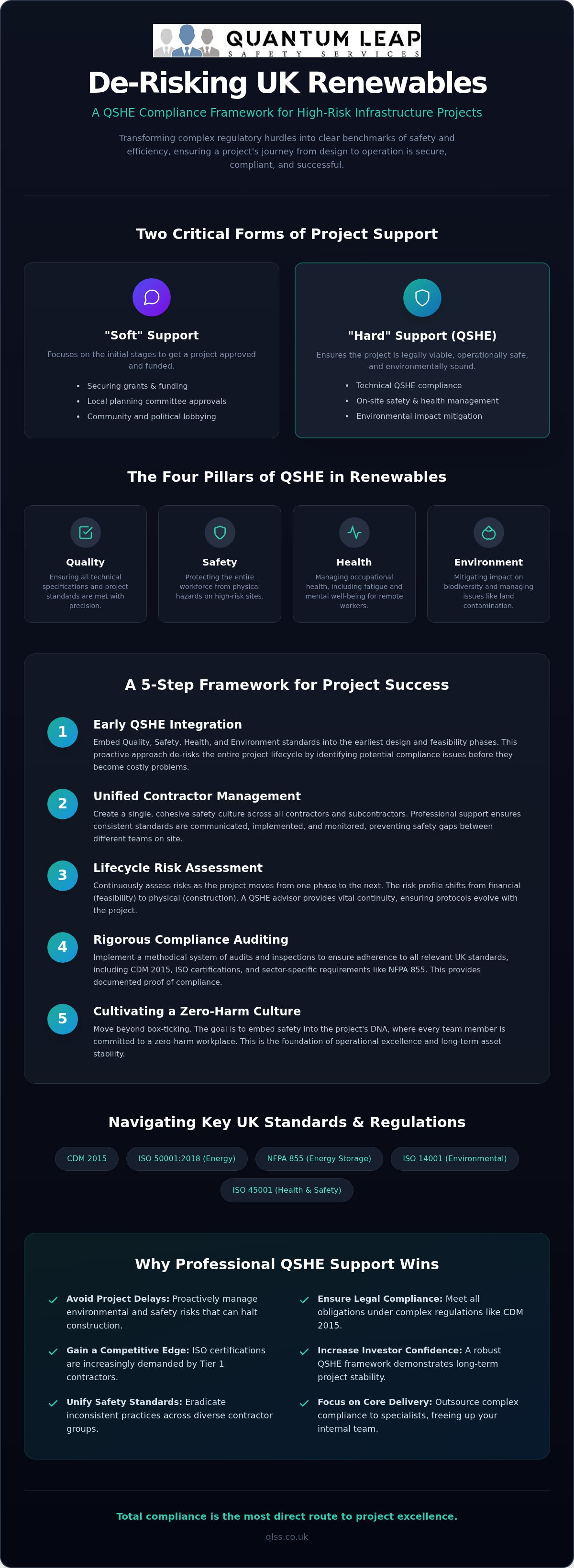
A 5-Step Framework for Renewable Project Success
Establishing a structured QSHE framework is the most effective way for SMEs to manage the transition from planning to site mobilisation. Without a clear methodology, projects often suffer from fragmented safety protocols and inconsistent contractor performance. Comprehensive renewable energy project support provides a disciplined roadmap that ensures every phase of the build meets national standards. This five-step framework serves as a benchmark for operational excellence.
Step 1: Early-stage QSHE integration. Safety and environmental considerations must be embedded during the design phase. Addressing risks like cable routing and substation positioning early prevents costly retrofitting later.
Step 2: Rigorous contractor vetting. You must verify the competence of every organisation in your supply chain. This involves checking accreditations and previous safety performance before they arrive on-site.
Step 3: Bespoke management plans. Generic templates aren't sufficient for high-risk infrastructure. You need a site-specific safety and environmental management plan that accounts for local topography and specific technical hazards.
Step 4: Mandatory safety training. Every individual on-site must undergo project-specific induction and competency training. This ensures a unified understanding of site rules and emergency procedures.
Step 5: Regular auditing and iteration. Safety protocols shouldn't be static. Regular inspections allow you to identify emerging risks and refine your processes in real-time.
Following this methodical approach reduces the administrative burden on your internal team whilst ensuring total compliance. If you need assistance implementing this framework, our team can provide the necessary Renewable Projects Support to de-risk your development.
Contractor Vetting and Accreditations
In a multi-contractor environment, maintaining consistent standards is a significant challenge. Accreditations like CHAS and SafeContractor are vital benchmarks; they provide independent verification that a contractor's safety management system is fit for purpose. However, vetting doesn't end with a certificate. Effective training management ensures that every worker's specific qualifications, such as turbine-specific lifting or high-voltage certifications, are current and documented. This level of oversight prevents the "competency gaps" that often lead to site incidents.
Environmental Excellence and Waste Management
The sustainability of a green energy project is often judged by the environmental impact of its construction. Minimising the carbon footprint of the build itself requires careful coordination of plant machinery and logistics. Managing waste streams is equally critical, ensuring that materials like packaging, excess cabling, and soil are handled in strict accordance with UK environmental regulations. Furthermore, professional oversight is essential for meeting biodiversity net gain requirements. This ensures that the local ecosystem is protected or enhanced, fulfilling your legal obligations and protecting the project's long-term reputation.
Partnering for Total Compliance: Why Professional Support Wins
Outsourcing QSHE managed services to a specialist consultancy like Quantum Leap Safety Services (QLSS) provides a strategic advantage that goes beyond simple regulatory compliance. Project directors often face the challenge of managing technical delivery whilst simultaneously ensuring that complex safety and environmental obligations are met. By securing professional renewable energy project support, you shift this responsibility to a dedicated partner. This transition allows your internal management team to focus on engineering milestones and budget control without being bogged down by the minutiae of audit and inspection work.
A retainer-based model for long-term project support is often the most cost-effective solution for SMEs. Ad-hoc compliance can lead to reactive decision-making and unexpected costs when issues arise on-site. In contrast, a methodical and ongoing partnership ensures that safety standards remain consistent from initial mobilisation through to final commissioning. This "safe pair of hands" approach acts as a form of operational insurance. It protects your business against the legal and financial repercussions of site incidents, ensuring that every project becomes a benchmark of safety and efficiency.
Pragmatic Support for Modern Enterprises
QLSS understands that safety protocols must be practical to be effective. We balance technical rigour with common-sense business needs, ensuring that compliance doesn't hinder site progress. Having access to competent advice at any project stage is vital, especially during the high-pressure transition from construction to the operational phase. As a project moves into its managed service lifecycle, the focus shifts from build-safety to long-term asset integrity and occupational health management. Our team guides you through this transition, maintaining a disciplined and process-driven approach throughout the asset's life.
Securing Your Project’s Future
There is a direct link between safety excellence and investor confidence. In 2026, stakeholders and financial partners increasingly view robust QSHE management as a key indicator of project stability. A development with a zero-harm culture and total ISO integration is a significantly more attractive asset for long-term investment. To begin this process, we recommend starting with a project-based safety audit to identify your current compliance status and map out a route to excellence. Contact QLSS today for a bespoke compliance review and discover how our renewable energy project support can secure the future of your green energy infrastructure.
Ensuring Long-Term Stability for Green Infrastructure
Managing the complexities of green energy infrastructure requires a disciplined shift from reactive problem-solving to proactive compliance management. This article has demonstrated how early QSHE integration and a structured framework transform high-risk sites into benchmarks of operational safety. By embedding these standards into your site culture, you protect your workforce whilst significantly enhancing the long-term value of your assets for investors and stakeholders. A methodical approach ensures that safety is a driver of efficiency, not a barrier to it.
Specialised renewable energy project support provides the technical authority needed to navigate intricate CDM regulations and ISO requirements with total precision. With over a decade of safety consultancy experience, Quantum Leap Safety Services offers pragmatic, SME-focused safety solutions that act as a reliable partner for your development. It's time to move beyond regulatory hurdles and focus on successful delivery. Secure your renewable project with expert QSHE support from Quantum Leap Safety Services. Our specialists in ISO implementation and CDM compliance help you establish a zero-harm site culture that maintains stability well into the operational phase.
Frequently Asked Questions
What exactly is renewable energy project support in a safety context?
Renewable energy project support in a safety context refers to the technical oversight of Quality, Safety, Health, and Environment (QSHE) throughout a project's lifecycle. It involves managing CDM compliance, site inspections, and contractor safety to ensure the project meets national standards. This support moves beyond high-level planning to focus on the practical hazards of high-risk infrastructure. It provides a methodical framework for operational safety on wind, solar, and energy storage developments.
Does my small renewable project really need a full QSHE audit?
Yes, because legal obligations under CDM 2015 apply regardless of project scale. Small projects often face the same high-risk activities as large developments, such as heavy lifting or complex electrical works. A QSHE audit identifies specific gaps in your safety management system before they lead to incidents on-site. It ensures your business remains compliant whilst protecting your reputation and operational stability from the earliest stages of the build.
How do CDM 2015 regulations apply to solar and wind farm developments?
CDM 2015 classifies these developments as construction projects, requiring the formal appointment of a Principal Designer and Principal Contractor. You must produce a robust Construction Phase Plan and ensure all parties demonstrate the necessary technical competence. Professional renewable energy project support helps you navigate these roles, ensuring that safety is integrated from the design phase through to decommissioning, fulfilling your legal duties as a client under UK law.
What are the most common safety risks on renewable energy construction sites?
Common risks include falls from height during turbine assembly, heavy lifting operations, and high-voltage electrical hazards. Remote site locations also introduce logistical risks, such as delayed emergency medical response times. Additionally, fire risks associated with Battery Energy Storage Systems (BESS) are a significant concern. Managing these requires site-specific fire safety plans and rigorous contractor vetting to ensure all personnel are competent in their assigned high-risk tasks throughout the project.
How can ISO 14001 certification benefit my renewable energy business?
ISO 14001 is the gold standard for environmental management and is increasingly required to secure Tier 1 contracts. It proves that your business manages waste, land contamination, and biodiversity impacts systematically. This certification enhances investor confidence and demonstrates a clear commitment to sustainability. It provides a competitive edge during tenders by verifying that your environmental protocols meet internationally recognised benchmarks of excellence and comply with the latest UK regulations.
What is the difference between project-based consultancy and a safety retainer?
Project-based consultancy focuses on specific milestones, such as an initial audit or a Construction Phase Plan. A safety retainer provides ongoing renewable energy project support throughout the duration of the build. Retainers are often more cost-effective for long-term projects, offering a "safe pair of hands" for regular inspections and real-time advice. This model ensures that safety standards remain consistent as the development moves from construction into the operational phase.
Can professional safety support help with my CHAS or SafeContractor application?
Yes, we provide comprehensive assistance with safety packages and accreditations like CHAS or SafeContractor. We help you organise your documentation and evidence to meet the strict criteria of these assessment schemes. Achieving these accreditations is vital for entering the supply chain of larger renewable projects. Our pragmatic approach ensures your application accurately reflects your safety management systems, increasing your chances of a successful first-time assessment and improving your marketability.
How much does QSHE support typically cost for a renewable project?
Costs vary depending on the project's scale, location, and the level of technical oversight required. Factors such as the number of sub-contractors, the complexity of site-specific hazards, and the total duration of the build influence the final price. We recommend a bespoke compliance review to determine the specific needs of your development. This ensures you receive a pragmatic, cost-conscious solution that fulfills your legal obligations without incurring unnecessary expenditure.


Comments