
The Best Citation Health and Safety Alternatives for UK SMEs in 2026
With the Health and Safety Executive Fee for Intervention rate currently at £188 per hour as of April 2026, many UK SMEs are actively reviewing their Citation health and safety alternatives to find better value. It's common to feel trapped in rigid five year contracts with national providers that offer generic templates instead of practical, sector-specific help. You likely recognise that an anonymous call centre doesn't provide the level of expertise required for high-risk sectors like construction or renewables where specific hazards require a more tailored approach.
We agree that safety support should be a "safe pair of hands" rather than a source of administrative frustration. This guide promises to show you how to move beyond "tick-box" compliance to a managed service that adds real operational value to your business. We'll explore how having a named Competent Person can help you secure vital accreditations like CHAS or ISO 9001 whilst ensuring your organisation remains truly protected and compliant.
Table of Contents
Why Businesses Seek Citation Health and Safety Alternatives
Many UK SMEs find themselves reviewing Citation health and safety alternatives when they realise that a standardised compliance model doesn't suit their specific operational needs. While large national providers offer a sense of security through scale, the reality for many businesses is a rigid three to five year contract that offers little flexibility as the company evolves. These long-term commitments often become a source of frustration, especially when the service feels more like a legal insurance product than a practical safety resource.
The primary issue with the "big box" model is the call-centre bottleneck. Dealing with different advisors who don't understand your specific site risks leads to generic advice that can be difficult to implement. This lack of continuity often results in operational delays. If an advisor suggests a control measure that is impractical for your specific workshop or site, it creates friction between compliance and productivity. Under the Health and Safety at Work etc. Act 1974, the legal responsibility for safety rests firmly with the employer; generic templates rarely stand up to the scrutiny of a focused HSE inspection where site-specific evidence is required.
The Limitations of Automated Compliance Software
Digital platforms are useful for organisation, but they cannot replace the "Competent Person" requirement under UK law. Software lacks the ability to walk a site and spot a failing scaffold or a mismanaged chemical store. We often see "template fatigue" amongst employees who stop engaging with safety because the documents feel like a corporate box-ticking exercise. Automated systems frequently miss site-specific hazards in complex industries like renewables or high-risk construction, leaving businesses vulnerable despite having a "green" dashboard status.
The Shift Towards Value-Driven Safety Partnerships
Forward-thinking businesses are moving from a mindset of "avoiding fines" to "improving culture". This shift requires a partnership rather than a subscription. Having a named consultant who visits your premises ensures that advice is grounded in reality and tailored to your team's behaviour. This specialist support is vital for business growth. Having robust, bespoke systems in place makes it significantly easier to achieve industry-specific accreditations like CHAS or ISO 9001. These badges of quality are often essential for tender success. By choosing Citation health and safety alternatives that prioritise expert consultancy, SMEs can turn compliance from a burden into a genuine operational asset.
Categorising the Market: Three Main Compliance Models
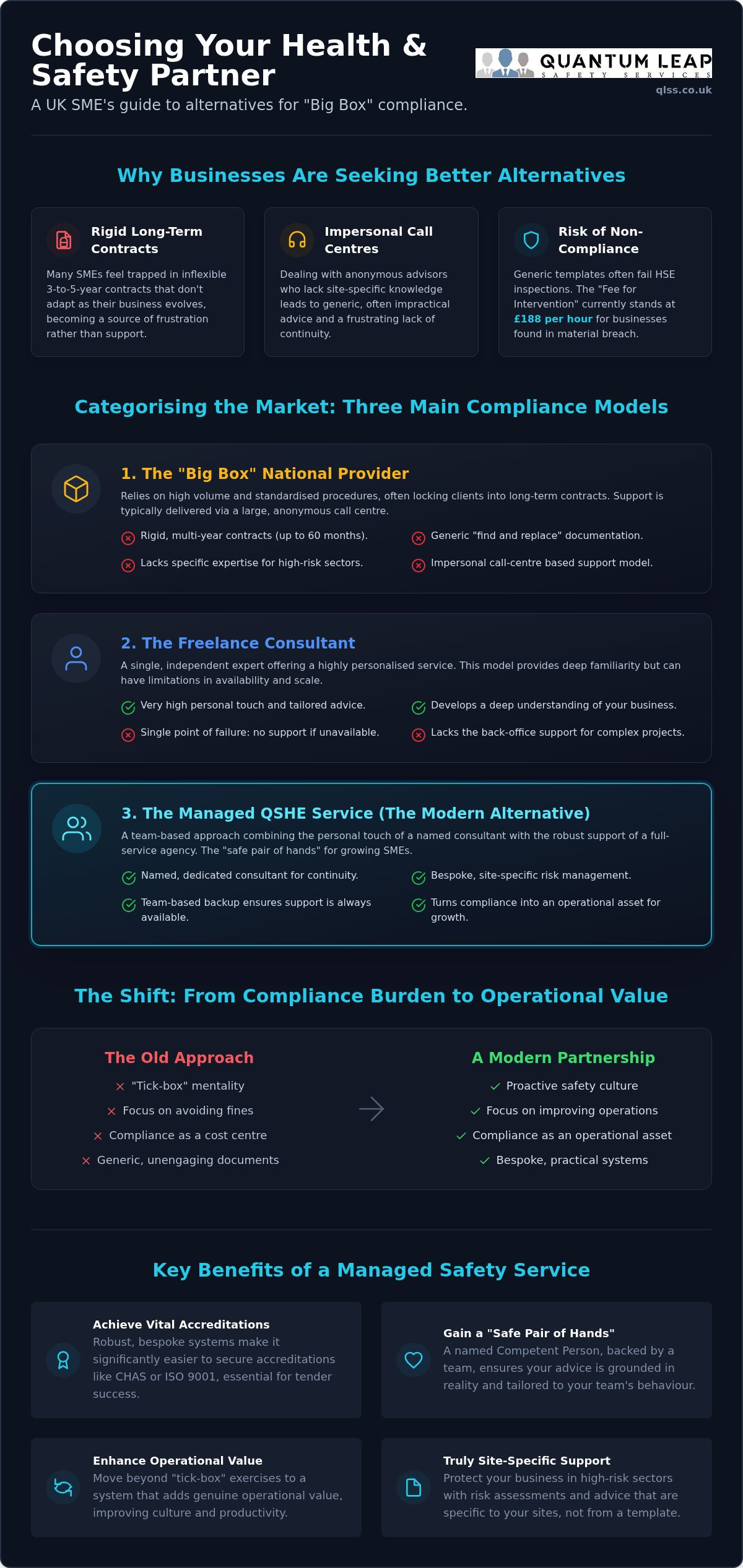
When searching for Citation health and safety alternatives, it's vital to understand that the market isn't uniform. Most providers fall into three distinct categories, each with different implications for your liability and operational speed. Selecting the right one depends on whether you view safety as a legal hurdle or a strategic foundation for growth. In 2026, the choice usually comes down to scale versus specificity.
The national "Big Box" providers rely on high volume and standardised procedures. Whilst they provide essential documentation, their business model often requires long-term lock-ins, sometimes lasting sixty months. This can be restrictive for a growing SME that needs to pivot quickly. Conversely, freelance consultants offer a high personal touch but often lack the back-office support needed for complex projects. If an individual consultant is on another site or unavailable, your compliance support effectively stops.
The managed QSHE service represents the third option. This team-based approach provides bespoke support without the call-centre feel. It ensures that your safety systems are managed by experts who understand your specific industry, offering a "safe pair of hands" for your entire operation. This model is often the most effective for businesses scaling their operations in high-risk environments.
The Call-Centre Model vs. The Named Consultant
Analysing response times is a key part of your evaluation. Call centres often provide instant but generic answers based on a script. This might satisfy a basic query, but it lacks the depth of considered expert advice. A named consultant understands your business history and site-specific challenges. This continuity matters because it ensures risk management is consistent over time. Many organisations now prefer outsourced QSHE managed services as a middle ground. It provides the technical authority of a large firm with the personal dedication of a specialist partner.
Specialist vs. Generalist Safety Advice
High-risk sectors like construction and renewables require more than generalist knowledge. Whilst official government guidance provides a solid foundation for all employers, complex sites involve intricate legal and technical requirements. Generalists often focus on office-based risks, whereas specialist partners understand the nuances of ISO management systems and supply chain expectations. Quantum Leap Safety Services (QLSS) bridges this gap by providing technical excellence alongside pragmatic advice. If you need to improve your safety culture whilst maintaining productivity, consider how our managed safety packages can support your specific sector requirements.
Comparing Service Features: Bespoke vs. Standardised
When evaluating Citation health and safety alternatives, the most critical distinction lies in the quality of the documentation provided. Many national providers rely on an online portal filled with thousands of generic documents. Whilst this looks impressive on a sales brochure, it often results in "find and replace" templates that don't reflect your actual workplace. A risk assessment that hasn't been tailored to your specific machinery or site layout offers little protection during a liability claim or an HSE visit.
The difference in audit quality is equally stark. A "tick-box" visit from a generalist advisor might ensure you have a fire extinguisher on the wall, but it rarely identifies the deep-rooted cultural or technical issues that lead to accidents. A deep-dive safety inspection, conducted by a specialist who understands your sector, provides actionable insights that improve operational efficiency. This proactive approach moves beyond basic compliance, ensuring that your safety systems actually support your team's daily workflow rather than hindering it.
Risk Assessments and Method Statements (RAMS)
UK law requires risk assessments to be "suitable and sufficient" to be legally valid. Generic templates often fail this test because they don't account for the unique variables of your environment, such as specific site constraints or the unique behaviour of your workforce. Bespoke RAMS improve safety behaviour on the shop floor because they are written in a language your team understands and address the actual hazards they face. Custom-built RAMS are the gold standard for liability protection because they demonstrate a specific, considered approach to hazard management that generic software simply cannot replicate.
Achieving Industry Accreditations
Navigating the application process for CHAS, Alcumus SafeContractor, or ISO 45001 can be an administrative burden for busy SME owners. Expert health and safety consultants UK wide help businesses bridge this gap by preparing the necessary evidence and guiding them through the assessment. This support is vital for winning larger tenders where these accreditations are a mandatory requirement. Many large providers treat accreditation support as an expensive "bolt-on" service, whereas a dedicated safety partner includes this as part of a managed compliance strategy. By focusing on technical excellence rather than just the basics, you ensure your business is ready for any supply chain audit.
Training management also benefits from a bespoke approach. Whilst generic e-learning modules have their place for basic induction, they can't replace the value of personalised coaching. Hands-on training ensures that your supervisors and managers truly understand their responsibilities, fostering a more resilient safety culture across the organisation.
Evaluating the True Cost of Compliance Support
Calculating the true expense of compliance requires looking beyond the headline monthly figure. When investigating Citation health and safety alternatives, it's essential to factor in the total cost of a sixty month commitment. A "cheap" monthly fee often masks a significant long-term liability if the contract is difficult to exit or if the advice provided lacks the technical depth required for your sector. Opportunity costs are equally significant. Poor safety advice can lead to project delays or lost contracts if your safety documentation fails to meet the standards of a major client's tender process.
In 2026, the financial risk of non-compliance is higher than ever. With the HSE Fee for Intervention rate now at £188 per hour, a single material breach can quickly escalate into a substantial bill. Specialist expertise in sectors like renewables and construction prevents these avoidable costs by identifying risks before they lead to an inspection or an accident. This proactive management ensures your operations remain productive whilst meeting all legal obligations.
Understanding Health and Safety Retainer Fees
A transparent health and safety retainer fee should cover more than just access to a document library. It must include regular site visits, a named consultant, and ongoing support for legislative changes. Many national providers operate an "extra charge" culture where updates to risk assessments incur additional costs. Project-based fees can sometimes be more cost-effective for specific goals like ISO implementation. This avoids the "contract trap" of paying for services you don't use whilst ensuring you have expert help when you need it most.
The Strategic Value of Specialist QSHE Support
Expert ISO 9001 implementation services UK wide often pay for themselves by streamlining internal processes and reducing operational waste. High-quality risk management also leads to lower insurance premiums as underwriters recognise the value of bespoke, site-specific safety systems. Beyond the balance sheet, expert management improves employee morale. Staff feel safer and more valued when they see a professional, hands-on approach to their well-being. This reduces staff turnover and the associated recruitment costs. If you want to move away from rigid, long-term contracts, explore how our managed compliance solutions can provide better value for your business.
Transitioning to a Managed Safety Service with Quantum Leap
Moving away from a "big box" provider to one of the leading Citation health and safety alternatives requires a methodical approach. Start by reviewing your current contract for notice periods and exit clauses. Many national firms require a specific window for cancellation; missing this can lead to an automatic renewal of your sixty month commitment. Once you've established your exit timeline, the priority shifts to ensuring there is no lapse in your legal coverage.
Conducting a thorough "Gap Analysis" is a vital next step. This process identifies exactly where your current provider has relied on generic templates that may not meet the "suitable and sufficient" legal standard. By pinpointing these weaknesses early, you can prioritise the creation of site-specific documentation that actually protects your workforce. This transition is not just about changing a logo on your letterhead; it's about evolving your safety culture from day one.
Steps to Switching Compliance Providers
A successful handover requires clear communication and a disciplined process. We recommend following these three steps:
Audit existing documentation: Identify generic or outdated content that doesn't reflect your current operational reality.
Appoint a named consultant: Ensure a qualified expert takes over the legal responsibility of "Competent Person" immediately upon the termination of your previous contract.
Communicate the change: Engage your team to explain how the new, hands-on approach will support their daily work and build a more proactive safety culture.
Why Quantum Leap Safety Services is the Pragmatic Choice
We provide a "Safe Pair of Hands" philosophy that balances technical authority with a supportive, approachable attitude. Our team offers specialist expertise in fire safety management plans and high-risk renewable energy projects. This ensures you receive the attention to detail typical of a boutique firm whilst benefiting from a national service capability. By choosing QLSS as your preferred Citation health and safety alternatives partner, you gain a dedicated expert who understands the resource constraints of an SME whilst navigating the complexities of corporate responsibility. Our onboarding process ensures your safety management system is personalised from day one, providing long-term stability and operational efficiency.
Securing the Future of Your Business Compliance
Choosing between the various Citation health and safety alternatives in 2026 requires a focus on technical expertise and contractual flexibility. We've explored how moving from a call-centre model to a dedicated safety partner ensures your risk assessments are "suitable and sufficient" whilst helping you achieve vital accreditations like ISO 9001 or CHAS. By prioritising site-specific advice over generic templates, you protect your workforce and your bottom line from the rising costs of non-compliance.
Quantum Leap Safety Services provides a "safe pair of hands" with specialist support for renewable energy and construction projects. Our team acts as your named competent person, delivering ISO 9001, 14001, and 45001 expertise tailored to your specific operational needs. Book a pragmatic QSHE compliance review with Quantum Leap Safety Services to discover a more effective way to manage your legal obligations. Professional safety management doesn't have to be a burden; with the right partner, it becomes a foundation for sustainable growth.
Frequently Asked Questions
What are the main differences between Citation and independent H&S consultants?
The primary difference lies in the level of personalisation and contractual flexibility. Large national providers often rely on call centres and standardised document templates, whereas an independent consultancy like Quantum Leap Safety Services provides a named consultant who visits your site. This ensures advice is grounded in your specific operational reality. Independents also typically avoid the rigid sixty month contracts common amongst larger national firms.
Can I cancel my contract with Citation or other national providers early?
Early cancellation depends on the specific terms of your agreement, which often include strict notice periods before the contract end date. Missing this window can lead to an automatic renewal of your commitment, sometimes for several years. When reviewing Citation health and safety alternatives, it's vital to audit your current exit clauses to ensure a seamless transition without incurring penalties or overlapping fees.
Is a named consultant better than a 24/7 advice line?
A named consultant provides continuity and technical depth that a generalist advice line cannot replicate. Because your consultant understands your business history and site-specific hazards, they can offer pragmatic solutions rather than generic script-based answers. This relationship is particularly valuable in high-risk sectors like renewables or construction, where understanding the physical environment is essential for providing legally sound and suitable safety advice.
Do I still need an H&S consultant if I have safety software?
Safety software is an organisational tool, but it doesn't fulfil the legal requirement to appoint a Competent Person under UK law. While digital platforms help manage documentation, they cannot conduct physical audits or identify nuanced behavioural risks on the shop floor. An expert consultant uses software to streamline processes, but they provide the human judgment and technical authority necessary to navigate complex regulatory changes and high-stakes HSE inspections.
How much do Citation health and safety alternatives typically cost for an SME?
Costs for Citation health and safety alternatives vary based on whether you require a monthly managed service or project-specific support. Many SMEs find that moving away from long-term national contracts allows them to pay for specific expertise, such as ISO implementation or fire risk assessments, rather than a generic retainer. This often results in better value, as the fees are directly linked to the technical support your business actually requires.
Can an alternative provider help me get CHAS or SafeContractor accreditation?
Yes, specialist consultancies often focus on managing the technical requirements of industry accreditations. A dedicated safety partner will audit your existing systems, identify gaps, and prepare the evidence required for a successful application. This hands-on support is often more effective than generic portal-based templates, as it ensures your safety management system reflects the high standards demanded by schemes like CHAS, Alcumus SafeContractor, or ISO 45001.
What happens to my documentation if I switch safety providers?
You generally retain ownership of any documentation you've paid for, though access to proprietary online portals usually ends when the contract terminates. When switching to a managed service like QLSS, your new consultant will audit your existing risk assessments and policies to identify outdated or generic content. We then personalise these documents to ensure they meet current legislative standards, providing a robust foundation for your ongoing safety management.
Is insurance-backed legal protection available with independent consultants?
Many independent consultancies offer access to insurance-backed protection as part of their professional service packages. However, the focus of a specialist partner is often on preventing the need for legal defence through high-quality, site-specific risk management. By implementing robust ISO management systems and conducting thorough audits, you reduce the likelihood of HSE enforcement actions. It's always best to check the specific professional indemnity cover included in your consultant's terms.


Comments