
The Ultimate Health and Safety Audit Checklist for UK Businesses (2026)
If a Health and Safety Executive (HSE) inspector walked through your front door this afternoon, would you feel confident in your records or would you worry about a costly Fee for Intervention? Most UK business owners understand the weight of their legal responsibilities, yet they often lack the time to navigate hundreds of pages of legislation whilst managing daily operations. Using a structured health and safety audit checklist is the most efficient way to bridge the gap between your current processes and strict regulatory compliance. It transforms abstract duties into a manageable, professional framework that protects your workforce and your reputation.
This guide provides a comprehensive, actionable checklist designed specifically for the 2026 regulatory environment. We believe that safety should be a source of stability, not a source of stress. We promise to help you master your obligations with a clear approach to safety requirements that saves time and reduces risk. You will learn the vital differences between audits and inspections, discover how to identify hidden hazards, and gain the peace of mind that your business is fully protected. We have organised this information to ensure you can move systematically from identifying needs to implementing dependable, cost-effective solutions.
Table of Contents
Understanding the Health and Safety Audit Framework
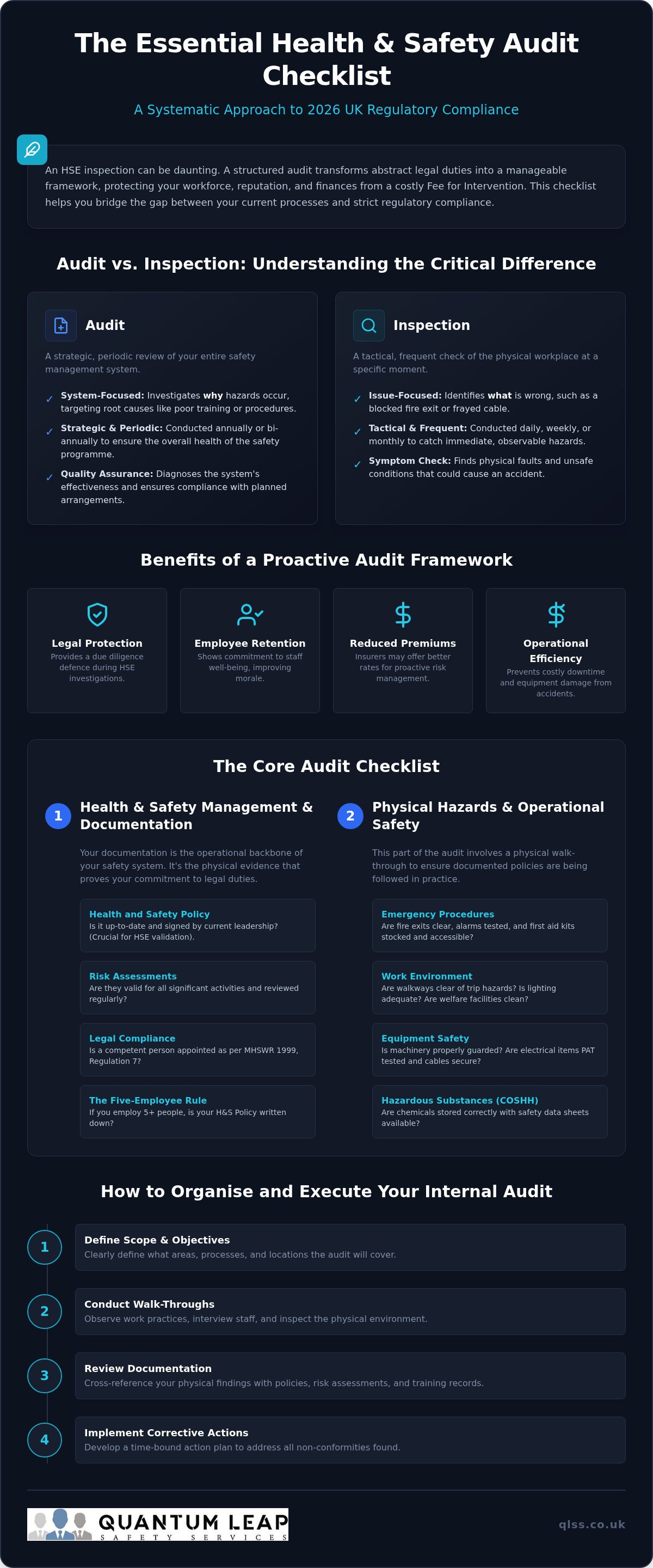
A health and safety audit is a systematic, independent examination of your entire safety management system. It's designed to determine whether your current safety activities and results comply with planned arrangements. In 2026, UK regulatory bodies expect businesses to move beyond a simple tick-box exercise. They look for evidence of a living safety culture where risks are actively managed rather than just documented on paper. By using a structured health and safety audit checklist, you ensure that no critical area is overlooked whilst maintaining a clear, professional record of your compliance efforts.
Understanding the Health and Safety Audit Framework is essential for any modern UK SME seeking operational resilience. A robust framework provides several tangible benefits for the organisation:
Reduced insurance premiums: Insurers often offer better rates to businesses that can demonstrate a proactive approach to risk management.
Legal protection: A documented audit trail provides a solid foundation for a due diligence defence during HSE investigations.
Employee retention: Staff feel valued and secure when they see a tangible commitment to their physical and mental well-being.
Operational efficiency: Identifying system failures before they cause accidents prevents costly downtime and equipment damage.
Audit vs Inspection: Why the Difference Matters
Many business owners confuse safety inspections with full audits. Inspections are tactical and frequent. They focus on the physical state of the workplace at a specific moment. An inspection might find a blocked fire exit or a frayed electrical cable. In contrast, an audit is strategic and periodic. It serves as the quality assurance of your entire safety programme. Whilst an inspection identifies that a fire exit is blocked, an audit investigates why the blockage occurred. It looks at the underlying system failure, such as a lack of staff training or inadequate storage space, to prevent the issue from recurring. One checks the symptoms; the other diagnoses the system.
Legal Requirements for UK Businesses in 2026
Compliance with safety law is a fundamental business obligation. The Management of Health and Safety at Work Regulations 1999 remains the cornerstone of UK safety legislation. Under Regulation 7, employers must appoint one or more competent persons to assist them in undertaking the measures needed to comply with the law. A comprehensive health and safety audit checklist helps you document this process effectively. It provides the evidence required to prove you've met your legal duties, ensuring you have a "safe pair of hands" guiding your corporate responsibility. This methodical approach transforms complex legislation into a clear, actionable framework that protects both the workforce and the leadership team.
Part 1: Health and Safety Management & Documentation
Documentation serves as the operational backbone of your safety system. It's the physical evidence that proves a safety culture exists within your organisation. Whilst a walk-through identifies immediate risks, your paperwork demonstrates a sustained commitment to legal duties. A robust health and safety audit checklist must begin with a rigorous review of these records to ensure they reflect the current state of your business in 2026. This process isn't merely administrative; it's about verifying that the "safe pair of hands" you've promised your employees is backed by a methodical framework.
Your Health and Safety Policy is the most critical document in this category. It must be updated and signed by current leadership to show top-down accountability. An outdated signature from a previous director can invalidate the policy's authority during an HSE inspection. Similarly, you must verify that risk assessments are valid for all significant workplace activities. These shouldn't be static files. They require regular review to account for new machinery, changed layouts, or updated working practices introduced over the last year.
Policy and Governance Documents
Effective governance ensures that every member of the team understands their role in maintaining a safe environment. When reviewing your governance, use these specific checklist items:
The Five-Employee Rule: If you employ five or more people, you must have a written Health and Safety Policy. For smaller teams, a written policy is still recommended as a best practice for clarity.
Defined Responsibilities: Ensure roles for safety management are clearly assigned. This includes identifying who is responsible for fire warden duties, first aid, and risk assessment reviews.
Statutory Displays: Confirm the "Health and Safety Law" poster is displayed in a prominent location, such as a staff canteen or reception area, or that equivalent leaflets have been distributed to all remote workers.
Training, Competence, and Consultation
Competence is a legal requirement under the Management of Health and Safety at Work Regulations. You must prove that your staff have the skills and knowledge to work safely. Start by verifying that your 2026 training matrix is up to date. This matrix should track mandatory certifications and identify upcoming expiration dates for first aid or fork-lift licenses. If you find that your records are fragmented, our QSHE Managed Services can help centralise and professionalise your safety documentation.
Evidence of employee consultation is equally vital. This might include safety committee minutes or records of toolbox talks. It proves that safety is a two-way conversation amongst your team. Finally, confirm that induction training records are kept for all new starters and contractors. These records are your first line of defence, proving that every person on your site was briefed on essential safety protocols before they commenced work. Reviewing your accident book and RIDDOR reporting procedures for the current year will then highlight if these training efforts are successfully reducing workplace incidents.
Part 2: Physical Workplace Hazards & Operational Safety
Once you've verified the integrity of your documentation, you must transition from the office to the shop floor or site. This is where theoretical safety culture meets practical reality. A professional health and safety audit checklist serves as a bridge, ensuring that the physical environment reflects the standards set out in your policy documents. This phase of the audit requires a methodical walk-through to observe actual working behaviours and the condition of physical assets. It's about seeing safety in action rather than just reading about it in a file.
Fire Safety and Emergency Procedures
Fire safety remains a top priority for HSE inspectors because of the potential for catastrophic loss. Your audit should verify that your Fire Risk Assessment is current and has been reviewed within the last 12 months. It's essential to check that fire alarm tests are recorded weekly and evacuation drills are documented at least every six months. For organisations looking to deepen their understanding of these requirements, we have developed detailed fire safety management plans that align with the latest 2026 regulations. Clear signage and unobstructed escape routes are the basic requirements that your audit must confirm through direct observation.
Equipment, COSHH, and the Physical Environment
Statutory inspections are non-negotiable for operational safety. You must confirm that PUWER (Provision and Use of Work Equipment Regulations) and LOLER (Lifting Operations and Lifting Equipment Regulations) inspections are current for all relevant machinery. A common failure in internal audits is overlooking the COSHH register. Ensure every hazardous substance has a corresponding, up-to-date Safety Data Sheet (SDS) and that control measures, such as local exhaust ventilation, are functioning correctly. This level of detail ensures that your health and safety audit checklist provides a truly comprehensive view of your risk profile.
The physical environment also demands constant attention. Walkways must be clear of obstructions; lighting should be adequate for the tasks performed; and temperature levels must be controlled to prevent staff fatigue. Beyond these immediate hazards, your audit should account for occupational health factors like noise levels and hand-arm vibration. Ergonomics also play a vital role in long-term staff well-being, particularly in repetitive manufacturing or office-based roles. By addressing these factors, you protect your team from chronic health issues whilst ensuring your business remains a productive, compliant environment.
How to Organise and Execute Your Internal Audit
Executing an audit requires a disciplined, methodical approach. It isn't enough to simply possess a health and safety audit checklist; you must apply it with a high degree of objectivity. This process demands a "fresh eyes" perspective to identify hazards that regular staff might overlook due to daily familiarity. If you lack the internal resources to maintain this level of detachment, our Audit & Inspection Services provide the independent technical authority required for complex or high-risk environments. A professional audit looks past the obvious to find the systemic reasons why safety protocols might be failing.
The Audit Cycle: Preparation to Reporting
Effective preparation ensures that your time on the shop floor is productive and focused. Follow these four structured steps to maintain a logical flow:
Step 1: Define the scope. Decide whether you are auditing the full site or focusing on a specific department, such as the warehouse or production line.
Step 2: Review existing documentation. Examine risk assessments, training records, and previous incident reports before you begin the physical inspection.
Step 3: Conduct the site tour and staff interviews. Observe work in progress and talk to the people doing the jobs to verify that practice matches policy.
Step 4: Draft the audit report. Document your findings and prioritise them based on the severity of the risk identified.
During the site tour, engage directly with employees. Ask them to describe their standard operating procedures for high-risk tasks. If their verbal description differs from the written risk assessment, you've identified a systemic training gap rather than just a physical hazard. This verification step is what separates a professional audit from a basic site inspection. It ensures that your safety system is functional and understood by everyone, from the managing director to the newest apprentice.
Remedial Actions: Closing the Compliance Loop
Closing the compliance loop is the final, most critical stage of the process. Every finding must be categorised by its risk level, such as Critical, Major, or Minor, to ensure that resources are directed where they are needed most. Assigning clear deadlines and specific responsibilities for every non-conformance ensures that the audit leads to tangible safety improvements. Without this follow-up, the audit remains a static document rather than a catalyst for change. For those requiring a structured framework for these tours, our guide on workplace safety inspection services offers professional templates to streamline the process and maintain clear records for future HSE reviews.
Moving Beyond the Checklist with Professional QSHE Support
Whilst a self-guided health and safety audit checklist is an excellent foundation for routine monitoring, it has limitations in complex or high-risk environments. Relying exclusively on internal personnel can lead to a phenomenon often described as "unconscious incompetence". This occurs when staff are so familiar with their daily surroundings that they no longer perceive established hazards or subtle system failures. Professional intervention ensures that your safety system remains dynamic, objective, and legally defensible. It transforms compliance from a static document into a proactive strategy for business continuity.
For many UK SMEs, the transition from internal checks to professional oversight is driven by the need for technical authority. Our outsourced QSHE managed services provide year-round peace of mind, ensuring that your business meets the "competent person" requirement under UK law. This level of support is particularly vital when aiming for industry accreditations such as CHAS or SafeContractor. These schemes require rigorous proof of safety management that often goes beyond the scope of a basic internal review.
The Value of Independent Auditing
Independent consultants identify the "blind spots" that internal staff often miss due to corporate habit or operational pressure. A professional audit report carries significantly more weight with insurance providers and regulatory bodies; it serves as a tangible record of your commitment to due diligence. This external validation can lead to more favourable insurance terms and a stronger reputation amongst clients and partners. We provide specialised support for high-stakes environments, such as health and safety for construction sites, where the complexity of multi-contractor sites demands a high level of technical expertise and constant vigilance.
Quantum Leap Safety: Your Partner in Compliance
Quantum Leap Safety Services (QLSS) prides itself on a pragmatic, common-sense approach to safety management. We understand that business owners need solutions that are legally robust without being operationally restrictive. By choosing our retainer-based services, you ensure that your health and safety audit checklist is always "green" and that your documentation reflects the latest 2026 regulatory updates. We act as a steady, methodical guide through the intricacies of corporate responsibility, allowing you to focus on your core business objectives with confidence.
Safety is not a one-time event; it is a continuous process of improvement and verification. If you are ready to move beyond basic compliance and build a resilient safety culture, we are here to help. Contact us for a professional health and safety audit to ensure your workplace remains safe, compliant, and protected against the risks of tomorrow.
Securing Your Business Future Through Proactive Compliance
Mastering your legal obligations requires a balance between rigorous documentation and practical, on-site vigilance. A well-executed health and safety audit checklist ensures that your management systems are not just theoretical but are actively protecting your workforce and your reputation. By identifying systemic failures before they lead to incidents, you create a more resilient and efficient operation that stands up to regulatory scrutiny. This methodical approach transforms safety from a daunting requirement into a pillar of business stability.
Since 2012, Quantum Leap Safety Services has acted as a steady partner for UK SMEs. We specialise in pragmatic compliance and ISO standards, providing non-alarmist advice that respects your operational constraints. Our team understands the specific challenges faced by modern enterprises and offers the technical authority needed to navigate intricate safety protocols. Whether you are aiming for CHAS accreditation or simply want the peace of mind that your legal duties are met, we are here to act as your safe pair of hands.
Download our 2026 Compliance Audit Framework or book a professional consultation with Quantum Leap Safety Services to verify your standing today. Taking these methodical steps now builds a safer, more stable workplace for everyone.
Frequently Asked Questions
How often should a health and safety audit be conducted?
Most UK businesses should conduct a full audit annually to ensure their management systems remain effective and up to date. High-risk sectors, such as construction or renewable energy, may require more frequent reviews to account for rapidly changing site conditions. Periodic auditing provides a clear paper trail for insurers and the HSE, demonstrating that you are actively monitoring your safety arrangements rather than treating compliance as a one-time event.
Is a health and safety audit a legal requirement for UK SMEs?
While the word "audit" isn't explicitly used in every piece of legislation, the Management of Health and Safety at Work Regulations 1999 requires employers to monitor and review their safety arrangements. Using a health and safety audit checklist is the most effective way to fulfil this legal duty. It provides the evidence needed to prove you are proactive in identifying system failures and meeting your obligations under Regulation 5.
Who is qualified to perform a health and safety audit?
An audit must be carried out by a "competent person" who possesses the necessary skills, knowledge, and experience to assess your specific risks. This can be an internal staff member with appropriate training or an external consultant. For complex environments, using an independent professional is often preferred. This ensures an objective perspective and provides the technical authority required to satisfy insurers and regulatory bodies that your systems are robust.
What happens if a business fails its health and safety audit?
Failing an audit is an opportunity to rectify weaknesses before they lead to accidents or HSE intervention. You should immediately categorise the findings into critical, major, and minor non-conformances. Assigning clear deadlines and specific responsibilities for remedial actions is essential to close the compliance loop. Ignoring identified failures can be seen as a serious breach of duty if an incident occurs later, potentially leading to higher fines.
How much does a professional health and safety audit cost in 2026?
The cost of a professional audit depends on the size of your organisation, the complexity of your operations, and the number of sites involved. Fees are typically structured as a fixed project price or included within a managed service retainer. Rather than looking for a generic industry average, businesses should request a tailored quote. This ensures the price reflects your specific risk profile and the depth of technical expertise required for your sector.
What is the difference between a safety audit and a risk assessment?
A risk assessment focuses on identifying specific hazards and implementing controls for a particular task or environment. In contrast, an audit is a strategic review of the entire safety management system. Whilst the risk assessment deals with the "what" and "how" of a hazard, the audit verifies that the system for managing those assessments is actually working as intended across the whole business to ensure long-term stability.
Can I use a digital health and safety audit checklist?
Yes, digital tools are highly effective for maintaining clear, time-stamped records and improving data accuracy. They allow for easier tracking of remedial actions and provide instant access to documentation during inspections. However, a digital health and safety audit checklist doesn't replace the need for competent advice. The real value lies in the quality of the information gathered and the professional analysis of the results to drive safety improvements.
How long should we keep our health and safety audit records?
You should retain audit records for at least three years to align with the standard limitation period for personal injury claims in the UK. Many organisations choose to keep these records for longer to demonstrate a sustained safety culture over time. For specific documents, such as those related to asbestos or health surveillance, statutory retention periods can extend to 40 years. Maintaining a methodical archive protects the business against future legal challenges.


Comments