
What is ISO 9001? A Complete Guide to Quality Management Systems
Most business owners treat international standards as a mountain of bureaucratic paperwork, but for the UK's most successful SMEs, it's the engine that powers scalable growth. You may feel your internal processes are becoming increasingly disorganised as you expand, or perhaps you've already lost out on lucrative tenders because you lacked the necessary credentials. It's a common frustration to see your hard work undermined by a lack of formal structure or the fear that certification involves endless "box-ticking" exercises. This guide explains exactly what is iso 9001 and why it remains the most effective framework for professionalising your operations.
We'll show you how this globally recognised standard can help you secure more contracts and drive consistent revenue growth. You'll gain a clear understanding of the core principles, a practical roadmap to certification, and essential insights into the upcoming ISO 9001:2026 updates. This is about more than just compliance; it's about building a stable, efficient business that's ready for the future. We'll break down the complexities into manageable steps, ensuring you have the confidence to move forward without the administrative headache.
Table of Contents
What is ISO 9001? Defining the International Quality Standard
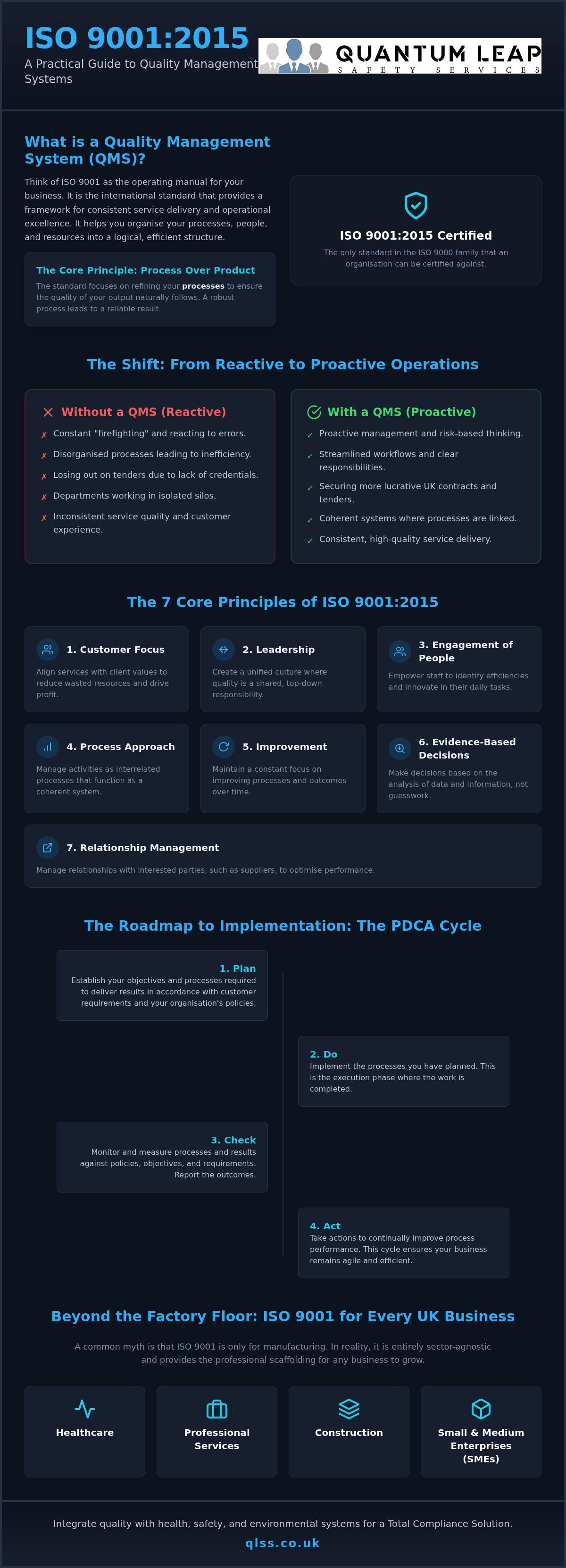
At its core, what is iso 9001? It's the international standard that defines the requirements for a Quality Management System (QMS). Whilst the name might sound technical, it's essentially a framework that helps businesses ensure they meet the needs of customers and other stakeholders consistently. It belongs to the broader ISO 9000 family of quality management standards, which provides the fundamentals and vocabulary for quality assurance. However, ISO 9001 is unique because it's the only standard in the series that an organisation can actually be certified against.
A common misconception is that this standard dictates the quality of your end product. In reality, it focuses on the processes used to create that product or deliver that service. If you have a robust process, the quality of the output should naturally follow. The current version, ISO 9001:2015, remains the benchmark for excellence. It places a heavy emphasis on risk-based thinking and leadership, ensuring that quality isn't just a tick-box exercise for the shop floor but a core business strategy. For many UK directors, understanding what is iso 9001 is the first step toward moving from a reactive business model to a proactive one.
The Meaning of a Quality Management System (QMS)
Think of a QMS as the operating manual for your entire business. It organises your processes, people, and resources into a logical structure where everyone knows their responsibilities. Without a formal system, many SMEs find themselves in a constant state of firefighting or reacting to errors after they've happened. A QMS shifts the focus toward proactive management. It creates a clear centre for your operations, allowing you to identify potential issues before they impact the client, which ultimately saves time and protects your reputation.
Who is ISO 9001 for? (Hint: It is not just for factories)
There is a persistent myth that ISO 9001 is only for manufacturing plants or engineering firms. This couldn't be further from the truth. The standard is entirely sector-agnostic. We see it implemented successfully in healthcare settings, professional service firms, and throughout the UK construction industry. In fact, small businesses often gain the most from implementation. Whilst a large corporation might have layers of management to absorb inefficiency, an SME needs a lean, structured approach to remain competitive. For smaller teams, the standard provides the professional scaffolding needed to grow without losing control of service standards.
The 7 Principles of ISO 9001:2015
To truly grasp what is iso 9001, one must look at the seven management principles that form its foundation. These aren't just abstract concepts; they are practical pillars designed to place quality at the centre of your business operations. To implement these effectively, most organisations follow the Plan-Do-Check-Act (PDCA) cycle. This is a simple, four-step management method: you plan your objectives, execute the work, check the results against your goals, and then act to improve the process. It's a continuous loop that ensures your business remains agile and efficient.
Customer Focus and Leadership
Profit is the lifeblood of any UK SME, and customer focus is the primary driver of that profit. By aligning your services with what your clients actually value, you reduce the risk of wasted resources and lost contracts. However, this focus must be driven by strong leadership. Management's role is to create a unified culture where quality is a shared responsibility. This involves moving away from restrictive, top-down commands toward an inclusive environment where every team member understands how their specific role contributes to the company's success.
Engagement of People and Process Approach
For a management system to be effective, you need genuine buy-in from your staff. Engaging your people means empowering them to identify efficiencies in their own daily tasks, which often leads to the best innovations. This works most effectively when you adopt a "Process Approach" to your work. The Process Approach is the method of managing activities as interrelated processes that function as a coherent system. Instead of departments working in isolated silos, you view the business as a series of linked actions that lead toward a high-quality outcome. If you are finding it difficult to map these connections, our managed QSHE services can provide the external expertise needed to streamline your workflows.
Improvement, Evidence-Based Decisions, and Relationship Management
Stagnation is a significant risk for growing businesses, which is why "Continual Improvement" is a core objective within the requirements for a quality management system (QMS). To improve effectively, you must rely on evidence-based decision-making. This involves using hard data and performance metrics to steer the company, rather than relying on a gut feeling which can be unreliable during periods of rapid change. Finally, the standard recognises that no business operates in a vacuum. Effective relationship management with suppliers and partners ensures that your entire supply chain is working toward the same high standards, protecting your reputation from external failures and ensuring a clear understanding of what is iso 9001 across your network.
Why ISO 9001 Matters: Benefits for UK Businesses
Understanding what is iso 9001 is often the catalyst for a business to move from local success to national prominence. It serves as the international standard for Quality Management Systems (QMS), offering a dual advantage of external marketability and internal efficiency. Beyond the prestige, certification is a practical tool for risk management. It forces a business to identify potential failure points and build resilience into its core structure; this ensures that operations remain stable even during market volatility. For many directors, the standard is the foundation of a total compliance strategy that protects the company's long-term interests.
Winning Tenders and New Business
For many UK SMEs, the decision to seek certification is driven by commercial necessity. Public sector bodies and Tier 1 contractors in industries like construction and renewables frequently list ISO 9001 as a mandatory requirement in their procurement processes. It acts as a universal shorthand for trust and reliability. When you present your certificate, you're telling a potential client that your processes have been independently verified to meet high standards. This provides a significant competitive advantage over uncertified rivals who must spend more time and effort proving their reliability during the bidding stage. It simplifies the pre-qualification questionnaire (PQQ) process and opens doors to contracts that would otherwise be out of reach.
Operational Efficiency and Cost Savings
Internal benefits are often where the real return on investment lies. By mapping out your workflows to meet the standard, you can identify and remove "bottlenecks" that have been slowing down production or service delivery. This systematic approach reduces costly errors, reworks, and customer complaints. When your team follows consistent, documented processes, financial outcomes become far more predictable. This consistency reduces waste and saves money in the long term by ensuring resources are used efficiently. You'll find that staff spend less time "firefighting" and more time on activities that add value to the business.
Implementing these changes requires a methodical approach to ensure the system fits your specific needs. For a deeper look at the financial and logistical considerations of this process, see our ISO 9001 Implementation Services UK: The 2026 SME Buying Guide. This resource provides the specific context needed for UK businesses planning their certification journey in 2026, ensuring you avoid common pitfalls and maximise your investment. Ultimately, the goal is to create a business that is not just certified, but genuinely better at what it does every day.
The Roadmap to Certification: How ISO 9001 is Implemented
Implementing the standard is a methodical journey that transforms your understanding of what is iso 9001 from a theoretical concept into a daily operational reality. This process isn't about creating a library of unused manuals; it's about refining what you already do to ensure consistency. By following a structured roadmap, you can transition from your current state to full certification without disrupting your core business activities. Most UK SMEs can achieve this by focusing on lean, functional processes that prioritise common-sense solutions over unnecessary ornamentation.
Gap Analysis and Documentation
The first stage of the journey is a gap analysis. This involves comparing your existing workflows against the standard’s requirements to identify exactly where your current systems fall short. Once these gaps are identified, you begin creating a "Quality Manual" that reflects your actual business behaviour. It's essential to keep this documentation lean. Many businesses fail by over-complicating their manuals; instead, you should focus on documenting only the processes that add value or mitigate risk. This pragmatic approach ensures your team isn't drowning in paperwork but is supported by clear, functional instructions.
The Internal Audit and Management Review
Before an external auditor arrives, you must test the system yourself to ensure it's fit for purpose. An Internal Audit is a first-party check to ensure the QMS meets the organisation’s own requirements and the standard. This is followed by a Management Review meeting, which is a critical component of 2026 compliance. During this meeting, leadership reviews performance data, customer feedback, and audit results to make strategic adjustments. This ensures the system remains effective and that the business is continually improving, rather than just standing still.
The external certification process is then split into two distinct parts. Stage 1 is a "readiness review" where the auditor checks your documentation to ensure the required framework is in place. Stage 2 is the main audit, where they look for evidence that you are actually following those processes in your day-to-day work. If you find this prospect daunting, our team can act as a "safe pair of hands" to guide you through ISO management systems implementation and ensure you are fully prepared for every stage.
The Role of UKAS Accreditation
Choosing the right certification body is perhaps the most important decision in the roadmap. In the UK, you should only work with bodies accredited by the United Kingdom Accreditation Service (UKAS). UKAS is the sole national body recognised by the government to assess the competence of organisations that provide certification. Non-accredited "cowboy" certificates are often cheaper and easier to obtain, but they are frequently rejected by major contractors and public sector procurement teams. You can verify a body’s credentials directly on the UKAS website to ensure your investment is protected and your certificate is globally recognised. Understanding what is iso 9001 includes knowing that the value of the certificate is only as high as the reputation of the body that issued it.
Beyond Quality: Integrating ISO 9001 with QSHE
Once you have established a firm grasp of what is iso 9001, you quickly realise it does not exist in a vacuum. It serves as the logical backbone for a wider range of international standards, including ISO 14001 for environmental management and ISO 45001 for occupational health and safety. This compatibility is made possible by Annex SL, a high-level structure that provides identical core text and common terms across different management systems. By using the quality standard as your foundation, you create a scalable framework where adding environmental or safety protocols becomes a matter of integration rather than starting from scratch.
Combining Quality, Health, Safety, and Environment (QSHE)
Combining these standards into a single, unified system offers significant advantages for UK SMEs. Instead of managing separate sets of manuals and procedures, you operate a Total Compliance Solution that addresses quality, safety, and environmental impact simultaneously. This streamlined approach drastically reduces audit fatigue, where staff feel overwhelmed by constant internal and external checks. By aligning your objectives, you ensure that a change in a quality process does not accidentally compromise a safety protocol. Managing multiple standards can be resource-intensive, which is why many businesses opt for managed QSHE services. This allows you to maintain high compliance levels without the overhead of a full-time hire, ensuring your system remains effective as you take on complex work like a 2026 Health and Safety Audit for Renewable Projects.
How Quantum Leap Safety Services Supports Your Journey
At Quantum Leap Safety Services, we act as a safe pair of hands for businesses navigating the complexities of certification. We understand that every SME has unique constraints, so our approach is always pragmatic and focused on common-sense solutions. We don't believe in creating paperwork for the sake of it; we believe in building systems that actually help you run a better business. Our national expertise allows us to provide high-level consultancy that is accessible and grounded in the practical realities of the UK market.
We transition with you from the initial project-based setup to ongoing managed service support. This ensures that the hard work you put into understanding what is iso 9001 and achieving certification continues to pay dividends year after year. Whether you are looking to secure your first major public sector contract or you want to professionalise a rapidly growing team, we provide the steady, methodical guidance needed to achieve long-term stability and operational excellence.
Securing Your Business Future with Quality Management
Moving from a reactive operation to a structured, certified business is a significant milestone for any UK SME. By understanding what is iso 9001 and implementing its core principles, you build a foundation for consistent growth and improved marketability. This standard isn't just about satisfying an auditor; it's about refining your internal processes to reduce waste and secure high-value contracts. Whether you are aiming for public sector tenders or integrating your quality systems with health and safety protocols, the right approach makes all the difference.
We provide UKAS-aligned implementation strategies and specialised QSHE managed services for SMEs that value a pragmatic, common-sense approach to compliance. Our team acts as a steady partner to ensure your certification journey is efficient and adds genuine value to your daily operations. Don't let complex paperwork hold your business back from its next stage of expansion. Professionalising your systems today ensures you are ready for the opportunities of tomorrow.
Ready to professionalise your operations? Book a pragmatic ISO 9001 consultation with our experts today and take the first step toward a more resilient business.
Frequently Asked Questions
Is ISO 9001 mandatory for UK businesses?
No, ISO 9001 is not a legal requirement for UK businesses under current 2026 regulations. However, it is often a commercial necessity. Many public sector bodies and Tier 1 contractors in construction and renewables mandate certification as a prerequisite for bidding. Whilst you won't face legal penalties for not having it, you may find your growth limited if you cannot demonstrate this level of quality management to potential high-value clients.
How much does ISO 9001 certification cost for an SME?
The total cost varies based on your organisation's headcount, complexity, and the number of sites involved. Typically, expenses are split between implementation consultancy and the fees charged by a UKAS-accredited certification body. For a small UK business, the investment covers the initial gap analysis, system development, and the two-stage audit process. It is important to view this as a long-term investment in operational efficiency rather than a one-off administrative expense.
How long does it take to get ISO 9001 certified?
Most SMEs can achieve certification within three to six months. This timeline depends on the maturity of your existing processes and the resources you can dedicate to the project. The process involves conducting a gap analysis, documenting your procedures, and allowing the system to run for a period to generate evidence for the auditor. Rushing the implementation can lead to a "hollow" system that fails to deliver genuine internal improvements or cost savings.
Can a small business with only one employee get ISO 9001?
Yes, the standard is designed to be scalable for organisations of any size, including sole traders and micro-businesses. For a single-person operation, the focus is on ensuring that your core processes are documented and repeatable. This demonstrates to larger clients that you have the professional structure required to handle their contracts reliably. It provides a level playing field, allowing smaller entities to compete with much larger rivals by proving their commitment to quality.
What is the difference between ISO 9000 and ISO 9001?
ISO 9000 refers to a family of standards that cover the fundamentals and vocabulary of quality management. In contrast, what is iso 9001 specifically relates to the requirements for a Quality Management System (QMS) that an organisation must meet to become certified. Essentially, ISO 9000 provides the definitions and principles, whilst ISO 9001 provides the actionable framework that auditors use to assess your business's ability to meet customer and regulatory needs consistently.
Do I need a consultant to implement ISO 9001?
Whilst you can implement the standard yourself, many UK businesses prefer to use a consultant to ensure the process is efficient and correct from the start. An expert acts as a "safe pair of hands," helping you avoid over-complicating your documentation and ensuring you are ready for the UKAS audit. This often saves money in the long run by preventing failed audits and ensuring the system is tailored to your specific operational needs.
How often do we need to be re-certified?
ISO 9001 certification operates on a three-year cycle. After your initial certification, a UKAS-accredited body will perform annual surveillance audits to ensure your system is still being maintained and improved. At the end of the third year, a more comprehensive re-certification audit takes place to renew the certificate for another three-year term. This ongoing process ensures that your quality management remains a living part of the business rather than a forgotten document.
Will ISO 9001 help my business win more tenders?
Certification significantly improves your chances of winning tenders by providing immediate proof of your operational standards. For many procurement managers, seeing that you understand what is iso 9001 and hold a valid certificate allows them to bypass lengthy sections of the pre-qualification questionnaire. It removes the need for them to conduct their own deep-dive audit into your quality processes, making you a much lower-risk option compared to uncertified competitors.


Comments