
Workplace Health Surveillance Programs: The 2026 UK SME Guide
Only 28% of UK SMEs currently provide occupational health services, even though the Health and Safety Executive (HSE) now charges a £188-per-hour Fee for Intervention for material breaches of safety law. It's understandable if you're confused by the fine line between general employee wellness and mandatory workplace health surveillance programs. You want to protect your staff's long-term health, but the fear of regulatory fines or the perceived cost of occupational health services can feel like a heavy burden for a growing business.
This guide provides a clear roadmap to help you navigate your legal duties for 2026, ensuring you meet statutory requirements while maintaining operational efficiency. We'll examine exactly when health checks become a legal necessity, how to handle sensitive health records for the required 40-year period, and how to implement a tiered screening system that respects your budget. By the end, you'll have the confidence to manage your health obligations as a reliable, hands-on partner to your workforce.
Table of Contents
What are Workplace Health Surveillance Programs?
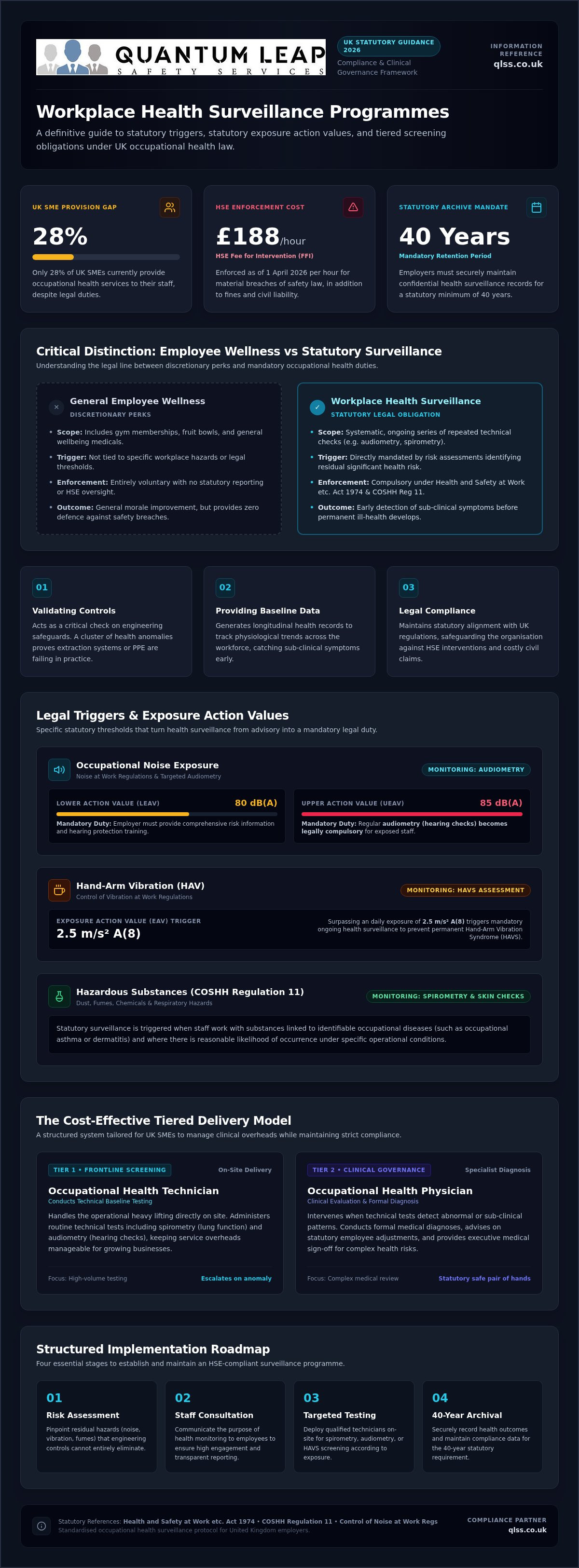
A workplace health surveillance program is a systematic, ongoing series of health checks for employees who are exposed to specific risks in their daily roles. Unlike a one-off medical examination, workplace health surveillance systems are designed to be repeated at regular intervals. This allows you to monitor the health of your workforce over time and identify any patterns of ill-health before they become permanent. It's a proactive safety net, not a reactive response to an injury.
Many business owners mistake these statutory requirements for general "perk" medicals or wellness schemes. Whilst gym memberships and fruit bowls support general wellbeing, workplace health surveillance programs are a legal obligation triggered directly by your risk assessment. If your assessment identifies a residual risk to health from hazards like noise, vibration, or hazardous substances that cannot be entirely eliminated through engineering controls, you have a duty to monitor the health of those affected.
The Core Objectives of Health Monitoring
The primary aim is the early detection of sub-clinical symptoms. These are physiological changes that occur before an employee even recognises they have a problem. By catching these signs early, you can adjust working practices to prevent debilitating conditions. Beyond individual health, these programs serve three critical functions:
Validating Controls: If surveillance reveals a cluster of health issues, it proves your current safety measures, such as extraction systems or PPE, are failing.
Providing Data: Regular monitoring creates a clear health record that helps you track long-term trends across your organisation.
Legal Compliance: It ensures your business remains on the right side of UK health and safety legislation, protecting you from potential HSE interventions.
Surveillance vs. Occupational Health
It's helpful to clarify the terminology, as surveillance is actually a specific subset of occupational health services for SMEs. Whilst general occupational health might involve a one-off referral for a staff member returning from long-term sickness, health surveillance is a planned, recurring requirement for those in high-risk roles.
In practice, much of the heavy lifting is done by an Occupational Health Technician. These professionals visit your site to conduct technical tests, such as lung function or hearing assessments. If a technician identifies a potential issue, the case is escalated to an Occupational Health Physician for a clinical diagnosis. This tiered approach keeps the process efficient and cost-effective for smaller enterprises, providing a "safe pair of hands" for managing complex health data without unnecessary overheads.
The Legal Framework: When is Health Surveillance Mandatory?
The Health and Safety at Work etc. Act 1974 establishes your general duty of care, but specific secondary regulations dictate when workplace health surveillance programs become a statutory requirement. You're legally required to implement these programs when your risk assessment identifies a "significant risk" to employee health that cannot be fully eliminated. This isn't a discretionary choice; it's a mandatory safeguard triggered by specific exposure thresholds across various industries.
Regulation 11 of the Control of Substances Hazardous to Health (COSHH) is a primary driver for many UK businesses. Under COSHH Regulation 11 health surveillance duties, you must provide monitoring if your staff work with substances linked to particular diseases or if there's a reasonable likelihood that an identifiable disease may occur under their specific working conditions. Failing to meet these duties can lead to an HSE Fee for Intervention, which as of 1 April 2026, is charged at £188 per hour for material breaches. Beyond fines, the absence of a compliant programme leaves your business vulnerable to costly civil claims and long-term reputational damage.
Identifying the Legal Triggers
Determining your legal obligations depends on the specific hazards present in your workplace. For noise, the Lower Exposure Action Value (LEAV) is 80 dB(A); if noise reaches this level, you must provide information and training. However, once exposure hits the Upper Exposure Action Value (UEAV) of 85 dB(A), regular audiometry becomes compulsory. Similarly, for hand-arm vibration (HAV), an Exposure Action Value of 2.5 m/s² A(8) triggers mandatory health surveillance to prevent Hand-Arm Vibration Syndrome.
Exposure to respiratory sensitisers or skin irritants also acts as a trigger. For example, updated guidance from May 2026 requires mandatory respiratory surveillance for workers regularly exposed to respirable crystalline silica (RCS). If you're unsure whether your current hazards meet these thresholds, a professional audit of your safety management system can provide the necessary clarity.
Record Keeping and Data Protection
Maintaining accurate records is a vital part of compliance. Under COSHH, asbestos, and lead regulations, you must retain health surveillance records for at least 40 years from the date of the last entry. This long-term requirement ensures that if an employee develops a condition decades later, the historical exposure data is available. Because these records contain Special Category Data under UK GDPR, they must be stored securely and handled with strict confidentiality.
A health record contains an individual's fitness-for-work status and any required workplace adjustments, whereas a medical record contains confidential clinical findings and diagnostic data accessible only to occupational health professionals. You only need to store the health record. By keeping these two types of data separate, you protect employee privacy whilst fulfilling your legal duty to manage workplace risks effectively.
Common Types of Health Surveillance for UK Industries
Effective workplace health surveillance programs are built around specific tests designed to detect the earliest signs of occupational disease. Rather than a generic "one size fits all" checkup, these programs focus on the unique physiological impacts of the hazards identified in your risk assessment. By using targeted screening, you ensure your resources are directed where they provide the most protection for your staff and the most robust evidence of compliance for your business.
Audiometry is a core component for many industrial SMEs. It involves regular hearing tests to monitor for noise-induced hearing loss. Following HSE hearing health surveillance guidance, you should establish a baseline for new starters and conduct annual follow-ups for the first two years to identify any rapid changes. If the results remain stable, the frequency can often be reduced to every three years. Similarly, spirometry measures lung function for those exposed to respiratory sensitisers like wood dust or vapours. It's a vital tool for detecting reduced lung capacity before a worker develops chronic respiratory conditions.
For businesses where staff handle chemicals or engage in "wet work", skin surveillance is essential. Regular inspections by a "responsible person" can identify early-stage dermatitis, allowing for immediate intervention. Hand-Arm Vibration Syndrome (HAVS) monitoring is typically managed through a tiered system. Tiers 1 and 2 involve simple annual questionnaires to screen for symptoms like tingling or numbness in the fingers. If an employee reports issues, they escalate to Tier 3 for a clinical assessment by an occupational health nurse, and potentially Tier 4 for a formal diagnosis by an occupational physician.
Specialist Medicals and Screenings
Some roles require specialist checks that go beyond standard hazard monitoring. Vision screening is a pragmatic requirement for forklift drivers and those in safety-critical roles where depth perception and peripheral vision are vital. Night worker health assessments are another specific requirement under the Working Time Regulations; you must offer these to any staff member who regularly works at least three hours of their shift during "night time" hours. In cases of high-toxicity exposure, such as work with lead or isocyanates, biological monitoring via blood or urine samples may be necessary to measure the actual absorption of chemicals into the body.
Industry-Specific Requirements
Hazards often cluster by sector, dictating the focus of workplace health surveillance programs. In construction, the emphasis is heavily on dust (RCS), noise, and vibration. Manufacturing environments frequently require a broader mix of respiratory and skin monitoring due to chemical handling and metalworking fluids. For the renewables sector, particularly offshore or height-based work, medicals must ensure staff are physically capable of performing rescues or working in confined spaces. This sector-specific approach ensures that your surveillance programme is both proportionate to the risk and efficient to manage.
How to Organise an Effective Surveillance Programme
Establishing workplace health surveillance programs requires a methodical approach to ensure both legal compliance and genuine worker protection. The process isn't merely about booking medical appointments; it's a structured cycle that begins with your risk assessment. You must identify specific hazards, such as noise, vibration, or hazardous substances, and determine if your current engineering controls are sufficient. If a residual risk to health remains, implementing a surveillance programme becomes a mandatory next step.
Once you've identified the need, the following steps provide a clear roadmap for implementation:
Consult with employees: Explain the purpose of the programme to reduce anxiety and encourage honest reporting of symptoms.
Select a competent partner: Choose an occupational health provider with experience in your specific industry to deliver the medicals.
Act on the results: If health issues are detected, you must immediately review and refine your control measures to prevent further harm.
Maintain and review records: Ensure health records are stored securely and review the entire programme annually to maintain compliance.
Compliance is a continuous commitment rather than a one-time event. By following this logical flow, you protect your staff whilst building a robust defence against potential regulatory intervention.
Integrating Surveillance into Your Safety Culture
Moving from a "box-ticking" exercise to a safety-first mindset is essential for long-term success. This involves training your managers to recognise early warning signs of occupational ill-health, such as a worker frequently complaining of tingling fingers or struggling to hear instructions. When employees feel comfortable reporting these symptoms without fear of reprisal, your workplace health surveillance programs become far more effective. A transparent culture ensures that health issues are caught at the sub-clinical stage, long before they become debilitating conditions.
The Role of Managed Services
The administrative burden of scheduling medicals and maintaining records for the statutory 40-year period can be significant for smaller enterprises. This is why many SMEs benefit from outsourced QSHE managed services. A dedicated consultant can manage the entire scheduling process, ensuring no one misses their baseline or follow-up checks. This structured approach also ensures your programme aligns with ISO 45001 standards, demonstrating a disciplined approach to corporate responsibility. If you require expert support to manage your compliance, our occupational health services provide a pragmatic and reliable solution.
Quantum Leap: Your Partner in Occupational Health Compliance
Quantum Leap Safety Services (QLSS) understands that for an SME, safety management is about more than just avoiding a fine. It's about operational efficiency and the stability of your workforce. We provide pragmatic, professional support that avoids the unnecessary complexity often associated with corporate compliance. By acting as a "safe pair of hands", we navigate the intricate UK regulatory requirements on your behalf, ensuring your workplace health surveillance programs are both legally robust and resource-efficient.
Our approach moves beyond isolated medical checks. We integrate health monitoring into our broader Audit & Inspection Services and QSHE Managed Services. This holistic view allows us to spot trends across your business. For instance, if audiometry results suggest a pattern of hearing loss in a specific workshop, we don't just report the finding; we help you investigate the engineering controls or PPE protocols that may be failing. This national support ensures that whether you are in construction or renewables, your health data serves as a tool for continuous improvement.
Beyond the Medical Check
Interpreting the results of health surveillance is where many businesses struggle. QLSS provides the technical authority needed to translate clinical data into actionable safety improvements. We support your business in achieving and maintaining vital industry accreditations, such as CHAS or SafeContractor, by providing the documented evidence of health monitoring that these bodies require. Through our managed service retainer options, you gain continuous access to expert advice, ensuring your 40-year record-keeping obligations under COSHH are met without administrative stress.
Next Steps for Your Business
The first step toward total compliance is a clear-eyed look at your current risks. We recommend reviewing your existing risk assessments to identify any gaps where mandatory health monitoring might have been overlooked. If you're operating in high-risk sectors, you can download our specific guide to health and safety for construction sites to see how surveillance fits into a wider safety management system.
Once you've identified a potential need, contact our team for a no-obligation discussion. We'll help you determine the appropriate level of monitoring for your staff, ensuring you aren't over-spending on unnecessary tests whilst remaining fully protected against the HSE's £188-per-hour Fee for Intervention. Let us handle the complexities of occupational health compliance so you can focus on growing your business with confidence.
Securing Long-Term Compliance for Your Business
Implementing effective workplace health surveillance programs represents a vital shift from reactive safety to proactive health management. By identifying "significant risk" triggers early and establishing baseline medicals, you protect your employees from permanent harm whilst shielding your business from the HSE's £188-per-hour Fee for Intervention. Statutory record keeping requires a 40-year commitment; this makes a structured, managed approach the most reliable way to maintain compliance as your company evolves.
Quantum Leap Safety Services has provided pragmatic SME support since 2012, offering comprehensive QSHE managed services with national UK coverage. We act as a steady, knowledgeable partner, ensuring your safety systems are both practical and legally robust without the burden of unnecessary bureaucracy. You don't have to navigate these technical requirements alone; we're here to provide the "safe pair of hands" your business needs.
Ensure your business is fully compliant; speak to our QSHE experts today and take the first step towards a safer, more resilient workplace. We look forward to helping you protect your most valuable assets.
Frequently Asked Questions
Is health surveillance a legal requirement for all UK businesses?
Health surveillance isn't a universal requirement for every business; it's a statutory duty triggered only when a risk assessment identifies specific hazards. If your employees are exposed to noise above 85 dB(A), hand-arm vibration, or hazardous substances like silica dust, workplace health surveillance programs become mandatory. These programs ensure that control measures are actually working and protect your workforce from developing chronic, life-altering conditions.
How often should employees undergo health surveillance checks?
The frequency of checks varies based on the specific hazard and the individual's exposure levels. Usually, a baseline assessment is conducted when a new employee starts. For hazards like noise, you'll typically conduct annual audiometry for the first two years. If the results remain stable, the interval can often be extended to every three years. Your occupational health provider will help you determine the appropriate schedule based on current HSE guidance.
Can an employee refuse to participate in a health surveillance program?
Whilst employees have a right to refuse medical intervention, participation in health surveillance is usually a contractual requirement for those in high-risk roles. You should explain that the checks are designed to protect their long-term health rather than catch them out. If an employee continues to refuse, they may be unable to continue in a role where monitoring is a legal necessity for their safety.
What happens if an employee shows signs of ill-health during a check?
If a check identifies potential ill-health, you must act immediately to prevent further deterioration. This involves referring the individual to an occupational health physician for a formal clinical diagnosis. Simultaneously, you must review your current risk assessment and control measures to identify why the exposure occurred. You may need to provide alternative duties or implement more robust engineering controls to protect the affected staff member and their colleagues.
Who is responsible for paying for workplace health surveillance?
The employer is legally responsible for all costs associated with health surveillance. Under the Health and Safety at Work etc. Act 1974, you cannot pass these costs on to your employees or deduct them from their wages. This includes the cost of the medical tests, the time taken for staff to attend appointments during working hours, and any necessary travel expenses incurred by the workforce.
Do I need to report health surveillance results to the HSE?
You don't need to report the raw results of surveillance to the HSE. However, if a doctor formally diagnoses an employee with a specific occupational disease that's linked to their work, you must report it under RIDDOR (Reporting of Injuries, Diseases and Dangerous Occurrences Regulations). Your workplace health surveillance programs provide the evidence needed to identify these cases early, ensuring you meet your reporting obligations whilst protecting your business.
What is the difference between a health record and a medical record?
A health record is a document the employer keeps, detailing an individual's fitness for work and any necessary workplace adjustments. It doesn't contain confidential clinical data. Conversely, a medical record contains the detailed clinical findings, such as audiograms or lung function charts. These are strictly confidential and must be held by the occupational health professional. Employers only have a right to see the outcome and recommendations, not the private medical data.
How long must I keep health surveillance records for my staff?
Retention periods for health records are strictly defined by UK law. For employees exposed to hazardous substances under COSHH, asbestos, or lead, you must keep their health records for at least 40 years from the date of the last entry. For ionising radiation, this period extends to 50 years. Given these long durations, many SMEs choose to digitise these records and manage them through a professional safety consultancy to ensure ongoing compliance.


Comments